



Cartier is quietly overtaking Rolex among younger luxury buyers, as Gen Z and millennials shift from status-driven sports watches toward elegant, jewellery-inspired timepieces rooted in design and heritage.
Cartier is winning Gen Z, Rolex isn't

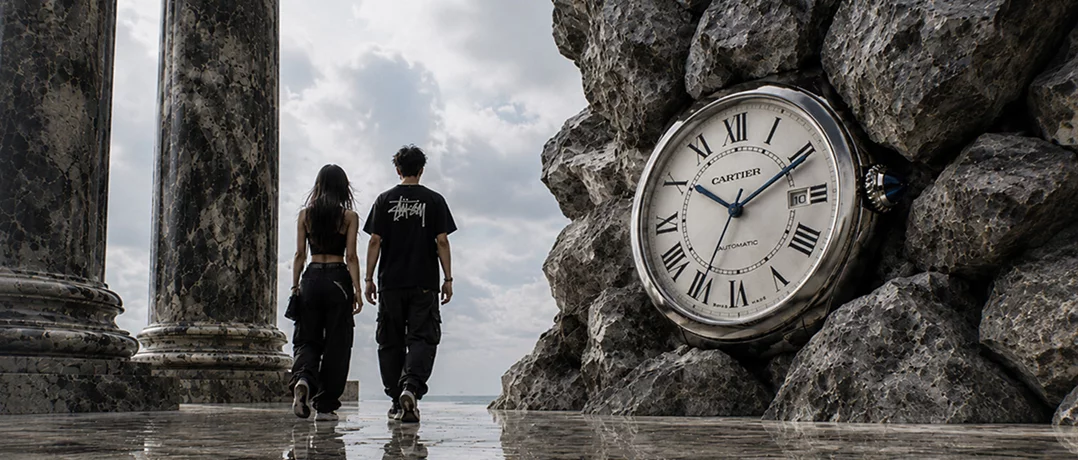
For the better part of three decades, the aspirational grammar of the luxury watch industry was largely written by one brand. To wear a Rolex was to signal professional, social, financial. The Submariner and the Daytona became infamous for a particular vision of ambition. No competitor mounted a serious challenge to that dominance. Until now.
The challenger, somewhat unexpectedly, is Cartier. The Parisian maison, long regarded primarily as a jeweller that also produced timepieces, has emerged as the dominant force among younger luxury consumers, through a disciplined return to its own heritage. The results, measured across primary and secondary markets alike, are difficult to dispute.
Data from Chrono24, the world's leading pre-owned watch marketplace, tells the clearest version of this story. Cartier's share of expenditure among buyers under thirty on the platform quadrupled between 2018 and the first half of 2025, reaching 6.8%, a rate of growth that substantially outpaced the brand's gains across all other age groups. Over the same period, purchases of dress watches among that cohort rose by nearly half, and dress styles now constitute the single largest category of watch acquisitions among younger buyers on the platform. Sales of new Cartier watches are estimated to have grown by around 15% last year, well ahead of Rolex, which posted single-digit growth over the same period. Second-hand prices for Cartier references rose approximately 10% in under twelve months.
Cartier is buying the future
The causes are structural as much as they are cultural. The generation now entering its peak years of discretionary spending has a materially different relationship with luxury than its predecessors. Where earlier cohorts prized the sports watch as an emblem of achievement, durable, legible, masculine in its associations, younger consumers are increasingly drawn to pieces that function as jewellery, worn for their formal elegance and their intimacy rather than their technical credentials. In this regard, Cartier's catalogue, the Tank, the Santos, the Panthère, is exceptionally well positioned. These are watches designed to be worn close to the skin, in proportion with the wrist, and valued as much for their line as for their movement.
The company's recovery also reflects deliberate strategic choices made well in advance of the current moment. Cyrille Vigneron, who led Cartier from 2016 until last year, redirected the brand away from complications and towards its archive of shaped, jewellery-adjacent design. The 2017 relaunch of the Panthère, with a campaign directed by Sofia Coppola, was aimed explicitly at an audience that had not yet entered the watch market. A parallel program offered free restoration of vintage Cartier pieces, an initiative that transferred heirloom watches between generations and cultivated loyalty long before new buyers had the means to purchase independently.
Strategy and consumer appeal
Pricing strategy has reinforced the brand's appeal. The entry point for a steel Panthère sits at a level that the luxury handbag market, which has seen sustained, significant price increases from houses including Chanel and Hermès, has rendered comparatively accessible. For a younger consumer weighing a considered luxury purchase, a Cartier watch increasingly represents better value retention, greater durability, and a more enduring form of self-expression than seasonal fashion goods.
Celebrity association has amplified these dynamics, if not originated them. The appearance of Taylor Swift wearing a discontinued gold-and-diamond Cartier Santos Demoiselle in widely circulated photographs accelerated existing momentum into something approaching a cultural signal. Secondary market dealers reported an immediate increase in requests for Panthère references; pre-owned prices responded accordingly.
Rolex, it should be noted, remains the structural anchor of the global watch market. The brand accounts for roughly one-third of total secondary market transaction value worldwide, a figure that no competitor approaches. Its watches have demonstrated exceptional value retention, holding on average more than their original retail price on the resale market, a distinction that continues to set it apart. The post-pandemic normalization of prices for steel sports references reflects the cooling of speculative demand rather than any erosion of underlying strength.
Yet even Rolex has registered the shift. The brand has introduced dressier references and explored more varied dial treatments, moves that acknowledge the industry's broader reorientation toward elegance and restraint. That the dominant force in watchmaking is adjusting its emphasis in response to changing consumer preferences is itself a measure of how substantially those preferences have moved.
What is taking place is less a passing trend than a recalibration of the market's center of gravity. A generation of consumers is determining, what constitutes a meaningful luxury object, and arriving at an answer that places design, proportion, and heritage above mechanical complexity or sporting association.
-
-

-
The Beiruter
-
