



Central Asia’s geography is reshaping trade routes and geopolitics.
Central Asia: The new strategic corridor

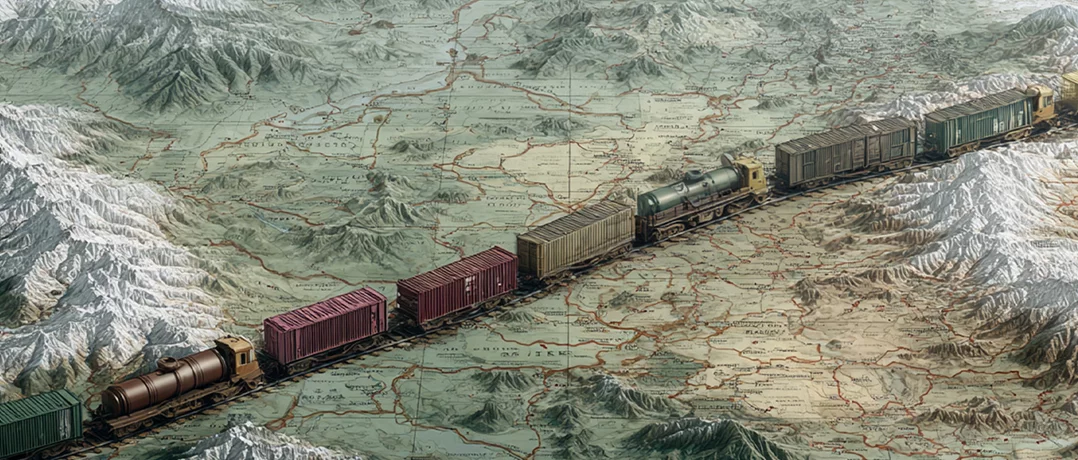
For much of the post–Cold War period, global trade and energy flows were organized around a set of assumptions that minimized the strategic relevance of continental interiors. Maritime transport was cheaper, faster, and politically insulated, while globalization reduced the perceived risks of long, tightly coupled supply chains. Central Asia, distant from oceans and embedded within the Soviet legacy, appeared structurally disadvantaged in such a system.
But in our current era, this framework has begun to unravel. Supply chains that were once considered safe and reliable are starting to buckle under the strain of great power conflicts and sanctions. The war in Ukraine fractured Eurasia’s northern corridors, while instability in key maritime chokepoints, from the Red Sea to the Panama Canal, has raised costs and uncertainty across global logistics.
From this uncertainty, Central Asia has re-emerged as an integral element in the ongoing reconfiguration of global trade routes. Its main advantage lies in its strategic position at the center of the now disrupted system: linking East Asia to Europe, Russia to the Middle East, and South Asia to the Eurasian interior. No other region in the world provides the same level of access. And this position is further reinforced by its extensive resource base.
Central Asia holds significant oil, natural gas reserves and mineral resources that are essential to the Eurasian energy markets. For example, Kazakhstan alone accounts for roughly 40% of global uranium production. In addition to resource extraction, Central Asia’s importance increasingly lies in its role as a transit zone. In 2023, the Trans-Caspian International Transport Route, a corridor that reduces the China-Europe transit to roughly 12 to 15 days compared to the average 35 to 45 days by traditional maritime shipping, handled around 3 million tons of cargo.
For Europe, the corridor’s importance is reinforced by the Caspian basin’s role as an energy transit space linking Central Asian producers with European markets via the South Caucasus and Turkey. Pipeline networks and port facilities along the Caspian allows for supply lines that bypass Russian territory, a consideration that has become increasingly important since the start of the Russo-Ukrainian war in 2022. While these routes remain less efficient than pre-war alternatives, their strategic value has risen as energy security priorities in Europe have shifted from cost optimization toward diversification and resilience.
The expansion of transit capacity has also altered how Central Asian states position themselves diplomatically. By acting as intermediaries rather than endpoints in the supply chain, Central Asia nations are now playing the role of facilitators, a position that brings increasing economic and strategic benefits. Their coffers are replenished thanks to transit revenues and infrastructure investment, while the reliance of external actors on these corridors embeds regional stability into their broader strategic interests. As a result, Central Asia’s infrastructure and resource base have drawn sustained attention from external powers seeking to secure access rather than control.
This newfound interest was quickly translated into massive waves of investment into Central Asia. China has consolidated its position as a leading economic partner, accounting for roughly 20 to 25% of total trade for several Central Asian states and investing more than 60 billion dollars since the launch of the Belt and Road Initiative. While Russia’s economic reach has been constrained by sanctions, it retains influence through security ties and labor migration. Income sent back from Russia by migrant workers still represents 20 to 40% of GDP in countries such as Kyrgyzstan and Tajikistan, highlighting the extent to which migrant labor from Central Asia remains essential to the Russian economy.
The European Union is also heavily invested in the region, pledging more than 10 billion euro in 2024 for sustainable transport connectivity in Central Asia. Moreover, the European Union is currently the largest foreign investor in Kazakhstan, responsible for over 40% of all foreign investment in the country, an approach it is seeking to extend to other Central Asian nations. Turkey, meanwhile, has combined expanding trade, exceeding 20 billion dollars, with an increasingly explicit cultural and institutional strategy. At the start of the 2024-2025 academic year, Turkish education authorities replaced the term Central Asia with Turkistan in official history textbooks, pointing to a longer-term attempt to shape regional narratives through institutional channels.
Even the United States is trying to get a piece of the pie. While trade remains limited, Washington has reinvigorated engagement through the C5+1 framework, culminating in a recent Central Asian leaders’ summit in Washington that signaled rapprochement and a renewed emphasis on political dialogue and critical minerals rights.
As external powers expand their presence, Central Asian states have responded by engaging several partners at once rather than committing to any single one. This allowed them to avoid exclusive alignment while extracting economic, political, and infrastructural benefits from competing initiatives. At the same time, overexposure to geopolitical competition carries its own dangers, as rival powers may seek leverage rather than partnership if regional balances shift. And how effectively these states manage their interest and those of their newfound investors will determine whether this renewed relevance translates into lasting strategic advantage.
-
-

-
Nami El KhazenJournalistFocusing on geopolitics and international affairs.
-
