

Born in 1906, Charles Habib Malik shaped the Universal Declaration of Human Rights and helped project Lebanon’s pluralistic voice onto the global stage.
Charles Malik’s legacy: From Lebanon to the world
Charles Malik’s legacy: From Lebanon to the world
By The Beiruter | February 11, 2026

Reading time: 6 min
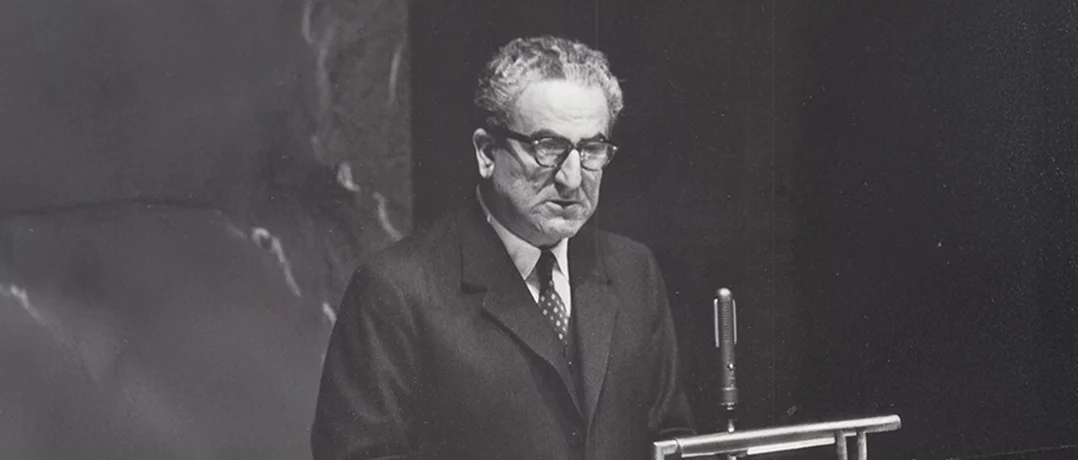
On this day in 1906, the renowned Lebanese philosopher and diplomat Charles Habib Malik was born.
A philosopher, diplomat, educator, and political thinker, Malik helped shape foundational international norms that continue to influence global governance. Yet, beyond his global achievements, his career reflected Lebanon’s ability, despite its small size, to project intellectual, diplomatic, and cultural influence on the international stage following independence.
Malik’s legacy also lies in his articulation of Lebanon as a model of pluralism, intellectual openness, and intercultural dialogue. Through his work, he transformed Lebanon from a newly independent state into a country whose intellectual and diplomatic contributions resonated far beyond its geographical boundaries.
Intellectual foundations and philosophical formation
Malik’s intellectual trajectory was deeply intertwined with Lebanon’s historical and cultural environment, playing a decisive role in shaping his diplomatic achievements. Born in the northern Lebanese village of Bterram, Koura, he grew up during the instability of World War I (1914-1918), an experience that contributed to his early awareness of political fragility and human suffering within Mount Lebanon and the wider region.
He pursued higher education at the American University of Beirut (AUB), initially specializing in mathematics and physics before transitioning to philosophy, which became the defining focus of his career. AUB played a formative role in shaping Malik’s worldview, reinforcing Lebanon’s reputation as a regional hub of liberal education and scholarly inquiry.
His academic ambitions led him to Harvard University, where he studied under Alfred North Whitehead, whose philosophical teachings profoundly influenced Malik’s understanding of human freedom and moral responsibility. Malik’s academic engagement at the University of Freiburg under Martin Heidegger further exposed him to existential and phenomenological thought. However, his experience in Nazi Germany, including harassment due to his ethnic identity, reinforced his conviction regarding the dangers of authoritarianism and ideological supremacy. These intellectual and personal experiences formed the foundation of Malik’s later commitment to universal human rights and ethical international governance.
Upon returning to Lebanon in 1939, Malik founded the philosophy department at the AUB, promoting liberal education and intellectual inquiry. His academic contributions helped establish Lebanon as a regional center for philosophical and humanistic scholarship, reinforcing the country’s reputation as an intellectual crossroads between East and West.
The emergence of Lebanon in multilateral diplomacy
Lebanon’s independence in 1943 created complex diplomatic challenges for the newly sovereign state. Recognizing Malik’s unique combination of intellectual authority, multilingual fluency, and global academic experience, Lebanese leaders recruited him into diplomatic service. Despite personal reluctance toward political engagement, Malik accepted the responsibility out of a sense of national duty and belief in Lebanon’s potential global role.
Malik participated in the 1945 San Francisco Conference, which resulted in the establishment of the United Nations (UN). During the conference, he articulated a vision of international institutions grounded not solely in political power but in moral responsibility. Malik argued that global governance should reflect universal ethical values and provide smaller nations, like his motherland, with mechanisms to influence international decisions. This position would become central to his diplomatic philosophy and a defining element of his contributions to multilateralism; as opposed to Realism (Realpolitik) which dominated much of European political history.
His diplomatic philosophy reflected Lebanon’s own geopolitical reality as a small yet strategically and culturally significant state. He argued that multilateral institutions should provide legal and diplomatic mechanisms enabling smaller states to balance global power asymmetries. His contributions helped institutionalize principles that allowed Lebanon to assert its presence in international diplomacy despite limited military or economic resources. His work within the United Nations helped institutionalize these principles and contributed to the development of international human rights law.
Following the conference, Malik served as Lebanon’s ambassador to the United States (US) and permanent representative to the UN. He also served 3 times as President of the UN Security Council (UNSC) in 1953 and 1954, and once as President of the UN General Assembly (UNGA) in 1958-1959. In these roles, he significantly enhanced Lebanon’s diplomatic visibility and demonstrated how intellectual leadership could amplify the country’s international influence.
Architect of the 1948 Universal Declaration of Human Rights
Malik’s most enduring global achievement was his central role in drafting the 1948 Universal Declaration of Human Rights (UDHR). In 1946, he was elected to the United Nations Economic and Social Council (ECOSOC), whom he chaired in 1948, which established the Commission on Human Rights responsible for drafting an international human rights charter. In February 1947, in accordance with a decision from the first session of the aforementioned commission (E/259), a group consisting of US First Lady Eleanor Roosevelt, Chinese philosopher and diplomat Pen-Chun Chang, as well as Charles Malik, began drafting what would become the International Bill of Human Rights.
Serving as rapporteur and later as president of the Commission, Malik played a decisive role in navigating ideological conflicts among Western liberal democracies, communist states, and representatives from diverse cultural traditions. His diplomatic skill and philosophical expertise enabled him to bridge ideological divides and promote universal ethical principles.
Furthermore, Malik’s Lebanese background strongly influenced his contributions, particularly regarding religious and cultural pluralism. His impact was especially evident in shaping Article 18 of the UDHR, which guarantees freedom of religion and conscience (principles closely aligned with Lebanon’s historical identity, social fabric and raison d’être). His insistence on intellectual and spiritual autonomy reflected both his philosophical beliefs and Lebanon’s longstanding tradition of religious coexistence.
These efforts culminated in the UDHR’s adoption on 10 December 1948 without opposition, marking a historic diplomatic achievement in which Lebanon played a disproportionately influential intellectual role.
Contributions to Lebanese national identity and political thought
Malik’s contributions to Lebanon extended beyond diplomacy into national intellectual and political life. He advocated a vision of Lebanon as a pluralistic society rooted in freedom, cultural diversity, democratic governance, and intellectual openness. Malik viewed Lebanon as uniquely positioned to mediate between Eastern and Western civilizations, fostering intercultural dialogue and intellectual exchange.
During his tenure as Lebanon’s foreign minister and minister of education in the 1950s, Malik promoted educational reform and international engagement. He highlighted the importance of intellectual development and human capital as essential components of national strength, reflecting the country’s long-standing reputation as a regional center for learning.
Politically, Malik contributed to Lebanese political discourse and became an influential figure, especially during periods of national crisis. His alignment with Western alliances during the Cold War (1945-1991) as well as his opposition to Soviet influence and certain Arab nationalist movements reflected his conviction that Lebanon’s sovereignty depended on preserving liberal democratic values and refraining from indulging in regional expansionist ambitions. His advocacy for American assistance during the 1958 Crisis in Lebanon (when the US Marines landed in Beirut to aid the Lebanese government and presidency in repelling the riots and Nasserite wave) demonstrated his belief that Lebanon’s political independence required protection from communism as well as regional ideological expansion and authoritarian movements. After the outbreak of the Lebanese War (1975-1990), Malik contributed to establishing the “Front for Freedom and Man” in 1976, at the outbreak of the Lebanese War (1975-1990), to defend the Lebanese and Christian cause; later renamed as the “Lebanese Front.”
Our aim is that Lebanon enjoy the clear distinction of being the only country in the Middle East in which the problem of minorities has received its complete resolution.
While these positions generated criticism from various domestic and regional factions, they reflected Malik’s broader commitment to liberal democratic principles, and ensuring Lebanon’s freedom and sovereignty.
Philosophical and religious dimensions of Malik’s legacy
Malik’s intellectual contributions extended into theological and philosophical discourse. Influenced by Thomistic philosophy and natural law theory, he promoted interfaith dialogue and Christian unity, advocating cooperation among religious traditions while highlighting universal ethical values.
If free Christianity falls in Lebanon, and Lebanon is the last sanctuary of Christianity in the East, it will disappear not only across the Middle East, but also in Asia and Africa.
His Orthodox Christian upbringing was further shaped by his exposure to Maronite history as well as intellectual and monastic tradition. In his notable publication “Two Letters to the Maronites,” Malik reminds the Maronites of their historic role and mission in the Orient, rooted in openness, creativity, and freedom. He urges them to draw lessons from the past and rise to the demands of their “historical moment.”
A free Lebanon is of priceless value in the general existential-humanistic design of the Middle East, and the Maronites are entrusted with this value, perhaps even more than others are.
An enduring legacy
Today, Charles Malik’s legacy remains deeply embedded in international human rights law and multilateral diplomacy, while also forming an essential component of Lebanon’s modern intellectual heritage. The UDHR continues to serve as the foundation of modern human rights conventions and international legal standards.
Malik’s life represents a remarkable synthesis of Lebanese intellectual tradition, philosophical inquiry, and international diplomacy. It illustrates how Lebanon’s intellectual tradition and cultural diversity enabled it to shape international norms disproportionate to its size. His career stands as a testament to Lebanon’s historical role as a center of scholarship, dialogue, and diplomatic engagement.
Alas, Malik’s legacy continues to symbolize Lebanon’s enduring cultural mission as a bridge between civilizations and a defender of freedom, sovereignty, pluralism, and education. As contemporary domestic and global challenges continue to test human rights and international institutions, Malik’s vision and contributions remain profoundly relevant to this day.
-
-

-
The Beiruter
-
