



China’s Shenzhou 23 mission advances Tiangong operations, highlighting long-duration spaceflight ambitions and intensifying competition with the United States lunar race.
China’s Shenzhou 23 and the new space race

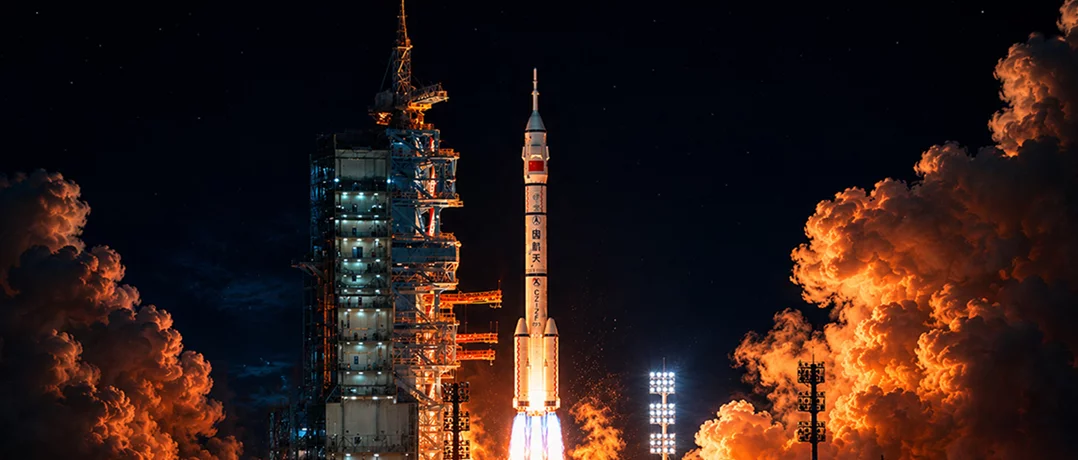
China has taken another major step in its rapidly advancing space program with the successful launch of the Shenzhou 23 spacecraft, carrying 3 astronauts to the Tiangong space station. More than a routine orbital mission, the launch reflects Beijing’s determination to establish itself as a leading global space power and to challenge the long-standing dominance of the United States (U.S.) in human space exploration.
The mission blasted off from the Jiuquan Satellite Launch Centre in northwestern China, highlighting the country’s accelerating ambitions in space, particularly its goal of achieving a crewed lunar landing by 2030.
A mission focused on long-duration spaceflight
The Shenzhou 23 spacecraft carried 3 astronauts: commander Zhu Yangzhu, former air force pilot Zhang Zhiyuan, and payload specialist Lai Ka-ying, also identified by Chinese authorities through the Mandarin transliteration of her name, Li Jiaying. Only hours after launch, the spacecraft successfully docked with China’s Tiangong space station.
During their stay aboard Tiangong, which translates to “Heavenly Palace,” the astronauts are expected to carry out dozens of scientific and application projects. The mission includes experiments focused on medicine, biology, engineering, and the effects of microgravity on the human body. Chinese authorities have increasingly emphasized the importance of such research as the country prepares for future deep-space exploration missions.
The astronauts will also conduct an in-orbit rotation with the Shenzhou 21 crew, who have been aboard the station for more than 200 days. This operational process is designed to ensure continuity aboard Tiangong while improving China’s ability to manage complex long-term missions in space.
The most remarkable aspect of Shenzhou 23, however, is the decision for one astronaut to remain aboard the station for a full year. Chinese state media reported that the extended stay is intended to “explore human adaptability and performance limits” in long-duration spaceflight environments. Such missions are considered essential for preparing future lunar expeditions and, eventually, possible crewed missions to Mars.
A year-long stay in orbit would place the mission among the longest continuous human spaceflights in history, approaching the 14-and-a-half-month record set by Russian cosmonaut Valery Polyakov in 1995. Scientists believe that extended stays in space provide critical insights into muscle deterioration, bone density loss, psychological endurance, cardiovascular health, and the technical challenges associated with deep-space travel.
Hong Kong’s first astronaut marks a historic moment
One of the most widely discussed aspects of the mission is the participation of Lai Ka-ying, the first astronaut from Hong Kong to travel into space. Born and raised in the city, Lai previously worked as a police officer before earning a doctorate in computer forensics and later joining China’s astronaut selection program.
Her inclusion in the mission has been celebrated by both Chinese and Hong Kong authorities as a historic milestone. Hong Kong Chief Executive John Lee described the launch as a proud moment for the city and a symbol of national achievement.
Beyond the scientific significance, analysts believe the mission carries political symbolism as well. Chinese authorities have increasingly promoted stories of national technological achievements to encourage patriotism, particularly among younger generations in Hong Kong. Lai’s participation therefore represents both a scientific accomplishment and a carefully highlighted symbol of national integration.
Tiangong and China’s independent space strategy
The Shenzhou 23 mission also illustrates how China has successfully developed an independent human spaceflight program after being effectively excluded from the International Space Station because of American national security concerns.
Rather than slowing China’s ambitions, the exclusion encouraged Beijing to create its own orbital infrastructure. The result was the Tiangong space station, which first hosted Chinese astronauts in 2021 and has since become the centerpiece of the country’s space program.
Since then, China has carried out multiple crewed missions to the station, steadily improving its operational experience and technical capabilities. The Shenzhou program itself, whose name means “Divine Vessel,” has become central to these efforts. Last year, the program attracted international attention after an emergency mission successfully returned astronauts stranded aboard the station following spacecraft damage, further demonstrating China’s growing expertise in complex orbital operations.
Chinese space officials increasingly view Tiangong as more than a scientific laboratory. It has become a symbol of national prestige, technological independence, and geopolitical influence. By maintaining a permanently occupied space station while many international projects face delays and political complications, Beijing has strengthened its image as a rising technological superpower.
The intensifying lunar race with the United States
The Shenzhou 23 launch also comes amid an intensifying space rivalry between China and the U.S. Washington and Beijing increasingly view lunar exploration not only as a scientific competition but also as a strategic contest for technological leadership and geopolitical influence.
NASA is currently pursuing its Artemis program, which aims to return astronauts to the Moon later this decade and establish a long-term lunar presence. China, meanwhile, has accelerated its own timetable, targeting a crewed lunar landing by 2030.
In recent years, China has achieved several important milestones supporting those ambitions. In 2024, the Chang’e-6 mission successfully retrieved rock samples from the far side of the Moon, becoming the first mission in history to do so. Later this year, China is expected to conduct an orbital test flight of the Mengzhou spacecraft, designed specifically for future lunar missions.
Experts note that long-duration missions such as the one planned for Shenzhou 23 are critical preparation for lunar exploration. Managing astronaut health, spacecraft reliability, and psychological resilience over extended periods remains one of the greatest challenges in human spaceflight.
As Beijing continues expanding its capabilities through missions such as Shenzhou 23, it is increasingly clear that the future of space exploration will be shaped not by one nation alone, but by an emerging competition between global powers seeking influence both on Earth and far beyond it.
.-
-

-
The Beiruter
-
