



Pakistan's first astronaut could make history aboard Tiangong. For China, the mission marks a new frontier in space diplomacy.
China’s space diplomacy begins

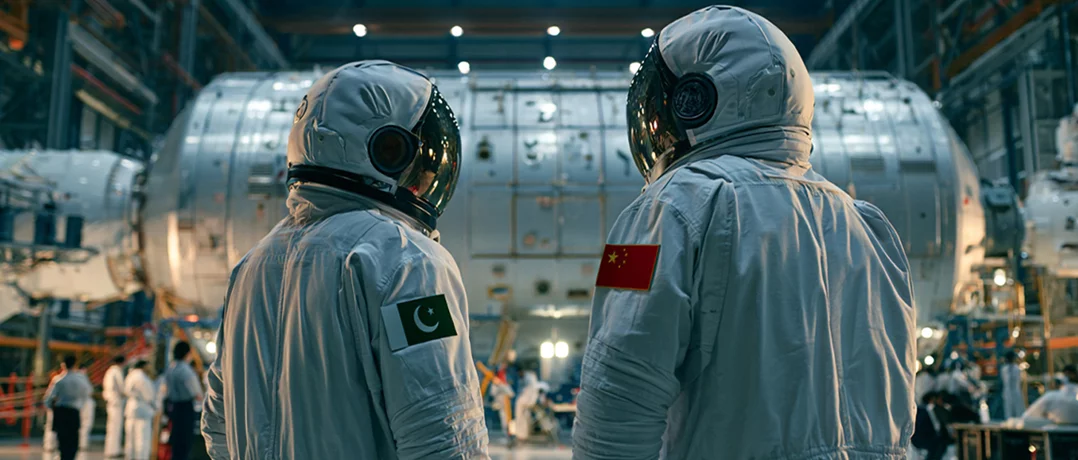
Two Pakistani pilots, Muhammad Zeeshan Ali and Khurram Daud, are training in Beijing for a mission only one will undertake. The objective: to become the first Pakistani to reach orbit and the first foreign national aboard China's Tiangong space station.
Since its first crewed mission in 2003, China has developed its own human-spaceflight system, from launch vehicles and spacecraft to a permanently crewed orbital station, largely outside the international framework that produced the International Space Station.
This investment established Beijing as one of the few powers capable of independently sending humans into orbit. Now, that technological independence is acquiring a diplomatic dimension, as China begins offering other countries access to infrastructure that took decades to develop.
From passenger to participants
Under a February 2025 agreement between Pakistan's Space and Upper Atmosphere Research Commission and the China Manned Space Agency, the selected Pakistani will serve as a payload specialist. During an expected weeklong mission, his principal responsibility will be conducting scientific experiments rather than piloting the spacecraft.
Four biotechnology experiments were chosen from more than 300 proposals submitted by Pakistani universities. Intended to investigate problems related to food security and climate change, they will be conducted in microgravity aboard Tiangong. To carry out this work, the astronaut will undergo training within China's human-spaceflight program, which will also provide the spacecraft, launch facilities and operational support required for the mission.
Pakistan has developed and operated satellites, but lacks the crewed spacecraft, human-rated launch vehicle and space station needed to undertake such a mission independently. Through the agreement, its scientific institutions can prepare experiments for a trained Pakistani specialist to perform aboard an orbital laboratory, giving them experience with the demands of crewed scientific research.
Why Pakistan come first
Pakistan's selection builds on a longstanding strategic relationship with Beijing. China is one of Islamabad's closest partners, with extensive cooperation in defense, infrastructure and technology. Space exploration has gradually become another area of collaboration, supported by agreements between the two countries' national space agencies.
In 2018, China launched Pakistan's PRSS-1 remote-sensing satellite. Six years later, Pakistan's ICUBE-Q satellite traveled to lunar orbit aboard China's Chang'e-6 mission, following its development through cooperation between Pakistani and Chinese institutions. Their partnership is now extending to the lunar surface, with a roughly 35-kilogram Pakistani rover scheduled to accompany China's Chang'e-8 mission around 2029.
These projects have already brought Pakistani engineers and scientific institutions into Chinese space missions, establishing channels for technical cooperation and coordination. Human spaceflight introduces a more demanding form of participation, involving the training of Pakistani personnel within China's astronaut program.
The astronaut as an instrument of diplomacy
The use of human spaceflight as an instrument of diplomacy dates back to the Cold War. On 2 March 1978, Czechoslovak cosmonaut Vladimír Remek traveled aboard the Soviet Soyuz 28 spacecraft to the Salyut 6 space station, becoming the first person from outside the United States or Soviet Union to reach space. His flight inaugurated the crewed phase of Interkosmos, a Soviet program that subsequently carried citizens of Poland, East Germany, Cuba, Mongolia and other friendly states into orbit.
These missions served scientific purposes, but also carried political significance. Countries without independent human-spaceflight capabilities acquired national astronauts, while Moscow demonstrated its technological leadership and strengthened ties with participating governments. The Soviet Union retained control over the spacecraft, training facilities and orbital infrastructure.
The United States developed a different model of international cooperation. Foreign astronauts flew aboard the Space Shuttle, while the Shuttle-Mir program deepened American-Russian cooperation during the 1990s. The International Space Station subsequently established a more integrated arrangement, with the United States, Russia, Europe, Japan and Canada contributing infrastructure, scientific resources and operational responsibilities.
China's planned Pakistani mission follows the earlier precedent of providing a foreign government with access to nationally controlled space infrastructure. Whether that initial arrangement eventually develops into a broader system of international participation remains an open question.
Tiangong's gradual internationalization
China began preparing its Tiangong space station for international participation long before its agreement with Pakistan. In 2016, the China Manned Space Agency signed a cooperation agreement with the United Nations Office for Outer Space Affairs, opening a path for foreign scientists to conduct research aboard its future station. Two years later, the organizations invited proposals from UN member states, with particular attention to opportunities for developing countries.
In June 2019, they selected nine scientific projects involving 23 institutions from 17 countries, covering fields including astronomy, biotechnology and microgravity physics. Six received full approval and three conditional approval. The initiative offered foreign researchers access to Chinese orbital facilities without requiring their governments to contribute to the station's construction or operation.
Beijing's plans for international participation also extended to astronauts. In 2017, European Space Agency astronauts Samantha Cristoforetti and Matthias Maurer participated in sea survival training alongside Chinese astronauts, although neither subsequently flew aboard Tiangong. In 2023, the China Manned Space Agency announced that it was ready to welcome foreign crews on joint missions. The Pakistani agreement now gives that invitation a concrete form.
Scientific experiments can involve researchers from many countries, but a place aboard a crewed mission is scarcer and more publicly visible. It also requires sustained coordination over astronaut selection, training and flight operations, bringing national institutions into closer working contact.
By selecting Pakistan for the first such flight, Beijing is making a visible diplomatic choice, giving an established strategic partnership an opportunity that few governments can offer. Future invitations could similarly help China cultivate relations with other countries seeking access to human spaceflight.
From Tiangong to the moon
China's efforts to attract foreign partners extend beyond low-Earth orbit. In 2021, Beijing and Moscow agreed to cooperate on the International Lunar Research Station, a proposed research complex on or around the Moon. Its initial stages are intended for robotic operations, with human participation envisaged later.
Pakistan is already connected to this project through its planned contribution to the forthcoming Chang'e-8 mission. The Pakistani rover will study lunar terrain and soil, contributing to research associated with the proposed station. Other countries have also joined the initiative, giving Beijing an emerging network of partners in lunar exploration.
Washington, meanwhile, has developed a broader diplomatic framework through the Artemis Accords. Established in 2020, the accords set out principles for peaceful exploration, transparency, scientific cooperation and the responsible use of space. By September 2026, 76 countries had signed them. NASA has also invited signatories to contribute scientific instruments and technology demonstrations to future lunar missions, although signing the accords does not itself constitute participation in an American space mission.
The two initiatives differ in both structure and maturity. The Artemis Accords establish nonbinding principles governing peaceful exploration, transparency and technical cooperation. Signing them does not automatically grant participation in NASA's Artemis missions, which require separate agreements defining each partner's contributions.
China's International Lunar Research Station, developed with Russia, is instead a specific infrastructure project around which Beijing is assembling partners to contribute to scientific research, construction and eventual operations. The American approach combines a broad diplomatic framework with established mission partnerships, while China's initiative centers on developing a research facility that has yet to be built.
For countries seeking to expand their space programs, the implications are practical as well as diplomatic. Participation in specific missions can influence which technologies their engineers work with, which institutions they collaborate with and what scientific expertise they acquire. Over time, these relationships can deepen cooperation with the countries providing access to space infrastructure, creating partnerships that extend well beyond individual missions.
A seat becomes foreign policy
For Pakistan, the planned flight would mark a national milestone. For China, it would establish a precedent for foreign astronauts to work aboard a station Beijing built and operates independently.
The importance of that precedent will become clearer after the first mission: whether foreign crews return regularly, whether partner institutions acquire lasting scientific roles and how much influence they have over the projects they undertake. The answers will help determine whether Tiangong becomes a durable instrument of Chinese space diplomacy.
-
-

-
Nami El KhazenJournalistFocusing on geopolitics and international affairs.
-
