

Each Christmas Eve, believers remember St. Charbel Makhlouf at Annaya, honoring his life of humility, prayer, and enduring spiritual legacy.
Christmas Eve 1898: remembering St. Charbel

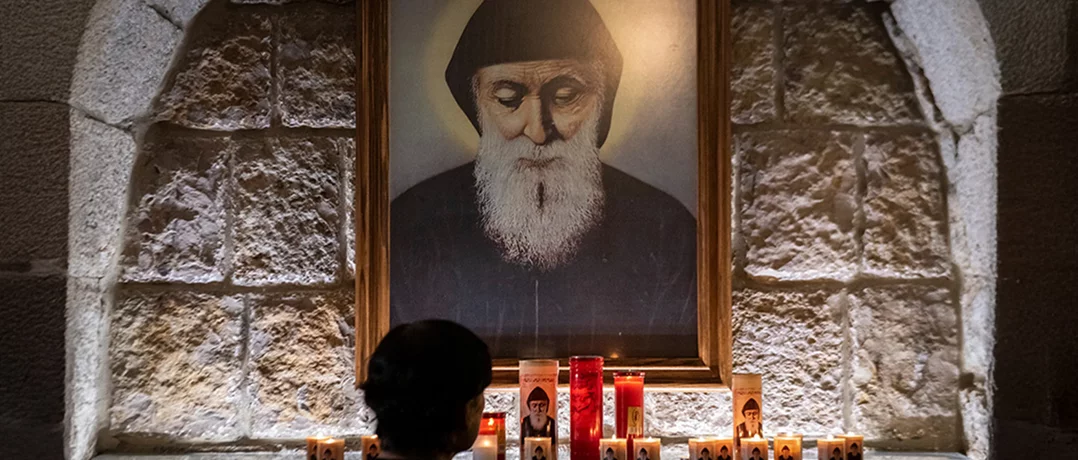
This date holds particular significance at St. Maron Monastery in Annaya, the place most closely associated with his life, asceticism, and enduring legacy. More than a historical site, Annaya has become a spiritual landmark that continues to attract pilgrims seeking reflection, healing, and inner peace.
Annaya Monastery: a place of silence and devotion
Located in the hills of Jbeil district, Annaya Monastery is officially known as the Monastery of St. Maron, Annaya. It was here that St. Charbel spent much of his monastic life after joining the Lebanese Maronite Order in the mid-19th century. The monastery is marked by simplicity, mirroring the austere lifestyle embraced by its most famous monk.
Within its stone walls, daily monastic life continues much as it did during St. Charbel’s time: prayer, manual labor, and silence. Visitors often remark on the atmosphere of stillness that surrounds the monastery, a quality that has helped transform Annaya into a destination not only for religious pilgrims but also for those seeking respite from the pressures of modern life.
The life of St. Charbel
Born Youssef Antoun Makhlouf in 1828 in the village of BkaaKafra, St. Charbel chose a path of deep spiritual withdrawal at a young age. After entering monastic life, he was ordained a priest and later requested permission to live as a hermit. For 23 years, he resided in the Hermitage of Saints Peter and Paul, near Annaya, dedicating himself to prayer, fasting, and contemplation.
On his final day, 24 December 1898, St. Charbel lived and died in the same spirit of humility and devotion that had defined his entire life. While celebrating the Divine Liturgy at the hermitage near Annaya, he suddenly faltered at the moment of the Eucharistic prayer before collapsing. He was gently assisted by fellow monks and carried to his cell, where he endured days of silent suffering marked by prayer and acceptance.
On Christmas Eve, he passed away quietly, without public attention or ceremony, leaving behind no possessions and no recorded words of farewell. His death, as modest as his life, reflected a complete surrender to God and would later be understood as the final testimony of a monk who had devoted himself entirely to faith, sacrifice, and obedience.
His life, largely hidden from public view, gained global attention after reports of miracles associated with his intercession began to spread following his death.
Miracles and global influence
After his burial, accounts of unexplained healings and spiritual experiences drew increasing attention to Annaya. The phenomenon of light reportedly emanating from his tomb and the preservation of his body contributed to his growing reputation for sanctity. Canonized by the Catholic Church in 1977, St. Charbel has since become a universal figure, venerated far beyond Lebanon’s borders.
Today, pilgrims from different faiths and nationalities visit Annaya, reflecting the saint’s broad spiritual appeal. Pope Leo XIV, the head of the Catholic Church, even visited the tomb for the first time in history and kneeling before the humbleness and holiness of both the place and its hermit as well as proclaiming it as an international religious monastery.
On the anniversary of his death, Annaya Monastery stands as a living testament to the enduring legacy of St. Charbel. The quiet paths he once walked now carry generations of visitors drawn by his life and example. His message of humility, sacrifice, and unwavering faith resonates in a world often marked by division and excess.
Remembering St. Charbel on 24 December is not merely an act of commemoration, but an invitation to rediscover values of simplicity, devotion, and inner strength; values that remain as relevant today as they were more than a century ago.
Each year on 24 December, the Maronite Church and countless faithful around the world pause to remember the death of St. Charbel Makhlouf, one of Lebanon’s most revered spiritual figures.
-
-

-
The Beiruter
-
