

Lebanese driver Christopher Feghali’s rise in international motorsport reveals a journey of talent, sacrifice, and resilience amid limited institutional support.
Christopher El Feghali: Lebanon’s rising force in motorsport
Christopher El Feghali: Lebanon’s rising force in motorsport
By The Beiruter | May 05, 2026

Reading time: 4 min
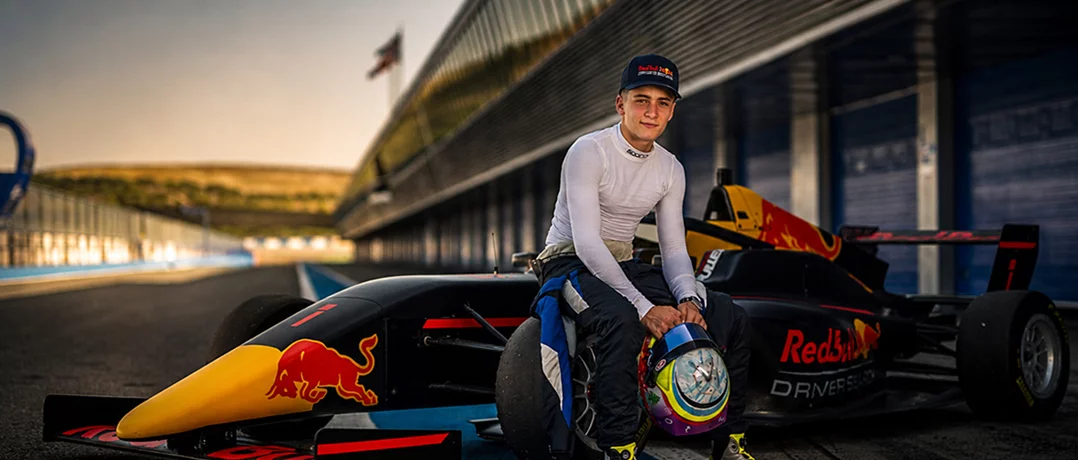
Christopher El Feghali, a 16-year-old Lebanese driver competing for the Drivex team, secured a landmark victory in his debut full season of the Eurocup-3 championship, finishing first in the series’ inaugural Sprint Race format. By any measure, it was a significant result and for Lebanon, a rare moment to celebrate a young citizen succeeding on the international stage.
Feghali drives for Drivex, a Spanish team ranked outside the championship’s top three. His entry into motorsport, however, began long before his professional career. From an early age, he was immersed in the sport, watching his father, Abdo Feghali a dominant figure in Lebanese motorsport known for winning dozens of rally titles as well as his uncle, compete across Lebanon, from the Côte du Rhodes to speed tests.
“He didn’t force me,” Feghali recalls. “When I was four years old, he asked me if I wanted to try it. From that moment, I got hooked. We just continued.”
What began as a hobby quickly evolved into a structured pursuit. For the first two years, Feghali trained informally, as age restrictions prevented him from competing in the Lebanese Championship. By the age of seven, he became eligible, and the approach shifted. “We took it very seriously,” he says.
Breaking from a racing legacy
Feghali comes from one of Lebanon’s most prominent motorsport families. Yet rather than follow the traditional rally path, he made a deliberate decision to chart a different course.
“I had the opportunity to become a rally driver,” he says. “I even went with my dad a few times. I told them I love it, but I want to try something different from the family tradition.”
That decision led him toward circuit racing. By the time he transitioned into competitive karting internationally, Feghali was already representing Lebanon abroad.
I’ve been racing in European and world championships since karting. I even won a world championship in 2022 and stood on the podium with the Lebanese anthem.
Racing with and without pressure
Despite the weight of his family name, Feghali describes his father’s influence as one that alleviates pressure rather than amplifies it.
“My dad pushed me from the beginning,” he says. “But when he’s at the races, instead of adding pressure, he reduces it. He tells me to enjoy it.”
Entering major competitions, Feghali says he carried no expectation of victory. “I went there to represent myself, Lebanon, and my family,” he says. “I was sacrificing a lot being away from my family and friends, living alone in Spain. But in the end, it was all worth it.”
Doubt, he insists, was never decisive. “I never thought of stopping,” he says.
The passion we have for this sport is unreal. I can’t imagine my life without motorsport, even in 30 or 40 years.
The cost of ambition
Behind the trajectory lies a more difficult reality: financial strain. “We were getting demotivated,” he says. “We were in midfield teams, not getting the results we wanted.”
At the start of the season, the challenge intensified when he was unable to continue with the Red Bull Junior Team due to budget constraints. “They required us to cover 50 percent of the cost around half a million euros,” he says. At one point, he considered stepping away entirely. “We were thinking maybe we stop, maybe I go back to Lebanon, live a normal life, maybe do some rally or speed tests,” he says. “From there, the motivation came back, because of discipline. If you’re not disciplined, even people with less talent but more money will achieve more than you.”
Leaving home at 15
In early 2025, Feghali relocated alone to Spain to begin his Formula 4 journey at just 15 years old. “I had to move because Lebanon doesn’t have proper circuits or training facilities,” he says. The transition was immediate and challenging. “It was very hard at the beginning,” he says. “It was my first time being far from my family.”
Living independently required rapid adaptation. “I had to learn how to cook, do my laundry, and manage my schedule,” he says. “But over time, it got easier. Now it’s part of my life.”
His education also shifted. He now follows a British online program after leaving his previous school in Lebanon a decision that came with emotional trade-offs, despite his family’s support. Feghali describes his current routine as singularly focused. “My personal life is effectively on pause,” he says.
I wake up at 7 a.m., train physically and mentally, and spend time on the simulator. Then I turn to my studies, prepare my meals, and follow a strict nutrition plan.
There is little to no time for leisure.” He does not present this as a sacrifice, but as a necessary commitment. “If it brings me closer to achieving my goal, I have no issue with it,” he says. “I’m fully driven.”
Representation without backing
For emerging athletes in high-cost sports such as motorsport, public institutions particularly the Ministry of Youth and Sports can play a decisive role. In most countries, national federations and ministries help identify talent, facilitate sponsorship pipelines, and reduce the financial burden of competing internationally. In Lebanon, however, that institutional framework remains largely absent.
Asked whether he had received any official support, Feghali was direct: “To be honest, no.”
Recognition of his achievements has largely remained limited to social media, including posts by the presidency and public figures, without translating into tangible backing. “This sport is very expensive,” he says. “To move to the next level, Formula 3, it costs around two million euros per season.” Even private sponsorships fall short. “Even if a sponsor gives you 50,000 euros, it’s still not enough,” he says. “You need investors. You need serious financial support.”
In the absence of institutional backing, the burden falls on families, private teams, and external investors raising broader questions about how Lebanon supports young athletes competing globally.
Focus under the helmet
Inside the car, the pressures fade. “When I put on the helmet, I forget everything,” he says. “I forget every worry and just focus on driving.” Like many young drivers, his long-term ambition is clear.
“The dream is Formula 1,” he says. “But it’s super hard. You need luck, financial support, talent, and a lot of hard work.” If that path proves out of reach, alternatives remain. “There’s Le Mans, GT racing, Formula E,” he says. “The goal is to become a professional driver and make a living from it.”
From his father, he says, he learned one principle above all: resilience. “He never gives up, no matter the situation,” Feghali says. “Even after every rally win, he reviews his onboard footage to see where he can improve. He keeps digging deeper. That’s how you move forward.”
Feghali’s advice is direct: “To achieve your dreams, you have to work hard and sacrifice,” he says. “I left my family and my friends, but in the end, it will all be worth it.”
“Everything is possible.”
-
-

-
The Beiruter
-
