



Oman and Iran propose competing frameworks for managing the Strait of Hormuz, exposing tensions over sovereignty, security, shipping fees, and navigation.
Competing Iranian-Omani visions for the Strait of Hormuz
Competing Iranian-Omani visions for the Strait of Hormuz
By The Beiruter | August 04, 2026

Reading time: 5 min
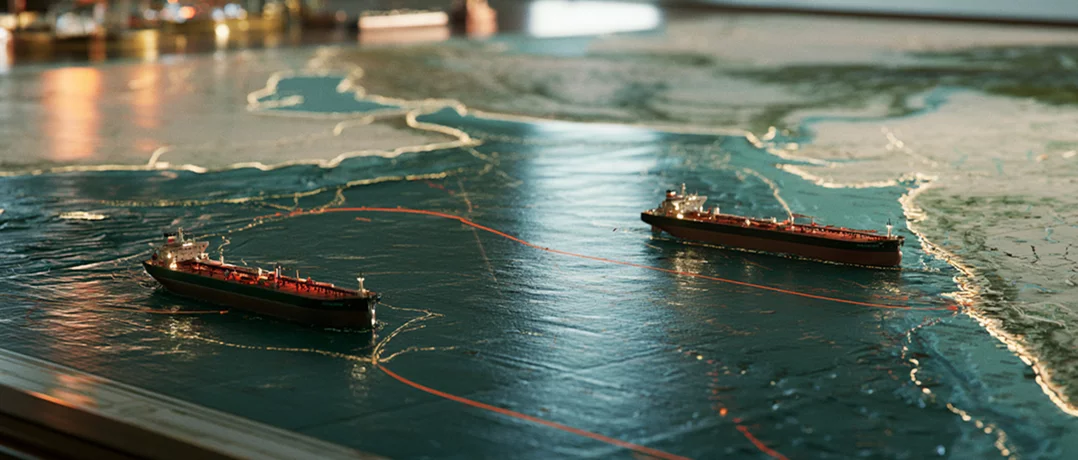
The Strait of Hormuz, serving as the primary maritime gateway between the Persian Gulf and the Gulf of Oman, has historically been vital to global energy security, carrying roughly one-fifth of the world’s oil and liquefied natural gas (LNG) exports before the latest regional conflict.
Oman has since stepped forward as a mediator, proposing a joint management mechanism aimed at balancing sovereignty, freedom of navigation, and regional security. Iran, however, has rejected Muscat’s proposal and introduced its own alternative, reflecting its determination to exercise greater oversight over one of the world’s most important maritime chokepoints.
Oman’s proposal: Shared responsibility
Seeking to restore stability while addressing the concerns of all parties, Oman has proposed a jointly administered framework for managing commercial traffic through the strait.
According to Iranian Deputy Foreign Minister (FM) Kazem Gharibabadi, Muscat suggested dividing responsibility equally between the two coastal states. Under the proposal, ships would transit through designated lanes split between Iranian and Omani territorial waters, allowing each country to supervise traffic on its respective side.
Rather than imposing mandatory transit charges, Oman proposed a system of voluntary financial contributions from shipping companies. These funds would support navigation safety, environmental protection, search-and-rescue operations, and maritime infrastructure.
The proposal closely resembles the cooperative management model used in the Strait of Malacca, where Indonesia, Malaysia, and Singapore coordinate maritime security while encouraging voluntary contributions from commercial vessels instead of mandatory tolls.
The initiative reportedly enjoys support from Gulf Cooperation Council (GCC) member states, whose foreign ministers recently discussed regional maritime security and freedom of navigation.
Iran’s counterproposal
Tehran has rejected the proposed 50-50 arrangement, arguing that it does not adequately safeguard Iran’s national security interests.
Instead, Iranian officials have presented a counterproposal that would substantially expand Tehran's oversight over maritime traffic. Under Tehran’s plan, one shipping lane would lie entirely within Iranian territorial waters, while portions of the opposite lane would also pass through Iranian-controlled waters. According to Gharibabadi, this arrangement would enable Iran to maintain effective oversight of both inbound and outbound shipping rather than limiting its authority to vessels traveling along its own coastline.
Iran has also made clear that the strait will not simply return to its pre-conflict status. Officials argue that the security environment has fundamentally changed and that new management mechanisms are necessary to address emerging risks.
Iranian leaders have further warned that if negotiations fail, the strait could remain closed for international shipping.
The debate over shipping fees
The most contentious issue remains whether commercial vessels should pay for using the strait.
Oman’s proposal envisions voluntary contributions similar to those collected in the Strait of Malacca. Such systems generate relatively modest annual revenues while preserving the principle of freedom of navigation.
Iran, however, has advocated a significantly different approach. Reports indicate that Tehran favors charging ships substantial service fees for transiting the waterway, with some estimates suggesting fees could reach approximately $1 million per vessel. Iranian officials argue that these revenues would help finance reconstruction following extensive infrastructure damage sustained during recent military operations.
The United States (U.S.) strongly opposes any mandatory payment system, maintaining that the Strait of Hormuz constitutes an international waterway where commercial navigation should remain free from compulsory tolls or restrictions. Washington has repeatedly highlighted that any long-term agreement should preserve the principle of unrestricted maritime transit under international law.
Additional issues under negotiation
While shipping routes and transit fees dominate public discussion, negotiators continue to address several equally important technical and security issues.
Among them are the precise location and direction of navigation lanes, authority over maritime traffic management, responsibility for defining operational procedures, and mechanisms for clearing any remaining naval mines.
During the conflict, Iran issued guidance directing approved vessels along routes considerably closer to its coastline than traditional shipping corridors. Tehran argued that these adjustments were intended to minimize risks associated with possible underwater explosives, although it has never officially confirmed the presence of mines.
Negotiators are also examining how maritime security responsibilities would be shared between the two countries and how future disputes involving commercial vessels could be managed without escalating into military confrontations.
Why the Strait of Hormuz matters
The Strait of Hormuz is one of the most strategically important waterways in the world. At its narrowest point, it is only a few dozen kilometers wide, with both Iran and Oman exercising sovereignty over portions of its territorial waters. The passage connects the oil-producing states of the Gulf to international markets through the Gulf of Oman and the Arabian Sea.
Before the recent conflict, approximately 20% of global oil consumption and a substantial share of worldwide LNG exports transited the strait. Any disruption immediately affects shipping costs, insurance premiums, energy prices, and broader economic confidence.
Following the outbreak of hostilities, Iran effectively closed the strait to most international shipping, while the U.S. responded with maritime enforcement measures targeting Iranian commercial activity. Although fighting has largely subsided following diplomatic efforts, disagreements over navigation rights remain unresolved.
Therefore, while Oman seeks a cooperative model based on shared management and voluntary contributions, Iran is pressing for a framework that grants it greater operational oversight and reflects the new regional realities created by recent conflict. At the same time, the U.S. and other international stakeholders continue to advocate for unrestricted freedom of navigation and oppose mandatory transit fees.
-
-

-
The Beiruter
-
