

As Syria and Israel explore security and economic arrangements under U.S. mediation, Lebanon risks being sidelined from negotiations impacting its sovereignty and regional balance.
Could Lebanon be sidelined in the Syrian-Israeli deal?
Could Lebanon be sidelined in the Syrian-Israeli deal?
By The Beiruter | January 12, 2026

Reading time: 5 min
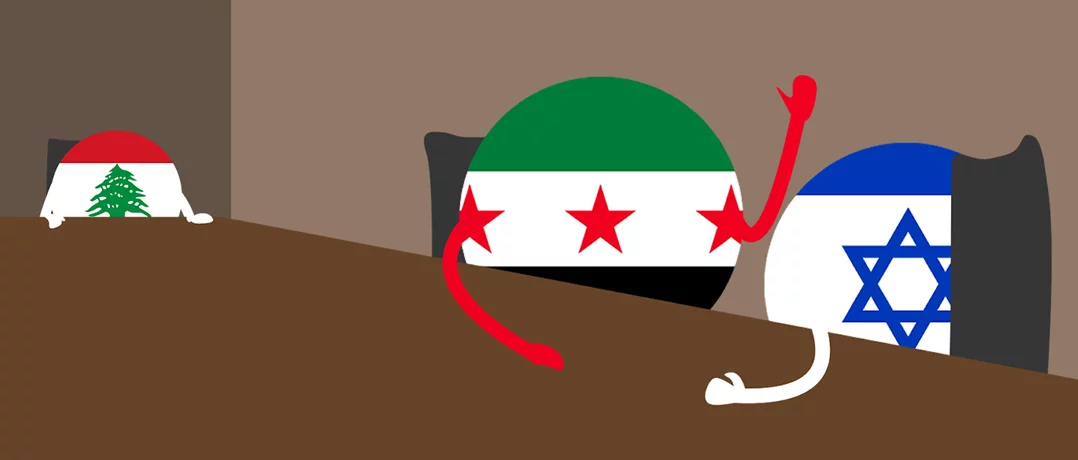
The United States-mediated talks held in Paris between Syria and Israel mark a significant shift in a relationship long defined by hostility, frozen agreements and periodic military escalation.
While framed as a technical security arrangement, the emerging deal carries strategic, political and economic implications that extend beyond the two parties involved.
Most notably, it raises pressing questions about Lebanon’s absence from discussions that directly affect its sovereignty and interests, particularly in the Mount Hermon (Jabal al-Sheikh) area.
A “dedicated communication cell” between Syria and Israel
At the core of the Paris talks is an agreement to establish a joint communication mechanism (described as a “dedicated communication cell”) designed to share intelligence, manage disputes and prevent military escalation.
Washington’s broader proposal goes further, envisioning a demilitarized zone along the Syria-Israel frontier paired with an economic component. This includes joint agricultural projects, renewable energy installations and a large-scale tourism development, potentially centered on Mount Hermon (the highest mountain in the Middle East at 2,812 meters above sea level). Such economic projects would reportedly include the best ski resort in the region. As for the mechanism, it would be headquartered in Amman, Jordan with the United States acting as a permanent mediator.
The initiative follows months of instability after the fall of the Assad regime on 8 December 2024, which Israel used as justification to expand military operations inside Syrian territory and move forces into areas previously governed by the 1974 Disengagement / Separation of Forces Agreement (the United Nations-brokered ceasefire agreement between Damascus and Tel Aviv following the 1973 Yom Kippur War). The Israel Defense Forces (IDF) seized the UN-monitored demilitarized buffer zone separating the occupied Golan Heights from Syria, including Mount Hermon and nearby villages, advancing at least 18km towards Damascus.
How could Syria and Israel benefit from this deal?
For Syria’s new leadership, the talks offer a pathway to reassert sovereignty and halt Israeli strikes that undermine post-war stabilization and investment. Damascus is primarily seeking a return to the pre-December 2024 military lines and the reactivation of the 1974 agreement, while resisting permanent demilitarization that would constrain state authority.
Israel, by contrast, views the process as an opportunity to consolidate security control, preserve territorial gains (which in gained over the past years through facts on the ground) and maintain leverage over southern Syria. The arrangement also allows Israel to counter rival regional influences, particularly Türkiye and Iran, while embedding itself economically and strategically in contested border areas.
Meanwhile, for both sides, US sponsorship provides political cover and international legitimacy. As both parties rely on crucial American aid (economically, diplomatically and even militarily), Washington holds significant leverage over Damascus and Tel Aviv, prompting them to potentially approve such deal. Additionally, having the US as a mediator and guarantor of the deal would relieve the two and ease suspicions against one another.
Could Lebanon be sidelined?
Despite being directly affected, Lebanon is absent from the Paris framework. This exclusion is most evident in discussions surrounding Mount Hermon, a strategic mountain shared by Syria, Lebanon and Palestine.
Lebanon holds clear sovereignty over its western slopes, just as Syria does over its eastern side. Any economic or security project centered on the mountain therefore has unavoidable Lebanese implications. Yet the proposed demilitarized economic zone and tourism projects proceed as if Mount Hermon were a bilateral matter. Israel’s continued control over key peaks, coupled with US-led arrangements that prioritize Syrian-Israeli understandings, effectively marginalizes Lebanon.
This mirrors the post Taif Agreement phase, whereby Lebanon was sidelined as the “Syria first” policy took precedence. Former US Ambassador David Hale clearly outlined the aforementioned American policy shift in his recent book “American Diplomacy Toward Lebanon: Lessons in Foreign Policy and the Middle East,” whereby he explained how Washington viewed its interests to lie with Damascus back then (especially after the latter contributed to US efforts in the 1990-1991 First Gulf War); which thus came at the expense of Beirut’s own sovereignty and interests.
Lebanon’s continuous objection to commence civilian negotiations with Israel, including on economic and trade matters such as its Syrian counterpart, has also played a role in its exclusion of the previously mentioned framework. Despite appointing former Ambassador Simon Karam to the ceasefire monitoring “Mechanism,” talks have nevertheless mostly centered on security issues, without diving into other fields, according to Lebanese authorities at least.
In conclusion, the Syria-Israel deal emerging from Paris is more than a confidence-building measure; it is a restructuring of security, territory and economic interests in the Levant. While Syria and Israel stand to gain stability and potential economic benefits, Lebanon risks paying the price of exclusion, particularly regarding Mount Hermon, where its sovereignty is legally grounded but politically ignored. Without Lebanon’s inclusion, any lasting arrangement risks entrenching injustice rather than delivering genuine regional stability.
-
-

-
The Beiruter
-
