



Greece’s recovery offers a case study in how stronger tax administration and institutional independence can help rebuild fiscal credibility after a financial crisis.
Could Lebanon follow Greece’s recovery model?

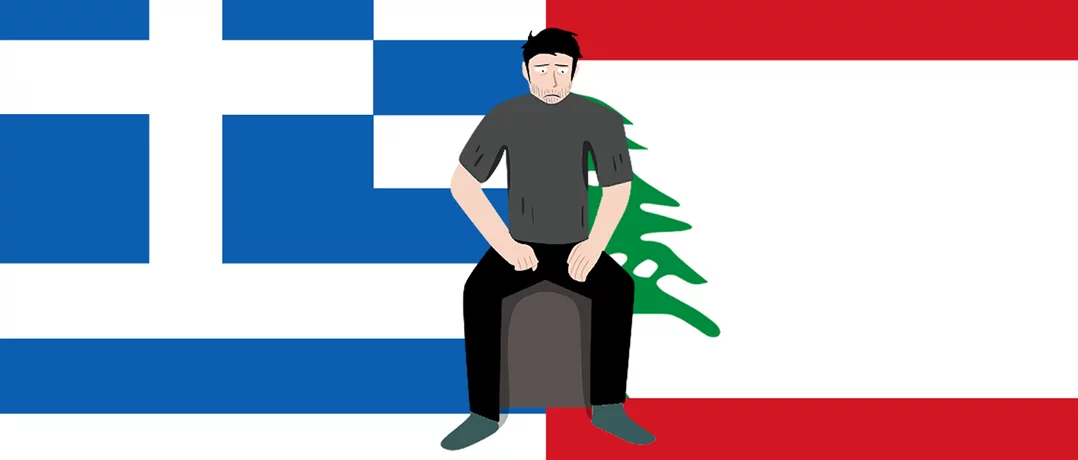
Illustration by Karim Dagher
If the Lebanese government is serious about emerging from its financial collapse, it must first address its public finance crisis, independently of the banking deposit issue. This effort can only be achieved by eliminating tax evasion, which in turn requires a clear political will that has so far been absent. Greece's experience offers an instructive case study.
Greece was once an outlier in Europe: a country largely shut out of financial markets, dependent on external support, and collecting too little tax revenue to finance public services and sustain economic growth. Today, however, it has become one of only five European Union member states running a primary budget surplus, meaning it collects more in revenue than it spends before interest payments on public debt are taken into account. The remarkable transformation highlights the extent of the country's fiscal progress and reflects, to a large extent, improved tax administration that has succeeded in closing tax compliance gaps and restoring fiscal credibility, one of the hidden drivers behind Greece’s broader economic recovery.
The International Monetary Fund’s latest annual report on the health of the Greek economy indicates that the country is well-positioned to withstand external shocks, including those stemming from the war in the Middle East. The primary surplus rose to nearly 5 percent of GDP in 2024–2025, while public debt as a share of GDP declined by roughly 65 percentage points from its 2020 peak. Financing conditions have also improved, with sovereign interest rate spreads, the premium investors demand to lend to the government, returning to levels not seen since the 2008 global financial crisis.
The reform program is not yet complete, but the scope and trajectory of Greece’s transformation offer valuable lessons for other countries seeking to overhaul their tax systems. The Greek experience underscores two key insights: First, governments cannot achieve meaningful fiscal reform unless taxation is credible, fair, and transparent. Second, building these capabilities may take time. In Greece, the reform took place in three integrated phases: stabilization (2010–2012), institution-building (2013–2017), and digital transformation (2018–2025), supported by the International Monetary Fund’s Capacity Development Program.
Stabilizing revenue
Facing the prospect of economic collapse, Greece sought financial assistance from what later became known as the “Troika”—the International Monetary Fund, the European Commission, and the European Central Bank. Early tax administration interventions focused on stabilizing revenue flows and laying the groundwork for deeper reforms. These measures included an anti-tax-evasion strategy, targeted programs to improve revenue collection from large taxpayers and high-net-worth individuals, and a medium-term reform roadmap.
Among the early successes was the digitization of VAT filing. By 2014, 96 percent of registered taxpayers were submitting VAT returns on time, compared with just 65 percent in 2010. Other initiatives, particularly efforts to strengthen collection from large corporations, wealthy individuals, and tax debtors, proved more difficult to sustain. Their mixed results exposed the limitations of reforms that failed to adequately address issues of governance and political interference
Building strong institutions
The second phase of Greece's reforms reinforced a critical lesson: tax administration reforms cannot deliver lasting results without independence, accountability, and effective leadership.
Beginning in August 2012, Greece consolidated its network of tax offices, reducing the number of local offices from 288 to 119 within a single year and reorganizing operations according to function rather than geographic location. As revenue collection improved, strengthening the political will needed to continue reforms, the next step was to grant the tax authority greater independence.
In 2016, a landmark law transferred responsibility for tax administration to a new independent authority with its own budget and governance framework. The law also stipulated the agency's board of directors and governor be selected through an open, merit-based process with clearly defined criteria. The Independent Authority for Public Revenue began operations in 2017, giving Greece a tax administration insulated from political interference and focused on measurable outcomes.
The impact was tangible. The tax-to-GDP ratio increased by 1.8 percentage points, from 25.8 percent in 2013 to 27.6 percent in 2017, improved tax compliance and enhanced institutional capacity.
Digitizing tax collection
Although digital tools had been introduced earlier, the decisive push came only after institutional foundations had been established. By this stage, the tax administration possessed the governance structures, technical expertise, and credibility necessary to ensure a comprehensive digital transition. Between 2020 and 2025, partly in response to the pandemic, Greece launched a series of digital systems, ranging from back-office analytics to real-time invoicing and integrated payment reporting systems.
These reforms made tax compliance easier for taxpayers and provided auditors with more precise tools to identify risks and direct enforcement efforts where they were most needed.
The results were clear: VAT compliance improved significantly, and VAT revenues rose by 2.4 percentage points of GDP over fifteen years, from 7.1 percent in 2010 to approximately 9.5 percent in 2025.
While Greece's experience is singular in certain respects, it demonstrates that rebuilding state capacity can gradually restore fiscal credibility. Lebanon would do well to study it closely.
-
-

-
The Beiruter
-
