



A tribute to the courage of Lebanese Red Cross volunteers, highlighting the death of paramedic Youssef Assaf and the growing dangers faced by medical teams responding to civilians during the ongoing conflict in south Lebanon.
Courage on the front lines

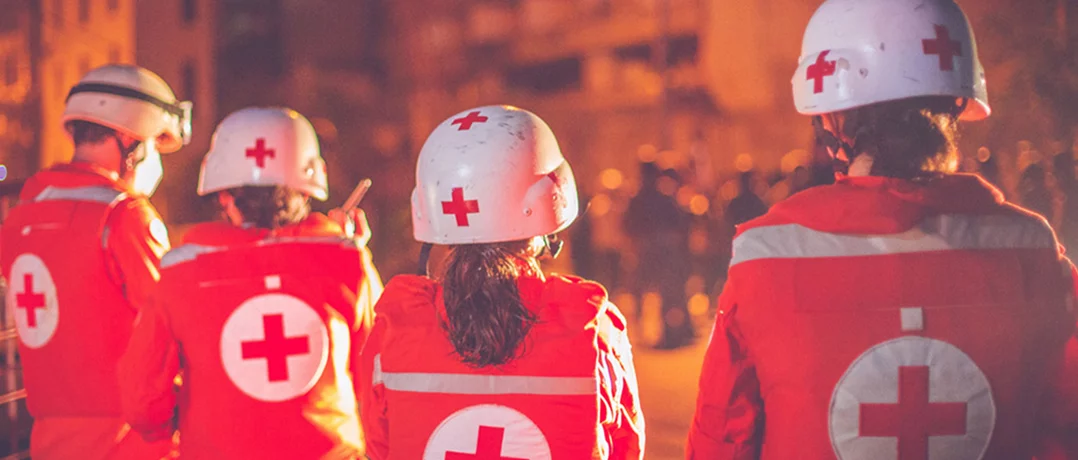
When the strike hits, most people run. It is the body’s oldest instruction, written into every human being who has ever heard the sound of incoming fire or felt the ground shift beneath a collapsing building. Run. Get away. Save yourself.
The Lebanese Red Cross volunteers do the opposite. They hear the same sounds, feel the same fear, and they get in the ambulance and drive toward it. The ambulance stops for anyone who is wounded. The volunteers do not ask your name or your religion or which side you are on. They stabilize, lift, and drive.
A presence across every crisis
During the civil war, they were there. During the Israeli invasions and the long occupation of the south, they were there. During the 2006 war, when southern Lebanon was bombed for thirty-four days and over a million people fled north, they were there. On the evening of August 4, 2020, when the port of Beirut exploded and shattered glass into the lungs of a city, the Red Cross was among the very first to arrive, entering collapsed buildings while the dust was still falling, reaching the wounded in streets where no one could yet see clearly.
The road to Majdal Zoun
In a statement received by The Beiruter, the Lebanese Red Cross confirmed the death of paramedic Youssef Assaf, who succumbed to wounds sustained while carrying out a humanitarian mission in south Lebanon. Assaf had been responding to victims after a location in the town of Majdal Zoun, in the Tyre district, was targeted on March 9.
He had volunteered at the Red Cross's Tyre center since June 27, 2025. In its statement, the organization described him as one of the paramedics who "carried the banner of humanity," dedicating himself to assisting the vulnerable and bringing reassurance to communities in times of both peace and conflict. The Lebanese Red Cross was unambiguous about what his death represents: the organization "affirms that paramedics and medical teams are not military targets and must be protected, both morally and in accordance with international humanitarian law, international conventions, and the resolutions of diplomatic conferences."
He was not a soldier. He was not a combatant. He was a paramedic, in a marked ambulance, on a humanitarian mission, and he was killed doing it.
Four more injured.
A source of the Lebanese Red Cross revealed to The Beiruter that "four paramedics were injured across two separate incidents. Two were wounded in Arnoun Al-Shaqif in Nabatieh, South Lebanon, while two others were injured on the night of the strike in Majdal Zoun, in the Tyre district." All of them had been present at the sites to transport injured civilians when they came under fire.
The Lebanese Red Cross emphasized that its ambulances were clearly marked with the Red Cross emblem on all visible sides, with illuminated insignia on the vehicles. As is standard practice for missions in the southern border areas, the organization had coordinated with UNIFIL forces to secure safe passage, and the International Committee of the Red Cross had been informed.
None of it offered protection. The organization responded with language that was careful in its precision and devastating in its implication: "the attacks on ambulance teams represent a clear and ongoing violation of international humanitarian law, UN conventions, and international conference resolutions, which stress the protection and neutrality of medical and relief teams operating in the field during armed conflicts."
The Red Cross called on all parties to ensure paramedics can reach the wounded, transfer them to hospitals, and return safely to their centers. It urged every state signatory to the Geneva Conventions of 1949 to exert pressure to enforce compliance. This is not a political statement. It is a legal one, grounded in some of the oldest rules of armed conflict. Medical personnel are protected. Ambulances are protected. Attacking them is not a grey area. It is a war crime.
What it means to volunteer
It is worth pausing on what it means, in Lebanon in 2026, to be a Red Cross volunteer in the south.
The Lebanese Red Cross will keep going. That is what it does. Tomorrow there will be another call, another strike, another road in the south that needs driving, and the volunteers will get in the ambulance and go, because someone has to, and because they have decided, each of them, that they are the ones who will. They deserve our gratitude. They deserve our outrage on their behalf. And they deserve, at the very minimum, the protection that the law has promised them and that the world has so far failed to enforce.
-
-

-
The Beiruter
-
