Lebanon’s Ministry of Culture launches “Culture Brings Us Together” to rebuild social cohesion through shared cultural spaces and activities during ongoing crisis.


Lebanon’s Ministry of Culture launches “Culture Brings Us Together” to rebuild social cohesion through shared cultural spaces and activities during ongoing crisis.

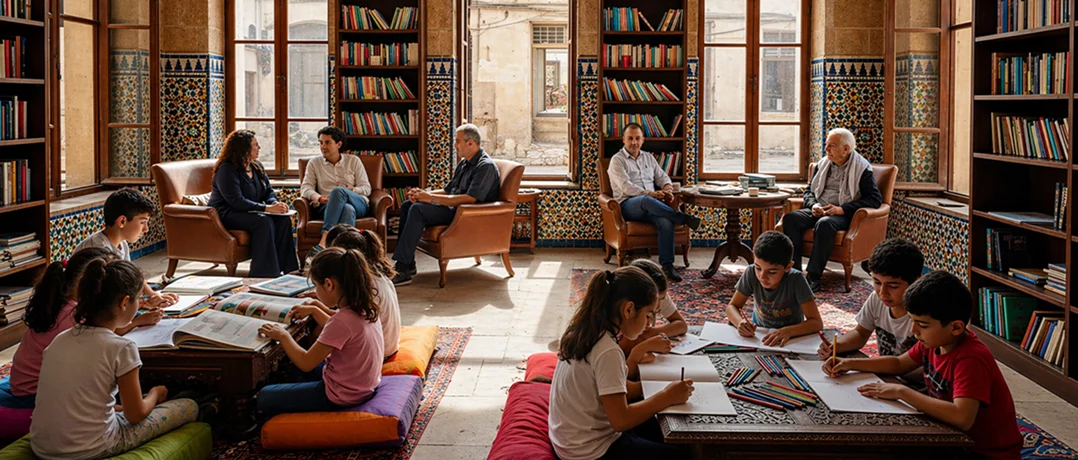
Lebanon’s Ministry of Culture has launched “Culture Brings Us Together,” an initiative designed to strengthen social cohesion across a country still navigating the wreckage of prolonged conflict. The program is an expansion of an earlier effort “Our Library Brings Us Together” which the ministry introduced at the onset of hostilities to establish public libraries and cultural activity centers as refuges for meeting, expression, and leisure across Lebanon’s regions.
The new initiative, the Ministry says, is not a departure from that work but its natural continuation. “What unites Lebanese people is greater than what divides them,” the source told The Beiruter. “Investing in culture is an investment in people, society, and their ability to recover and rebuild.”
Where its predecessor was grounded in public libraries, “Culture Brings Us Together” is built for broader ambitions. The Ministry says the initiative will extend to additional cultural landmarks and new spaces beyond libraries, accompanied by a wider range of programming. The explicit goal is to reach broader segments of society and, over time, to normalize culture as a fixture of daily life rather than an emergency measure activated by crisis.
To achieve that reach, the Ministry is coordinating with local community organizations, cultural and creative actors, public libraries, reading and cultural activity centers, and other cultural institutions across the country. The emphasis on local partnerships reflects a deliberate strategy: meaningful scale requires on-the-ground infrastructure, not centralized programming alone.
The programming planned under the initiative is deliberately varied, spanning age groups, interests, and immediate needs. Activities include storytelling sessions and book discussions, puppet theater, circus performances for children, art therapy, educational support, film screenings, craft workshops, and awareness programs centered on Lebanon’s cultural heritage.
The inclusion of art therapy and educational support signals an awareness of the acute needs still faced by children and families navigating the aftermath of conflict. Circus shows and puppet theater provide entry points for younger audiences. Film screenings and heritage programming speak to adult concerns of identity and collective memory questions that become charged, and consequential, in the wake of war.
Cultural initiatives rarely make headlines during a crisis. They are typically the first casualties of austerity, deprioritized when resources grow thin and the calculus of recovery narrows to the immediately material. Yet the Ministry’s framing points to something that research on post-conflict recovery has consistently demonstrated: social cohesion does not reconstitute itself spontaneously. It requires deliberate investment in shared spaces, shared experiences, and the encounters that remind people of what they hold in common.
Lebanon’s communities have absorbed successive rounds of displacement, loss, and communal strain. The risk in that context is not solely physical fragmentation. It is the slower, quieter erosion of the social fabric that makes recovery possible at all the trust, the familiarity, the sense of belonging to something larger than one’s immediate circumstances. Programs like this one create the conditions in which communities can begin to reconstitute themselves.
Whether “Culture Brings Us Together” delivers on that promise will depend on execution, on the durability of local partnerships, and on the Ministry’s ability to sustain momentum beyond the initial announcement. The aspiration, at least, is clear: to make culture not a luxury of peacetime, but a foundation for the work of rebuilding it.

