



Cyprus’s renewed push to acquire Israeli Merkava tanks reflects a broader shift away from Russian military equipment toward deeper defence ties with Israel, as Nicosia balances modernisation, deterrence and renewed negotiations over the island’s future.
Cyprus, Israel and the search for a new tank
Cyprus, Israel and the search for a new tank
By Nami El Khazen | August 24, 2026

Reading time: 5 min
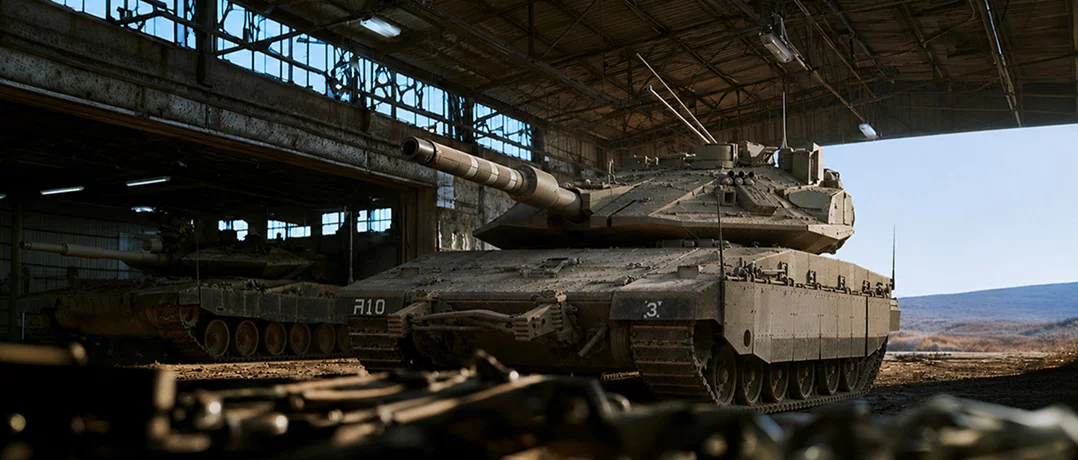
Cyprus appears to have settled on an answer to one of the most consequential questions facing its armed forces. As Nicosia looks toward the future of the National Guard’s armoured force, Israeli Merkava tanks have returned to the top of its list, with Cypriot media suggesting that efforts are underway at several levels to convince Israel to release them.
Why Nicosia keeps returning to the Israeli tank says more about the security environment Cyprus expects to face than any comparison of military specifications.
The Russian legacy
Cyprus’s reliance on Russian armour was not accidental. For decades, restrictions on American arms sales narrowed Nicosia’s options, while its position outside NATO left it freer than many European states to purchase equipment from Moscow. The relationship expanded considerably during the 1990s, with a military-technical cooperation agreement signed in 1996 allowing the Russian T-80s to become the backbone of the National Guard’s tank force.
The issue with those tanks today comes with keeping them running and operational. Russia’s war in Ukraine, Western sanctions and the wider collapse in relations between Moscow and Europe have made access to spare parts, ammunition and technical support increasingly difficult. For Cyprus, maintaining a Russian-built armoured force has consequently become more complicated and costly.
Replacing it is therefore becoming a matter of long-term practicality rather than preference. And when Nicosia began looking for an alternative, one of the most obvious possibilities came from much closer to home: Greece.
The Greek alternative falls short
Greece initially appeared to offer Cyprus a relatively straightforward way of strengthening its ageing armoured force. Talks between Athens and Nicosia considered the transfer of as many as 75 to 90 Leopard 1A5 tanks, a platform already operated by the Greek Army and one that could have brought obvious advantages in training and cooperation between the two countries.
But the proposal did not survive closer examination. In early June 2026, a Cypriot military delegation travelled to Greece to inspect the vehicles Athens was prepared to provide and returned unconvinced. The delegation concluded that the condition of those particular tanks meant they could not meet its requirements even as an interim solution. No transfer agreement followed.
With the most readily available Greek option effectively ruled out, attention once again shifted toward Israel and a tank Cyprus had already pursued before: the Merkava.
More than a tank deal
The Leopard’s rejection may have brought the Merkava back to the forefront, but it did not create Cypriot interest in the Israeli tank. As early as 2023, Cyprus and Israel were already holding discussions over the possible purchase of used Merkava Mk.3s.
There are many military reasons for that interest. The Merkava would give the National Guard a more modern platform with a strong emphasis on crew protection, an important consideration for a relatively small military whose trained personnel are not easily replaced. For Cyprus, whose land forces would operate under the shadow of a far larger Turkish military, survivability and the preservation of a relatively small pool of trained crews carry particular weight. But the specifications alone do not explain why Cyprus has kept returning to an Israeli solution.
Over the past several years, Israel has become an increasingly important defence partner for Nicosia. Cyprus has already acquired an Israeli air-defence system, the Barak MX missile system, which the government confirmed was fully operational in March 2025, while military cooperation has expanded alongside the broader relationship between Cyprus, Israel and Greece. At their latest trilateral summit, the three governments agreed to reinforce cooperation on defence, security and military affairs.
Such cooperation matters when purchasing something as important as a main battle tank. The decision creates a relationship with the supplier that can last for decades, covering training, maintenance, spare parts and future upgrades. In other words, Cyprus is choosing which countries it will depend on to keep its military operational.
Israel increasingly fits that role. It is geographically close, already works closely with the National Guard, and has become a regular defence supplier rather than an occasional one. The Merkava would deepen that relationship further, placing one of Cyprus’s most important land capabilities in Israeli hands for support throughout much of its service life.
The decision is Israel’s
Cyprus’s preference, however, is only half of the equation. Whether a Merkava deal moves forward ultimately depends on Israel, and there is still no indication that a final decision has been made.
The outbreak of war after October 7, 2023, changed the calculations in Jerusalem. Israel froze plans to export used Merkavas as tanks previously considered surplus were once again needed by the Israeli military. Three years later, that constraint has not entirely disappeared. Israeli operational requirements remain high, and recent Cypriot reporting suggests that there are divisions within the Israeli government over whether tanks should be released for export. Some officials reportedly support supplying Cyprus, while others want available Merkavas retained for the IDF.
That leaves Nicosia in an unusual position: the tank it increasingly wants may be available politically, but not necessarily militarily.
Arming for an uncertain peace
Cyprus’s renewed push to acquire Israeli Merkava tanks comes at a politically awkward moment. On August 26, Cypriot President Nikos Christodoulides and Turkish Cypriot leader Tufan Erhürman are due to meet under UN auspices as preparations continue for a new expanded conference aimed at reviving negotiations on the island.
Against that backdrop, a push to acquire Israeli main battle tanks is unlikely to go unnoticed. Erhürman has already criticised the Republic’s growing military ties with Israel and warned that decisions which deepen the island’s militarisation affect both communities.
Nicosia can counter that defence planning cannot simply be suspended whenever negotiations restart, particularly when Türkiye continues to shape the island’s military balance and has itself reinforced its posture in the north. Ankara deployed six F-16s and air-defence systems to northern Cyprus in March, saying further measures could follow if necessary.
Yet the push for stronger deterrence may not be entirely negative for the peace process. Security has long been one of the most difficult elements of any Cyprus settlement, particularly questions surrounding foreign troops, external guarantees and what would replace the existing military balance if reunification fundamentally altered the island’s security architecture. A Nicosia more confident in its own ability to provide for its defence could therefore feel less exposed when negotiating changes to those arrangements.
That confidence would matter most if talks eventually move from broad political formulas to the security provisions of an actual settlement. A National Guard that is better equipped and less dependent on ageing systems could reduce some of the uncertainty surrounding any future changes to external guarantees or the presence of foreign forces.
The effect should not be exaggerated. A few dozen tanks would not transform the strategic balance with Türkiye, nor would they determine the outcome of negotiations. But they could form part of a broader effort to give Cyprus greater confidence in its ability to provide for its own defence.
That may ultimately prove politically useful at the negotiating table, provided the same buildup does not convince the Turkish Cypriot side that Nicosia is preparing more seriously for continued division than for a settlement.
Cyprus’s search for a new tank therefore reaches well beyond the question of what should replace the T-80. The Merkava sits at the intersection of military necessity, changing defence partnerships and an uncertain political future. Nicosia is preparing for the possibility that the island’s division may endure, even as it returns to negotiations aimed at ending it.
-
-

-
Nami El KhazenJournalistFocusing on geopolitics and international affairs.
-
