Former U.S. Ambassador David Satterfield argues, in an exclusive interview with The Beiruter, that only bold political action not military force can weaken Hezbollah’s hold on Lebanon and restore the country's sovereignty.




Former U.S. Ambassador David Satterfield argues, in an exclusive interview with The Beiruter, that only bold political action not military force can weaken Hezbollah’s hold on Lebanon and restore the country's sovereignty.

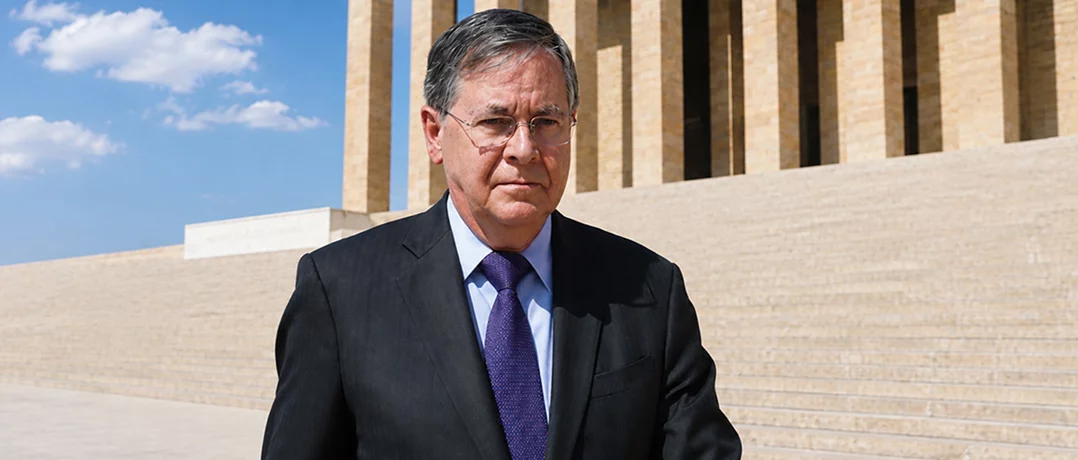
As the guns thunder once again along the Israel-Lebanon border, the world finds itself watching a familiar tragedy unfold. The cycle of violence - airstrikes, rocket fire, and diplomatic paralysis - has become a grim refrain for the Middle East. Yet the real crisis, argues Ambassador David Satterfield, is not just the violence at the frontier, but the stranglehold Hezbollah maintains over the Lebanese state. In a wide-ranging interview with The Beiruter conducted on June 2, 2026, Satterfield, former U.S. ambassador to Lebanon, a veteran of Middle East diplomacy, and now director of Rice University’s Baker Institute, offers a stark assessment of Lebanon’s predicament and the hard limits of military and diplomatic solutions.
Satterfield’s assessment is blunt:
Hezbollah’s literal death grip on the Lebanese people and the Lebanese political system continues.
For decades, Lebanon has struggled with internal instability. Still, Satterfield insists the country’s sovereignty crisis is unique a single, armed actor, backed by Iran, holds the state and its future hostage. Despite rare public denunciations by the Lebanese government and an unprecedented willingness among its leaders to see Hezbollah disarmed, the means to do so are simply not there. The risk of civil war, especially the fracturing of the Lebanese Armed Forces (LAF) along sectarian lines, makes any direct confrontation impossible.
No degree of Israeli actions or threats can force the Lebanese government to undertake something which it literally cannot physically do.
The tragedy, he says, is that even as Lebanese leaders express the desire to reclaim their sovereignty, their hands are tied. “Whatever the will may be and I think the will is considerable on the part of this government they wish to have Hezbollah disarmed. They don’t wish to have a non-state actor in defiance of Lebanon’s sovereignty after all these years, following the Taef agreement, the sole militia to retain its arms after 1990. Yet the government does not have the physical ability to confront and forcibly disarm Hezbollah.”
Satterfield is adamant that military action by Israel or others cannot deliver a sustainable solution. “Israeli military action, as an assessment, cannot do it on its own,” he says. The historical record is unambiguous. Time and again, Israeli airstrikes, buffer zones, and ground operations have failed to break Hezbollah’s hold. “History does not repeat itself, but it does rhyme. In the case of Israeli military action in Lebanon, sadly, it is not rhyming. It is repetition,” he remarks, echoing Mark Twain.
Hezbollah’s entrenchment politically, militarily, and economically renders military options ineffective. “Hezbollah retains a significant capacity to hit. So does Iran. Despite years of Israeli and international efforts, their ability to inflict pain remains undiminished,” Satterfield warns. He is dismissive of claims that Hezbollah has been meaningfully degraded, arguing that the group’s deep integration into Lebanon’s state and society makes it immune to outside force.
He elaborates: “The same tactics with the same ostensible objectives have been tried many times over the last half century. Those efforts have not succeeded. Only diplomatic negotiations have brought to a close the various engagements that Israel has attempted.”
If force cannot succeed, what can? Satterfield lays out a stark but clear path:
A political resolution, a framework in which Hezbollah’s legitimacy, its claim that it is alone the protector, the guardian of Lebanon, were reduced to the minimum.
He outlines a process that would require the Lebanese government to take the unprecedented step of going “over the head of Hezbollah, over the head of the Israeli government,” and declare an end to the state of war [with Israel], define a formal international border, and eventually commit to a formal peace agreement, contingent on full Israeli withdrawal. These steps, Satterfield argues, would undercut Hezbollah’s last standing justification for keeping its arms.
But he is frank about the risks. “Hezbollah will murder, Hezbollah will kill to preserve its position,” he warns. “They won’t kill the Prime Minister or the president. They don’t have to. There will be others.” The implication is chilling: progress is possible only with “enormous courage” from Beirut, and direct, top-level U.S. engagement not just with Lebanon, but with Israel as well. “That is the tragic reality of Lebanon,” Satterfield says.
Satterfield is adamant: only the direct engagement of the U.S. president can drive a diplomatic breakthrough. “It will require the President of the United States; no one subordinate to him will suffice to directly drive and shape this process. Not just with Lebanon, but with the government of Israel.” The Trump administration, he notes, faces a delicate balancing act: deterring further escalation while not emboldening Hezbollah or Iran.
Yet, even with American backing, the obstacles are immense. Lebanon’s entrenched elites and economic crises would persist even if Hezbollah’s influence vanished overnight. “The challenge is not just Hezbollah, but also Lebanon’s entrenched elites and unresolved economic crises problems that would remain even if Hezbollah’s influence vanished overnight,” Satterfield cautions.
He is clear-eyed about the limits of American power. The U.S. can offer political and material support, set clear expectations for Israeli behavior, and attempt to empower Beirut. But Washington cannot wish away Lebanon’s internal divisions or the willingness of some actors to use violence to protect their power.
Satterfield is clear that the problem is not Hezbollah as a Shia party, but as an armed, sub-state organization. “The rest of the world now finally makes no distinction between the so-called political wing of Hezbollah and the military terrorist wing. They are the same thing, precisely. But it is important to note that Hezbollah, as a Shia political party, is not the target here. It is this armed sub-state, sub-national entity with its...death grip over the people of Lebanon.”
Hezbollah’s refusal to become “just another Shia political party like Amal” ensures its continued defiance of the Lebanese state and the international order. Its external loyalties to Iran, above all mean that Lebanon’s sovereignty is fatally compromised.
Some in Washington and Tel Aviv have floated the idea that Lebanon could join the Abraham Accords, normalizing relations with Israel as the UAE, Bahrain, and Morocco have done. Satterfield is realistic, if not dismissive. “You have to jump over Hezbollah’s heads and the heads of the government of Israel to take these dramatic steps. Knowing it’s very, very hard to do, it will take enormous courage.”
He continues: “With Lebanon and Israel agreeing to an international border, the justification for liberation goes away. You then make the commitment this is the hardest step to a formal peace between Lebanon and Israel, but a peace which will not come into place until there is full Israeli withdrawal behind the agreed international border.”
Despite Lebanon’s crises, Satterfield pushes back against the “failed state” label. “Lebanon, in recent years, has emerged as far more of a real state, a modern state, than at any point in the long decades that preceded the last 10 or 15 years,” he asserts. But that sovereignty is ultimately hollow so long as Hezbollah retains its arms and its Iranian patronage.
Even if Hezbollah’s grip were broken tomorrow, the obstacles would remain immense. Lebanon would still face a “fundamental national crisis which has nothing to do with Hezbollah. It has everything to do with the elites of Lebanon... the financial crisis, the banking crisis, the self-serving, self-interested character of the banking sector in Lebanon.” In other words, Hezbollah is the central obstacle to sovereign decision-making—but not Lebanon’s only crisis.
For all his realism, Satterfield ends on a note of qualified hope. “I’m hopeful. I’m not pessimistic,” he says. Still, the Lebanese people’s resilience endures, even in the face of overwhelming adversity. As Lebanon stands at a crossroads, the stakes could not be higher: the country’s future depends on whether its leaders and their international partners can summon the collective courage and vision needed to break free from Hezbollah’s grip and restore true sovereignty.
“There is no other way to begin tackling Hezbollah except these steps, which will require enormous courage,” Satterfield concludes. For Lebanon, and for U.S. policy, the alternative is more of the same: a cycle of violence with no exit in sight.
