



By backing away from tariffs and ruling out force over Greenland, Trump eased immediate tensions with Europe, even as his sharp criticism exposed deeper strains in transatlantic relations.
Davos defuses US-EU tariff showdown

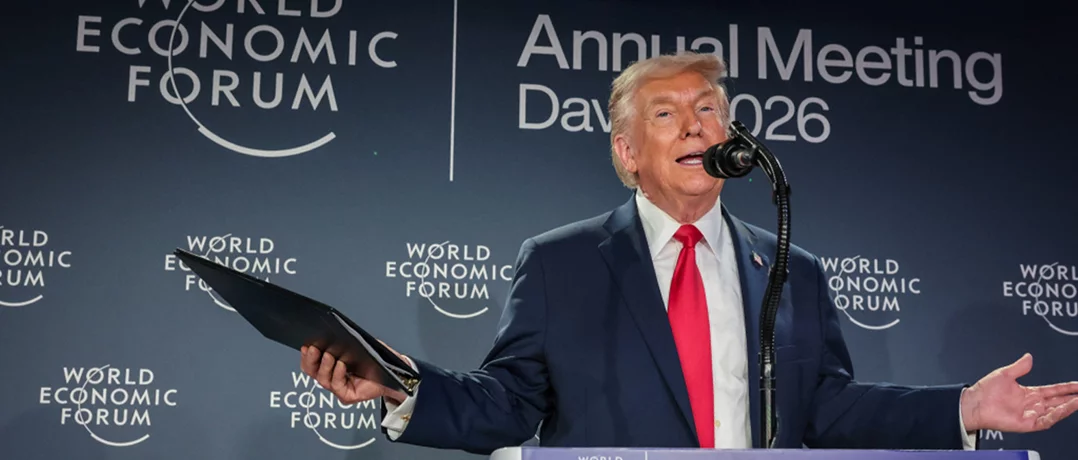
United States (US) President Donald Trump’s latest remarks on Greenland, delivered during a high-profile appearance at the World Economic Forum (WEF) in Davos, Switzerland, initially unsettled European leaders, who were bracing for a potential trade war and an unprecedented dispute over Greenland.
Yet, amid the sharp rhetoric, 2 elements ultimately eased tensions: Trump’s decision to back away from threatened tariffs and his explicit pledge not to use military force to acquire the Arctic territory. These moves helped defuse an escalating crisis, even as his broader criticism of Europe and its leaders underscored the fragility of transatlantic relations.
Easing the tariff showdown
Before Davos, Washington’s threat to impose tariffs on Denmark and several other European countries had raised fears of a new trade confrontation. The proposed levies, tied directly to negotiations over Greenland, were seen in Brussels as an attempt to use economic coercion against close allies. Markets reacted nervously, and European governments prepared retaliatory measures.
That standoff eased dramatically after Trump announced that the tariffs would be put on hold following discussions with North Atlantic Treaty Organization (NATO) Secretary General Mark Rutte. Trump framed the decision as part of progress toward a future framework on Arctic security, suggesting that dialogue within NATO had offered an alternative to economic pressure. The tariff pause was widely welcomed in Europe as a necessary step back from a damaging escalation and a sign that diplomacy could still prevail over brinkmanship.
Ruling out the use of force
Even more significant was Trump’s explicit statement that he would not use military force to take Greenland. This marked the first clear rejection of a military option after months of ambiguity. For European officials, the declaration was a critical reassurance at a time when the mere suggestion of force against a NATO-linked territory had threatened to undermine the alliance’s foundations.
While Trump maintained that Greenland is vital to US national security, his pledge reduced fears of a dramatic rupture within NATO. It also eased pressure on Denmark, which has consistently rejected any transfer of sovereignty while remaining open to discussions on security cooperation in the Arctic.
NATO’s role in de-escalation
NATO emerged as a central stabilizing factor. Trump linked his softer stance to ongoing alliance discussions, hinting that expanded US military cooperation in the Arctic could address American concerns without altering borders. Secretary General Mark Rutte publicly reaffirmed NATO’s commitment to collective defense, a reassurance Trump has frequently questioned.
The sequence of events, alliance assurances followed by the tariff reversal, reinforced the view in Europe that multilateral engagement, rather than unilateral pressure, helped pull the situation back from the brink.
A harsh critique of Europe and its leaders
Despite these de-escalatory steps, Trump’s speech was laced with sharp criticism of Europe and its political leadership. He accused European governments of taking advantage of the United States, questioned their ability to manage security and migration as well as suggested that parts of the continent were no longer recognizable due to misguided policies.
Trump also openly doubted Europe’s willingness to defend the United States if it were attacked, a remark that struck a nerve in capitals where NATO solidarity is treated as untouchable. His comments ignored the fact that the alliance’s collective defense clause has been invoked only once, and that was in support of the US after the September 11 attacks.
Personal criticism against European leaders and historical grievances further strained the atmosphere. For many officials listening, the tone reinforced concerns that Washington’s approach to Europe under Trump is increasingly transactional and dismissive, even when substantive compromises are reached.
Trump’s Davos speech delivered mixed signals, but its immediate impact was unmistakably calming. By easing the tariff threat and ruling out the use of force, the US president reduced the risk of an economic or military confrontation with Europe over Greenland. Yet his sweeping criticism of European leaders and institutions ensured that underlying tensions remain unresolved. For Europe, the episode offered both relief and a warning: while escalation can be avoided, the transatlantic relationship remains vulnerable to sudden shocks driven by rhetoric as much as policy.
-
-

-
The Beiruter
-
