



In an exclusive interview with The Beiruter, Ronnie Chatah analyzes Lebanese President Joseph Aoun’s historic White House visit and what it could mean for Lebanon.
Decoding Aoun’s historic Washington visit

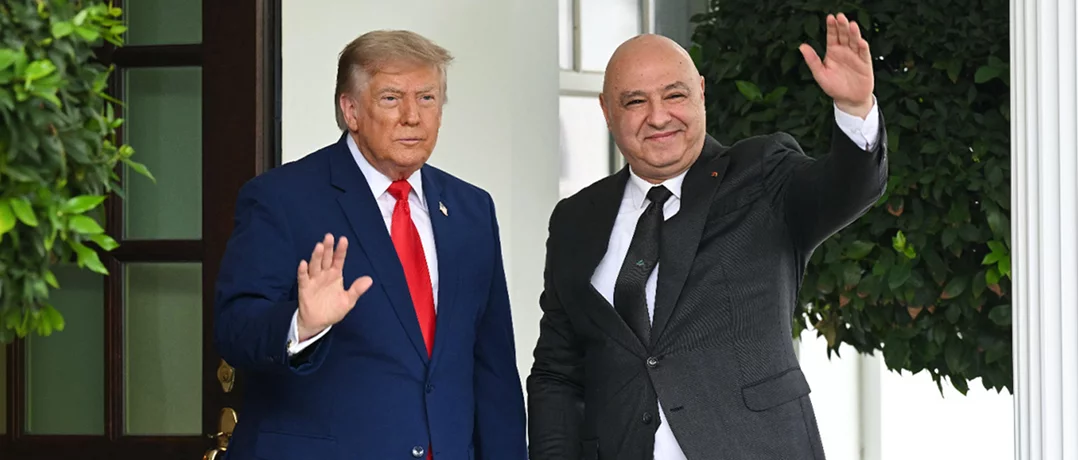
Lebanese President Joseph Aoun’s official visit to Washington marked a rare and highly symbolic moment in Lebanese-American relations. As the first Lebanese president to be formally received at the White House since 2009, Aoun was welcomed by United States (U.S.) President Donald Trump with unusually warm public praise, describing him as “respected by everyone” and suggesting he could become “one of the best leaders in the Middle East.”
In an exclusive interview with The Beiruter, political analyst Ronnie Chatah assessed the diplomatic significance of the visit, its domestic implications, and what it may, or may not, signal for Lebanon’s future.
Reasserting Lebanon’s diplomatic voice
According to Chatah, the visit’s greatest significance lies in the fact that the Lebanese state itself is once again directly representing its national interests before Washington.
He argued that, for the first time in years, Lebanon was speaking to the U.S. through its own constitutional institutions rather than through regional intermediaries or external powers.
The positive aspect is that the Lebanese president himself is directly discussing Lebanon’s national interest with the U.S. president.
Chatah explained that “not long ago, there was serious concern that regional actors, particularly Iran, would effectively negotiate Lebanon’s future instead. This meeting demonstrates that the Lebanese state has regained at least part of that role.”
He also noted that the composition of both delegations reflected a different strategic mindset than in previous eras. Unlike earlier periods, when preserving the status quo often meant tolerating armed non-state actors in the name of stability, today’s diplomatic and military representatives acknowledge that sustainable stability requires addressing the issue.
Earlier leaders defended the status quo. Today, there is recognition that lasting stability cannot coexist with weapons outside the authority of the state.
Chatah pointed to President Aoun’s own remarks regarding Palestinian armed groups in southern Lebanon before the civil war as evidence that the current leadership is framing security differently than many of its predecessors.
Prioritizing dialogue and lasting ceasefire
One of Chatah’s key observations focused on the objectives of Lebanon’s current leadership.
He rejected characterizations portraying President Aoun and Prime Minister (PM) Nawaf Salam as pursuing an explicitly anti-Hezbollah agenda. Instead, he believes their immediate priority is securing a durable ceasefire rather than entering into direct confrontation.
In his assessment, even Hezbollah itself has demonstrated interest in avoiding renewed conflict, making a long-term ceasefire an objective that multiple parties may ultimately support.
At the same time, Chatah drew a clear distinction between maintaining a ceasefire and resolving Lebanon’s long-standing question of Hezbollah’s weapons. While dialogue appears to be the preferred approach, he stressed that there is currently no indication that the Lebanese leadership intends to pursue forced disarmament. “I do not think we are there,” he noted, adding that President Aoun continues to favor dialogue and coordination over confrontation.
Berri’s position and the limits of domestic political consensus
President Aoun’s remarks suggesting that Parliament Speaker Nabih Berri supports the ongoing diplomatic efforts also attracted considerable attention.
Chatah believes these statements should not be interpreted as evidence of a major political breakthrough. While acknowledging that Berri’s cooperation is essential for any lasting political settlement, he described the public exchanges between the two leaders as largely diplomatic courtesy rather than indicators of substantive policy shifts.
Berri may publicly express reservations while privately supporting a ceasefire. If he opposes any issue, it is very difficult for it to happen in Lebanon.
However, he argued that the more difficult issue remains Hezbollah’s military role. “The real question is not whether Berri supports a ceasefire, but whether Lebanon can eventually separate itself from Iranian influence and find an arrangement regarding Hezbollah’s weapons that serves Lebanon’s national interest,” he said. Until that issue is addressed, Chatah believes Lebanon’s internal political balance will remain fundamentally unchanged.
Trump’s Syria comments: American pressure or policy?
Aside from Aoun’s comments, Trump’s suggestion that Syria could potentially play a role in Lebanon’s security also generated widespread debate.
Chatah dismissed the comments as rhetorical pressure rather than a serious policy proposal. He argued that, “fortunately,” neither Beirut nor Damascus has any interest in such a scenario and suggested that many officials within Washington itself would oppose the idea.
If this were ever implemented as actual American policy, it would rank among the biggest strategic mistakes in modern Middle Eastern history.
Instead, Chatah interpreted the comments as characteristic of Trump’s negotiating style: using provocative statements to increase pressure without necessarily intending to implement them.
The real test begins at home
Despite viewing the meeting positively, Chatah cautioned against exaggerating its immediate impact.
He stressed that while diplomatic symbolism matters, the difficult political questions remain unresolved. “It is still very early to know whether the pilot security arrangements will succeed, how Hezbollah will evolve over the coming months or years, or whether Israel will be prepared to complete its withdrawal,” he said.
For Chatah, these unanswered questions mean that much of the visit should currently be viewed as diplomatic positioning rather than a decisive turning point.
Joseph Aoun and Donald Trump can say many things, but at the same time nothing may happen. It is still far too early to judge the outcome.
Furthermore, the announcement regarding the resumption of direct flights between the U.S. and Lebanon falls into the same category. Although welcoming the move as a positive and promising gesture, Chatah argued that it remains largely symbolic.
He acknowledged that both developments carry symbolic value but argued that international confidence ultimately depends on Lebanon’s domestic stability rather than diplomatic optics. In his view, restoring security, reinforcing state authority, and reducing regional tensions would do far more to encourage Gulf investment and international engagement than reopening direct air routes. He even suggested that affordable regional connectivity for ordinary Lebanese citizens, from northern Lebanon to Europe, could ultimately prove more economically valuable than expensive direct flights to New York.
Moreover, Chatah explained that restoring direct air links requires significant technical and security preparations that Lebanon has yet to complete. More importantly, he argued that improved aviation links alone do not address Lebanon’s deeper political and security challenges.
Lebanese already travel back and forth. The flights are welcome, but they are not the story.
In this context, Chatah also recalled his father Mohamad Chatah’s role in an earlier chapter of Lebanese-American relations. He noted that in the late 1990s, when his father served as Lebanon’s ambassador to Washington, Beirut successfully lobbied the U.S. to lift restrictions that had effectively discouraged American citizens from traveling to Lebanon. For Chatah, that experience illustrates an important lesson: meaningful progress comes when Lebanon takes the initiative rather than waiting for Washington to act.
The Lebanese pushed for it, and it worked in lifting the travel ban so that Americans could actually visit Lebanon again.
He argued that while American goodwill and symbolic gestures are welcome, they cannot substitute for domestic reforms and a clear national strategy. The responsibility for restoring Lebanon’s stability and international standing ultimately rests with the Lebanese state itself.
We need Lebanon to work for its own sake.
Hence, in Ronnie Chatah’s view, President Aoun’s successful White House visit should be measured not by the warm reception it received in Washington, but by whether Lebanon can translate diplomatic momentum into concrete reforms and lasting stability at home. It should be viewed as the beginning of a process rather than its conclusion.
-
-

-
The Beiruter
-
