



From Monroe to Shield of the Americas, hemispheric defense has expanded from territorial security to economic, technological and strategic autonomy.
Defending the Hemisphere: from Monroe to Shield of the Americas
Defending the Hemisphere: from Monroe to Shield of the Americas
By Nami El Khazen | September 29, 2026

Reading time: 6 min
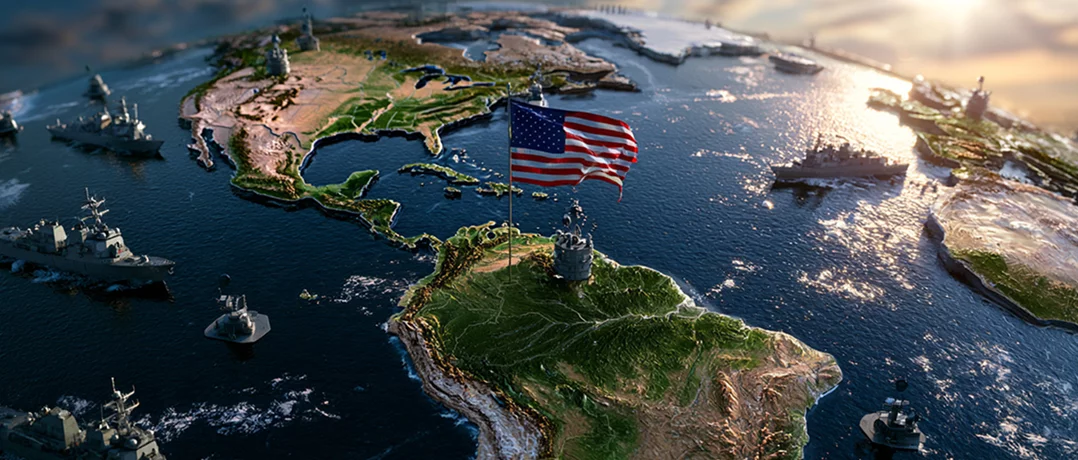
“The largest and most powerful alliance for economic and national security ever to convene in the Western Hemisphere.”
That was how President Donald Trump described Shield of the Americas as leaders and senior officials from across the region gathered in New York on 22 September. By the end of the meeting, the United States and fourteen Latin American and Caribbean governments had issued a Joint Statement on Defending Hemispheric Sovereignty, committing themselves to a new framework spanning economic, security and diplomatic cooperation.
The declaration raised a deceptively simple question: what does it mean, in 2026, to defend the Western Hemisphere? It is a question with roots stretching back nearly two centuries.
Inventing the strategic hemisphere
In 1823, American president James Monroe warned European powers against further colonization or intervention in the newly independent states of the Americas. The doctrine rested on a basic division: European powers were not to establish new colonies or impose political control over independent American states, while the United States would avoid involvement in European political conflicts and leave Europe's existing colonies in the Americas untouched. It was not an alliance or a collective security arrangement, but a unilateral American declaration that treated Europe and the Americas as separate political spheres.
President Theodore Roosevelt added another dimension in 1904. His Roosevelt Corollary argued that if instability, debt crises or “chronic wrongdoing” in a Latin American state risked inviting European intervention, the United States could intervene itself. Rather than allowing European powers to use such crises as a reason to establish a foothold in the hemisphere, Washington claimed an international police power to address them first.
The Second World War pushed the idea in another direction. Hemispheric security could no longer rest solely on a unilateral American declaration. In 1945, the Act of Chapultepec established the principle that aggression against one American state concerned the others, laying the groundwork for a permanent collective system.
Two years later, the Rio Treaty formalized that principle. It declared that an armed attack against one American state would be considered an attack against all and committed the parties to assist in meeting it. But it did not require an automatic military response. States could determine their immediate actions individually, while collective measures were decided through consultation, with no member compelled to use armed force without its consent.
When the threat changed
The system created in Rio was soon tested by threats more complicated than a conventional attack on one American state.
The Cold War brought a major expansion in practice. During the Cuban Missile Crisis in 1962, the Organization of American States acted under the Rio Treaty to demand the removal of Soviet offensive weapons from Cuba and authorized member states to take measures preventing further deliveries. Hemispheric defense was now being applied to the military presence of an outside power within a Latin American country, rather than to the invasion of one.
Twenty years later, the Falklands War exposed the system’s limits. Argentina invoked the Rio framework after Britain moved to retake the islands, arguing that it faced action by an extra-continental power. Washington rejected that interpretation and ultimately supported Britain, maintaining that British action did not constitute the type of aggression covered by the treaty. The decision badly strained U.S. relations with much of Latin America, where many governments saw it as a breach of hemispheric solidarity.
The definition of a common threat widened further after the Cold War. Following the September 11 attacks, Rio Treaty members declared the terrorist attacks on the United States to be attacks against all American states and pledged assistance against the networks responsible. The aggressor was no longer another state at all.
In 2019, the treaty was activated again over Venezuela. The resulting measures focused on identifying individuals linked to alleged corruption, money laundering and organized crime and facilitating financial and legal action against them.
Across these episodes, hemispheric defense was gradually being applied to a wider range of dangers: extra-continental military threats, terrorism, regional security crises and transnational networks.
Sovereignty beyond territory
Shield of the Americas pushes that evolution further. Its September declaration calls for strengthening the “resilience of the Western Hemisphere” through three pillars: economic security, security cooperation and multilateral coordination. What stands out is how much of the framework concerns areas that once sat outside the traditional definition of hemispheric defense.
The economic pillar calls for investment-screening mechanisms, diversified and reliable sourcing of critical minerals and “trusted supplier” regulations for digital infrastructure. It also declares that economic sovereignty is defended when capital entering a country is “transparent and verifiable.” Strategic vulnerability, in this framework, does not require the loss of territory. Dependence on particular suppliers, infrastructure or sources of investment can itself become a security concern.
The security pillar commits governments to defend democratic governance against “armed narco-terrorist networks” through coordinated sanctions, designations, financial measures and expanded civilian law enforcement. The first joint action targets 24 organizations, including MS-13 and Tren de Aragua, alongside the Sinaloa Cartel, CJNG, the ELN and others. Participants also intend to ask the Organization of American States to convene the Rio Treaty’s consultation mechanism to facilitate collective action against these groups.
The third pillar extends cooperation into diplomacy, committing governments to coordinate shared objectives in multilateral institutions, including international enforcement against transnational criminal organizations and proposals for institutional reform.
Together, these pillars broaden hemispheric sovereignty beyond territorial defense. Strategic autonomy now also depends on who finances infrastructure, supplies critical resources, controls technological networks and operates across national borders.
Building the framework
The September declaration did not emerge in isolation. In the weeks before the New York meeting, Washington was already using bilateral diplomacy to build many of the security and economic relationships that Shield would bring together under a regional framework.
During Marco Rubio’s 8–10 September tour of Colombia, Ecuador and Peru, counternarcotics cooperation and transnational crime dominated the security agenda. In Ecuador, Washington announced plans for $45 million in additional security assistance and new maritime capabilities. In Peru, President Keiko Fujimori announced that her country would join Shield, arguing that membership would allow faster intelligence sharing against criminal organizations operating across borders. The announcement came just twelve days before Peru joined the other governments in New York.
The economic agenda was taking shape at the same time. During Rubio’s stop in Colombia on 8 September, the two governments signed a critical-minerals framework covering mining, processing, geological mapping, investment and the diversification of supply chains, alongside a separate agreement on civil nuclear cooperation. The State Department described the arrangements as part of efforts to restore the U.S.-Colombia relationship as a linchpin of security and economic cooperation in the Western Hemisphere.
Those bilateral agreements effectively provided some of the building blocks for what was formalized regionally on 22 September: cooperation against transnational criminal organizations alongside investment screening, critical-mineral security and trusted digital infrastructure.
The remaining question is whether these individual partnerships can be connected into a durable hemispheric system. Shield now provides a common framework, but its significance will depend on whether governments coordinate the security, economic and diplomatic policies operating beneath it. If that coordination takes hold, hemispheric defense will have evolved from guarding the Americas against outside intervention into preserving strategic autonomy within an increasingly interdependent region.
-
-

-
Nami El KhazenJournalistFocusing on geopolitics and international affairs.
-
