

Ai and technology breakthroughs have made their way into dentistry and the individuals who are falling in line.
Dental care in a new veneer: AI and the new patient experience
Dental care in a new veneer: AI and the new patient experience
By Grace Massoud | February 13, 2026

Reading time: 3 min
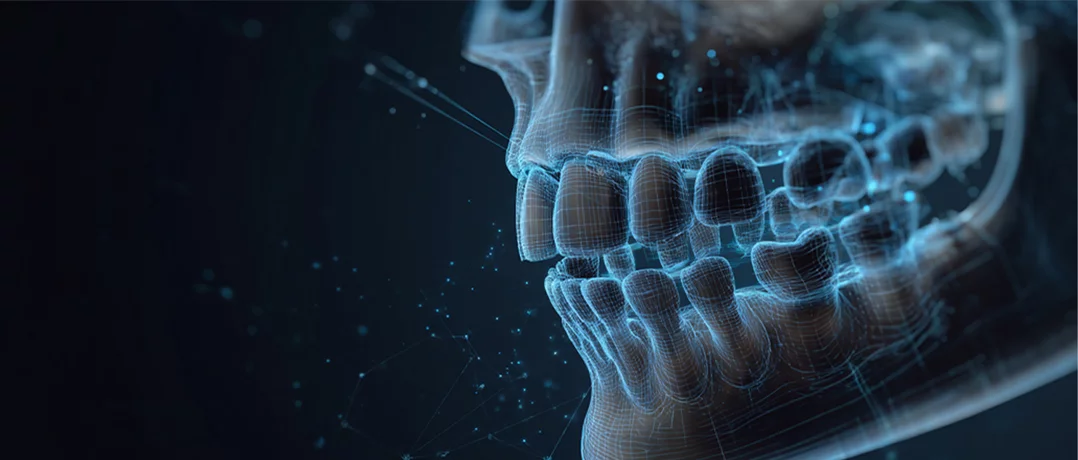
Artificial intelligence has begun to insinuate itself into dentistry with an almost inevitable quality. It does not replace the dentist so much as sit beside him or her, an attentive, unsleeping assistant, parsing images, flagging anomalies, and refining judgment. In a profession long dependent on the trained eye and steady hand, AI introduces something new: pattern recognition at scale.
Consider diagnostics. Algorithms now examine X-rays, cone-beam scans, and intraoral photographs, identifying cavities, fractures, and early periodontal disease with a consistency that tempers human oversight. Companies such as Overjet and Pearl have built systems that highlight potential problem areas, inviting the clinician to confirm, or contest, the machine’s assessment.
Prediction, too, has entered the equation. By analyzing medical histories and microbial data, AI models attempt to forecast gum disease or decay before they advance beyond repair. In orthodontics, firms like Align Technology use artificial intelligence to simulate tooth movement and refine aligner treatment plans, turning approximation into choreography.
In fact, some other subtler changes are no less consequential. Automated charting and voice recognition reduce clerical drag; AI-integrated scanners collaborate with 3D printers to design crowns and surgical guides with uncanny precision. Chatbots dispense aftercare instructions. Remote image analysis expands tele-dentistry, allowing preliminary consultations to occur far from the clinic’s fluorescent glow.
The cumulative effect amounts to recalibration. Dentistry is edging towards the preventive and the predictive. The human touch remains indispensable, nonetheless accompanied by a second gaze, tireless and algorithmic. Hence, oral health has taken on a new veneer, pun intended.
The algorithmic turn in dentistry has sharpened diagnostics and slowly but surely redrawn the boundaries of the industry itself. As care becomes predictive and digital, the notion of who participates in molding oral health is expanding. What was confined to the operatory now extends into branding, user experience and consumer trust. It is within this broadened terrain that ECLA Smile took root.
Omar Bsaibes and Wafic Medawar made it to the Forbes 30 under 30 list in co-founding ECLA Smile, a dental whitening brand partnered with over 150 clinics. The company has amassed an annual revenue close to $700,000 in 2025.
“It was a moment of immense pride and validation for the hard work we’ve poured into ECLA Smile. Building a consumer brand in a challenging market isn't easy, and this recognition belongs as much to the team as it does to us”, says Omar.
The most valuable asset
"I understood that time is the most valuable asset”.
Growing up, Omar’s father was his first and sturdiest role model. “From as early as I can remember, he was clear about one thing: he would never work for someone else”. He believed in investing his time in himself, building something of his own, and creating long-term value rather than trading his years for someone else’s vision.
Working in construction and real estate, Omar’s father created things that lasted. Omar got a front-row seat to the responsibility, the pressure, the risk, and the discipline that came with the career.
What stood out most was resilience. He saw him show up every day, solving real problems, carrying heavy responsibility, and staying the course regardless of unfavorable conditions. There were no shortcuts. Just consistency, accountability, and ownership.
Dental care as necessity
The moment they realized dental care was being treated like luxury was when the partners decided to build a brand in this space. Either people go to the dentist and overpay, or they ignore it completely, not paying much heed to oral hygiene. There was nothing in between that felt credible, well designed, and accessible. “Coming from architecture and design, I saw how badly healthcare brands underestimated aesthetics and user experience. I didn’t want to “sell whitening”, admits Omar. “I wanted to normalize self-care in a way that feels modern, safe, and part of everyday life”.
From personal experience, the two partners have learned to quickly adapt to changes in a country that has upheavals woven into its identity.
Seeing how quickly circumstances can change taught me not to take stability for granted. It shaped my mindset.
Being young entrepreneurs, they faced many challenges that tested their patience. They learnt that leadership is staying calm when everything is unstable. True leadership is about taking responsibility publicly and privately. When things work, the team shines. When things fail, it’s on them.
A blatant attack
At one point, they faced a challenge that tested their business and their values.
A renowned dentist chose not to work with their brand at a time when it was becoming increasingly popular. More people were whitening their teeth at home, and some dentists felt threatened.
Instead of viewing this shift as an opportunity to evolve with the industry, this particular dentist chose confrontation, launching a public smear campaign against them.
He attacked ECLA Smile directly across social media, even targeting one of the models featured in a campaign video. Instead of taking legal action, responding publicly and aggressively, or escalating the matter to the Order of Dentists in Lebanon, they chose restraint. Despite harmful repercussions, like loss of approximately one hundred thousand dollars in revenue and momentum, they chose the high road, refusing to give credit to what was clearly a bid for attention.
They addressed the matter privately and professionally where necessary. Despite the aggressive attack, the brand continued to grow exponentially over the years.
They won by staying calm, focused, and silent when it was the harder yet wiser choice.
A solid partnership
Disagreements being an inevitable evil in any partnership, different perspectives are bound to collide, signaling both parties are genuinely invested in the outcome.
Over time, they built a simple system. They listen, break everything down, then brainstorm openly. Then they step back and ask one question: “What is the most logical decision for the company?”
Logic always comes before emotion, and the company before personal positioning.
“When logic wins over ego, progress becomes inevitable”, says Wafic.
“The most important quality an entrepreneur needs is resilience. Not motivation. Not ideas. Not even talent. Because all of those disappear the moment things go awry”, affirms Omar.
What matters is the reaction when the odds are stacked against you.
The defective batch issue with ECLA Smile was one such instance. They had already paid for production, shipments were split, and some units had reached customers, when they realized they had a problem with supplier quality. They had a tough call to make, either ignore the matter and keep business as usual, or take full responsibility.
They ceased sales, handled customer complaints, absorbed the losses, and paid the team out of pocket. They spent months dealing with the situation, protecting the brand’s credibility, even though it cost time, money, and momentum.
Brands are not built when everything is going well. They’re built when things go wrong and you still choose to do the right thing.
The real superpower
That experience reinforced what resilience meant to them. A man who has accompanied them from the very beginning of their journey in entrepreneurship put it perfectly. “Unstable markets produce the strongest founders”, says Jad Al Fakhani, also known as Wolfofbey. They learnt to adapt and execute faster, and survive without safety nets, building a superpower called resilience. With that mindset firmly in place, these young Lebanese entrepreneurs have their sights on leaving their mark on the construction, real estate, and automotive industries.
-
-
-
Grace MassoudWriter and Head of PRFocusing on general entertainment.
-
