



In its simplicity and authenticity, a short film struck a chord with international audiences.
Director Joseph Hanna’s stroke of genius with a Jacquemus dust bag
Director Joseph Hanna’s stroke of genius with a Jacquemus dust bag
By Grace Massoud | April 07, 2026

Reading time: 4 min
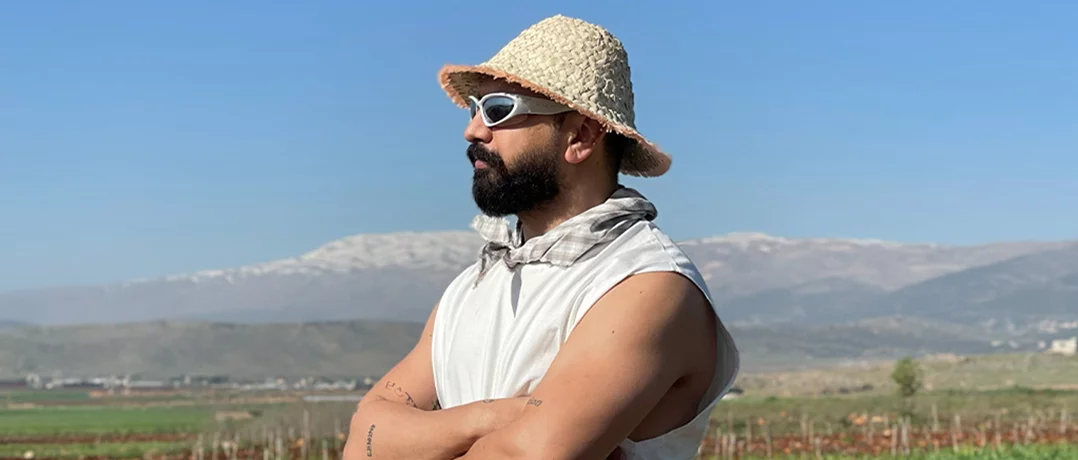
Everything changed for Lebanese director Joseph Hanna overnight. His short film starring his mother, a rooster and a Jacquemus dust bag went viral and gained international praise. The back-to-basics concept attracted the brand itself, which got in touch with the director and reposted it on its page.
“Ever since Jacquemus started gaining traction, I found myself attracted to the brand. His creativity is like mine, true, and simple. He was able to compete with international brands even though he advertises in the opposite manner”, says Joseph. What gave the video more meaning for the brand’s founder, Simon Porte Jacquemus, was his own mother’s passing.
A stroke of inspiration
The short is based on a true story. Joseph’s mother is his source of inspiration, his biggest support and takes care of his every detail. “She’s iconic. When I saw she was using my Jacquemus dust bags this way, she made me laugh”. Georgina took both of his bags, used them to make labneh, pound zaatar, even store keshek.
The award-winning director wanted to dedicate a campaign to his mother and show how she simplifies matters. “If human beings returned to basics, they would be happy. This is what people were pulled to”, says Joseph.
International resonance
In the aftermath of the campaign going live, influential figures across the region and beyond sent him direct messages pleading with him: “Take all our bags, our cars, but give us a quarter of what you have”.
Celebrities like Karen Wazen commended and interacted with him on his beautiful work, even Prada reached out. Now, Joseph has big plans in the works with other major fashion brands, all because of a small film with a big impact.
The dust bag became a trend, with people showing it to him being used for keshek and vegetables, they even sent him a comment to do the same with Hermes, which would cause outrage.
Power in authenticity
When Jacquemus reached out and major publications were covering the short, his mother was elated. Still, all she cared about was if Simon Porte Jacquemus was going to send her more bags.
Shot it in a day in his mother’s country home in the north of Batroun, Assia, the film was authentic. Not one ornament was moved, and Georgina was talking the way she always does. “I don’t like the city, I don’t go there”, she says in the short. Some people might find that backwards thinking, but she didn’t care. She asked that they include everything she uttered.
When Joseph saw his mother using the bag, he thought of people living in luxury, how they’re busy portraying perfection in fashion with their unboxing.
Fakeness and the luxury life are draining; live as you wish. When I saw my mother making the most of it, a bag that people show off, I thought everyone can live like this. Even if you have money, you can live simply.
A curated veneer
According to him, society is wrapped up in what people and magazines like. His clients are usually weary, and place barriers. “I broke the rules and all international magazines wrote about this campaign despite being the total opposite of what they’re doing”.
After the short, many of his clients told him: “Now we get you”. This is his signature; it’s his life rooted in God who lived in modesty and love.
Every person has God living in him, and He is the way to a good life. Let’s break free of this illusion.
Working with his mother, Georgina, heightened the intimacy in the documentary. It was difficult to direct her, as he feared she might get the feeling that he was bossing her around. In some scenes she got frustrated, in others they laughed, in some she said things she shouldn’t say. In one scene he gave her the water vase and she said: “Hal may ma atyaba, bterweh”, “this water is so good, it satisfies my thirst”. Right before she had exclaimed in the middle of shooting: “Don’t you want to give me some water? I’m thirsty”. The film was completely improvised.
An international identity
As a Lebanese filmmaker navigating both local and international spaces, he never felt pressure to translate his stories for an international audience. “It was more difficult to explain my vision to people in Lebanon”. He works for international brands in Lebanon, Saudi Arabia, Dubai and Spain, such as the jewelry brand Yeprem. He made a short film for them that got short-listed in Cannes Lions in France and won an award at the Mirada Corta Film Festival in Mexico. International brands have a boldness much like his. “In the Arab countries we have a safe zone that we reside in. Abroad, they take risks”, shares Joseph.
When asked who Joseph is, his answer is this short film. He used to give hints in his campaigns, until he decided to raise enough money to create his own projects. No Limits is another baby of his, winning an award in Melbourne, Australia, and getting nominated at the London Fashion Film Festival. “This is the message I was always trying to convey: living simply, and at peace”.
-
-
-
Grace MassoudWriter and Head of PRFocusing on general entertainment.
-
