

The Druze debate reflects the tension between enduring communal identity and shifting political alignments, especially in contemporary Lebanese sectarian discourse.
Druze identity: Between constant and changing political
Druze identity: Between constant and changing political
By The Beiruter | April 22, 2026

Reading time: 4 min
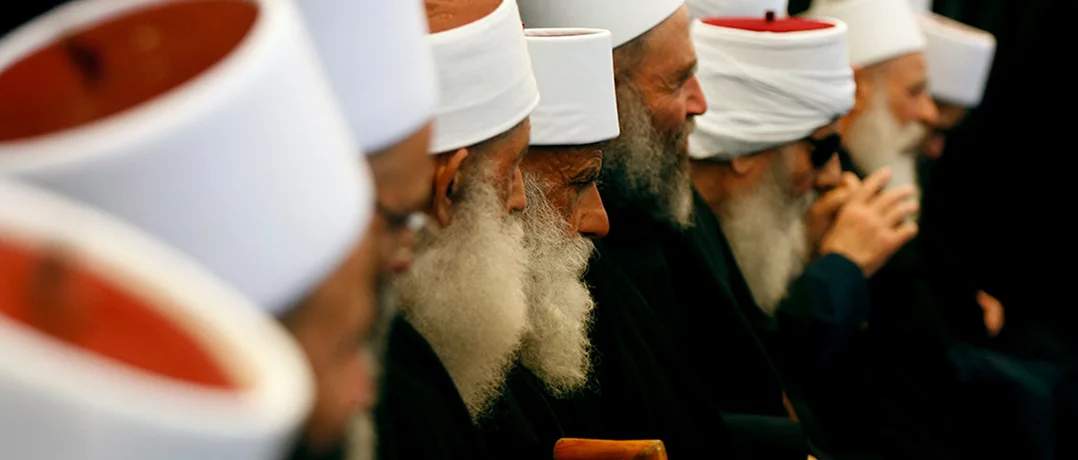
Nida Al Watan received a statement issued by the spiritual authority of the Druze monotheist community, Sheikh “Abi Yusuf” Amin al-Sayegh, following the media interview of the former leader of the Progressive Socialist Party (PSP) Walid Jumblatt, in which he addressed the question of Druze identity and the Jumblatt family within the broader Sunni sphere, drawing on the Ottoman political framework of his grandfather Prince Shakib Arslan and his theory of the “Islamic Ummah,” in addition to his reference to his mother Mrs. May Jumblatt’s conversion to Sunnism.
Jumblatt’s statements come at a sensitive regional moment marked by the repositioning of Lebanese political forces, which gave his remarks a dimension that goes beyond internal political debate. As a result, media platforms were widely engaged with the issue, particularly among segments and members of the Druze community. Former minister Wiam Wahhab also published Sheikh al-Sayegh’s full statement on his “X” and “Facebook” pages, commenting: “the voice of truth and reason.”
Regardless of the interpretations that accompanied the issue, prominent Druze sources told Nida Al Watan that al-Sayegh’s response was “the clearest and most authoritative in defining the boundaries of the relationship between Druze identity and politics,” considering that Jumblatt’s remarks touched upon a foundational principle of communal solidarity and constituted an attempt to redefine Druze identity within a situational sectarian and political context that is inconsistent with the community’s historical particularity. Although al-Sayegh did not name Jumblatt, his statement carried a direct response to this inclination. He opened by affirming historical continuity, saying: “We have remained steadfast through time, and we settled our choice 1,400 years ago,” adding: “Our Islam is total submission to God, our doctrine is reason, our path is monotheism, our identity is belonging to the preservation of honor and land.”
This 4-part formulation implicitly responds to reducing the Druze to an appendage of the Ottoman line or a branch of Sunni sectarianism, rather than Islam in general. The spiritual authority emphasized the uniqueness of the Druze experience in the Levant, stating: “We are the community that lived at the heart of religions without dissolving into them, and carried the sword of Arabs and Muslims and the values of the prophets without surrendering its decision to anyone. We were and remain the enigma of history that has resisted breaking.” In doing so, he distinguishes between historical alliances with Arabs and Muslims and permanent political allegiance to the caliphate line. Shared battles, in his view, are “not a constraint or a bondage” to be used today to restrict the Druze position or attach it to transient regional projects, whether Ottoman in the past or otherwise today. He affirmed that “the Druze are not competitors to anyone in their religion; we see in all religions manifestations of the one truth. However, this openness does not mean relinquishing the estimation that preserved our cohesion, safeguarded our unity, and made both the elite and the general body of this community one body.”
He addressed political figures within and outside the community, saying: “O officials, know that you are not facing individuals scattered by winds of interest, but a single body. If one part of it suffers in the far reaches of the mountain, the rest of the monotheists rally to it in vigilance and zeal.” In direct response to the theory of the “Islamic Ummah” adopted by Shakib Arslan and which Jumblatt sought to revive, al-Sayegh said: “Identity is fixed and politics are changeable. We extend the hand of partnership to every partner in the homeland and in humanity, but we do not mortgage fourteen centuries of constants to the fluctuations of transient interests.” He added: “Form political alliances as you wish, but do not drag doctrinal identity into changing political projects. The caliphate has fallen, axes shift, but the solemn covenant of monotheism remains.”
He addressed members of the community, saying: “To our people, the sons of Bani Maaruf, your greatest interest lies in your unity. In preserving the brother is the salvation of identity from the evils of division, and in honesty of speech lies protection from the deception of politics.” He reminded that “the common people are the elite in times of hardship, and they are the ones who preserved identity when some politicians were preoccupied with gains and positions.”
Sheikh al-Sayegh concluded: “Do not misread the monotheists. We are not a minority seeking protection, but an origin that grants legitimacy to those who respect its existence. Our loyalty is steadfast and does not seek anyone’s certification. We are the heart of this region; we defended it before the emergence of modern states, where our Arabism is action, not words, and our monotheism is a covenant, not a slogan.”
-
-

-
The Beiruter
-
