Caught between geography and economic fragility, Egypt navigates the regional war through cautious containment, balancing diplomacy, security, and survival.




Caught between geography and economic fragility, Egypt navigates the regional war through cautious containment, balancing diplomacy, security, and survival.

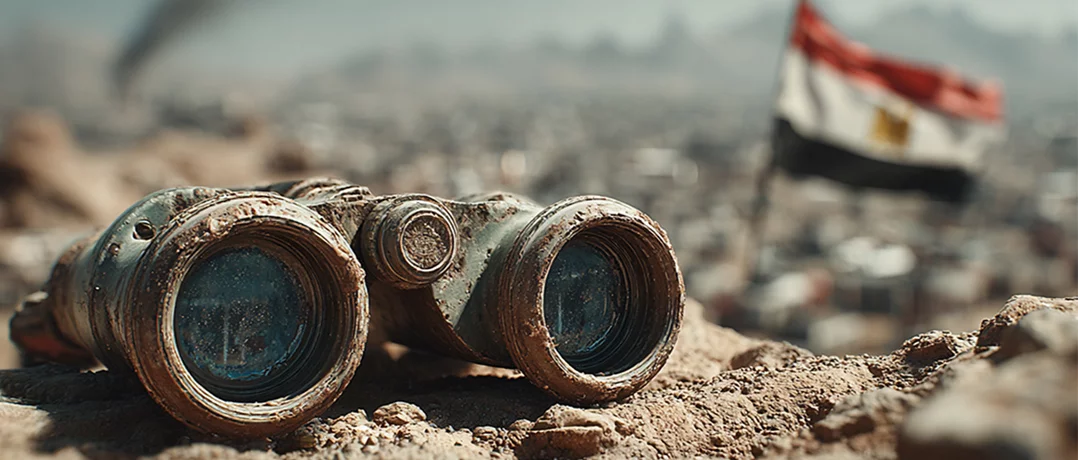
As the war expands across the Middle East, Egypt has emerged as a critical but carefully restrained actor. Its geography places it at the edge of the conflict bordering Gaza, overlooking the Red Sea, and controlling the Suez Canal, yet its economic fragility limits its capacity to absorb the cost of deeper engagement. Rather than projecting force, Cairo has opted for containment: protecting domestic stability, securing key infrastructure, and pushing diplomatically for de-escalation.
That posture is reflected in both rhetoric and policy. President Abdel Fattah el-Sisi has warned that continued escalation could plunge the region into “total chaos,” while also emphasizing the war’s broader implications for global trade and economic stability. Egypt’s approach operates within a dual reality: it retains the diplomatic weight to influence regional outcomes, but faces immediate economic and political costs if the conflict deepens.
Egypt’s restraint should not be mistaken for disengagement. From the outset, Cairo has pursued a two-track approach, insulating its domestic economy while maintaining active diplomatic channels across rival blocs.
That balancing act reflects a broader strategic logic, according to Riccardo Fabiani, Project Director for North Africa at the International Crisis Group, speaking to The Beiruter. “From the start of the conflict, Egypt has worked on two tracks: containing the domestic economic repercussions… and keeping channels of communication open between Iran, Arab countries and the US.”
This positioning allows Egypt to remain diplomatically active without assuming the risks of military involvement. Cairo has maintained contact with Gulf states, Western partners, and, critically, Iran, even while condemning its retaliatory strikes against Gulf Arab countries. “Egypt doesn’t have any interest in participating in the war,” Fabiani adds, emphasizing that Cairo has also been largely spared direct security consequences, in part because it does not host U.S. bases.
This is not neutrality. It is calibrated engagement, designed to shape the conflict’s trajectory without direct involvement.
At the core of Egypt’s posture lies a simple constraint: it cannot afford a wider war.
The country entered the crisis already under economic strain, following years of inflation, currency depreciation, and mounting debt. The conflict has intensified these pressures, particularly through rising energy costs and disruptions to key revenue streams.
“Egypt is the regional country most vulnerable economically to the Iran war,” Fabiani notes, pointing to its dependence on tourism, energy imports, and Suez Canal revenues.
Analysis from the American think tank the Atlantic Council similarly warns that Egypt’s economic fragility could have broader implications. A crisis in Egypt could ripple outward, affecting global markets, migration flows, and regional stability.
The risks are not abstract. A prolonged energy shock could raise import costs and further strain household budgets after years of economic hardship. Fabiani warns this could deepen an already precarious domestic situation.
Egypt’s foreign policy thus becomes inseparable from its economic survival. Escalation is not only a geopolitical risk, but a domestic one.
Egypt’s vulnerability is most visible in the Suez Canal, one of the world’s most critical trade arteries and a cornerstone of the country’s economy. The canal generates billions in annual revenue and serves as a key source of foreign currency. But its geographic position ties it directly to the conflict’s maritime dimension. As insecurity in the Red Sea intensifies, some shipping routes have shifted, reducing canal traffic and state revenues.
This dynamic underscores a central paradox: Egypt’s greatest strategic asset is also a point of exposure. The canal integrates Egypt into the global economy, but it also embeds it within the conflict’s expanding geography.
At the same time, Egypt faces growing security risks along its borders. The Sinai Peninsula remains a focus of counterinsurgency efforts, while the expansion of conflict in Gaza raises concerns about spillover, arms flows, and displacement. The Rafah crossing also captures this tension. It serves as both a humanitarian gateway and a security buffer, requiring Cairo to facilitate aid while maintaining tight control over movement.
Alongside these pressures, Egypt continues to position itself as a diplomatic intermediary. “Cairo is positioning itself as a bridge-builder,” Fabiani explains, describing an approach centered on engagement across competing actors.
Yet Egypt’s influence has limits. The current conflict, fragmented across multiple actors and theaters, complicates traditional mediation efforts. Cairo can facilitate dialogue, but it cannot dictate outcomes.
Egypt’s position in the conflict is shaped as much by its constraints as by its capabilities.
Its geography places it at the intersection of the region’s most sensitive fault lines, while its economy ties it closely to the stability of global trade and energy flows. These same factors give Cairo influence but also narrow its range of options.
Egypt’s role is therefore less about directing the conflict than managing its consequences. As the war evolves, its posture may be defined not by strategic shifts, but by how effectively it absorbs and adapts to pressures beyond its control.

