



How unity and compromise made Lebanon's independence in 1943, and what that history asks of us today.
Eleven days in Rashaya

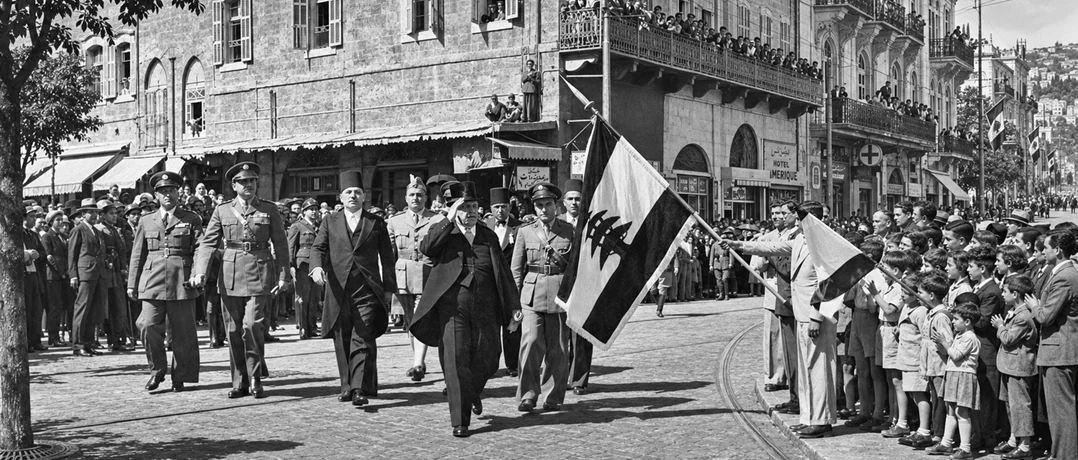
On the night of 11 November 1943, French soldiers arrested President Bechara al-Khoury, Prime Minister Riad al-Solh and three ministers, Camille Chamoun, Adel Osseiran and Salim Takla, together with deputy Abdel Hamid Karami. They were driven to the old citadel of Rashaya, at the foot of Mount Hermon. Three days earlier, parliament had voted unanimously to remove from the constitution every article linked to the French mandate. For France, this was rebellion. For the Lebanese, it was the end of a long road.
That road began in the Mountain. From 1864, the Administrative Council of autonomous Mount Lebanon gave every community its share of seats: Maronites, Druze, Greek Orthodox, Greek Catholics, Sunnis and Shiites governed together for half a century. In 1919, Patriarch Elias Hoayek carried this experience to the Paris Peace Conference. He asked for an independent Lebanon within its historical and natural borders. The Maronites could have asked for a small state with a large Christian majority. They chose a larger country shared with Muslims and Druze, a state of partnership, not a state for one community. On 1 September 1920, General Gouraud proclaimed Greater Lebanon.
For many Lebanese Muslims, the new state was hard to accept. The sociologist Salim Nasr called their reaction "a veritable trauma." They boycotted the 1921 census and the early elections, and their congresses demanded union with Syria. The founders did not answer with force. They answered with institutions. The constitution of 1926, which Michel Chiha helped to draft, fixed Lebanon's borders, shared parliament among the communities, and protected each community's faith, personal status and schools. Public schools opened mainly in the neglected regions. Slowly, the state won its citizens. In 1932, Muslims took part in the census, and Sheikh Mohammad al-Jisr, a Sunni from Tripoli, ran for president. The question was no longer whether Lebanon should exist, but how all could share in it.
By the late 1930s, Khoury and Solh, the most popular Maronite and Sunni leaders, were meeting quietly in Beirut, helped by mediators such as the banker Henri Pharaon. Chiha gave their project its philosophy: "Diversity is our destiny." Lebanon, he believed, could live only as a free country, open to the West, close to its Arab neighbours, and a crossroads of trade and ideas.
The Second World War opened the door. In 1941, General Catroux proclaimed Lebanon's independence, but France kept delaying it. In the summer of 1943, the parties of independence won the elections. On 21 September, parliament elected Khoury president, and he asked Solh to form the government. On 7 October, Solh read his ministerial statement. It was the closest the National Pact ever came to a written text: Lebanon would be a sovereign and independent homeland, with an Arab face, open to the world, never a base or a passage for any colonial power.
The Pact rested on two sacrifices made at the same time. The Christians, whose leaders had seen France as a protector for generations, gave up foreign protection. It was an act of trust in their Muslim partners. The Muslims gave up union with Syria or any Arab state, and accepted Lebanon as their final homeland. Lebanon would be "neither East nor West." It would cooperate with Arab states as long as they respected its sovereignty, and stay neutral in their conflicts. Power would be shared among all communities. In 1957, the journalist René Aggiouri wrote in L'Orient that the Pact was the unwritten will of Lebanon's communities to live together in an independent and sovereign state.
France tested that will in November 1943, and the answer was unity. The Kataeb and the Najjadeh, a Christian and a Muslim youth movement that had been rivals, formed a joint command and called a general strike. Ministers Habib Abi Chahla and Majid Arslan, a Greek Orthodox and a Druze who had escaped arrest, set up a government in Bechamoun. Deputies met in secret and adopted a new flag: a green cedar on red and white.
For eleven days, the country stood still. Shops closed in Beirut, Tripoli, Sidon and Zahle. Students left their classrooms and filled the streets. Women marched to the foreign legations to demand the release of the prisoners. Religious leaders of every community, from Maronite Patriarch Antoine Arida to the Mufti of the Republic, stood with the arrested government and refused any authority imposed by the mandate. The clashes with French troops left dead and wounded, and their names joined those of the patriots hanged in 1916. For the first time, a Maronite in Kesrouan, a Sunni in Tripoli, a Shiite in the South and a Druze in the Chouf were defending the same thing: one state that belonged to all of them. Under this pressure, and that of Britain and the United States, France gave way. On 22 November, the prisoners of Rashaya came home to Beirut.
Independence gave Lebanon a clear place in its region. In 1945 it was a founding member of the Arab League and of the United Nations. In 1948, Charles Malik helped draft the Universal Declaration of Human Rights. Beirut became the region's bank, its university, its hospital and its free press. Lebanon was small, but it played a role no one else could play.
Eighty-three years later, Lebanon is again looking for its independence. This time the danger is not a foreign mandate but an armed party inside the country, loyal to Iran, holding weapons the state does not hold and taking decisions the state did not take. Since October 2023, Lebanon has been pulled into a war it did not choose. Parliament has postponed its own election. The region is being redrawn: the Assad regime has fallen, and old alliances are breaking. In such moments, small countries either choose their role or have one chosen for them.
The men of 1943 knew this. They did not agree on everything. They agreed on what mattered. No community would call a foreign power to protect it. No community would carry arms the state did not carry. Every community would have a place in the state, and the state would serve every region, not only the centre. Their neutrality was not weakness. It was a decision, taken together, that Lebanon would be a meeting place and never a battlefield.
A new pact can only begin where the old one began. One state, one army, one decision on war and peace. Neutrality toward every regional axis, not only Arab quarrels. Real decentralization, as promised at Taif in 1989, so that people feel the state in their schools, their water and their roads. And this time, a pact written down, so that no one can claim it means something else.
None of this is beyond the Lebanese. It has been done before, under occupation, with fewer means and deeper fears.
In November 1943, a Maronite president and a Sunni prime minister shared a prison in Rashaya. A Greek Orthodox and a Druze kept the state alive in a village house in Bechamoun. Christian and Muslim young men who had paraded for rival dreams in the streets of Beirut marched under one flag that had not existed a week before.
No one gave Lebanon its independence. The Lebanese gave it to each other.
-
-
-
Dr. Elie EliasUniversity Lecturer & Political Historian
-
