



Former allies edge toward war as Eritrean troops reportedly return to Tigray and Ethiopian forces advance northward. From the battlefields of Tigray to the diplomatic corridors of Alamein, Asmara is preparing for a confrontation that could reshape the Horn of Africa.
Eritrea’s Two Frontiers: From Tigray to Alamein
Eritrea’s Two Frontiers: From Tigray to Alamein
By Nami El Khazen | October 10, 2026

Reading time: 6 min
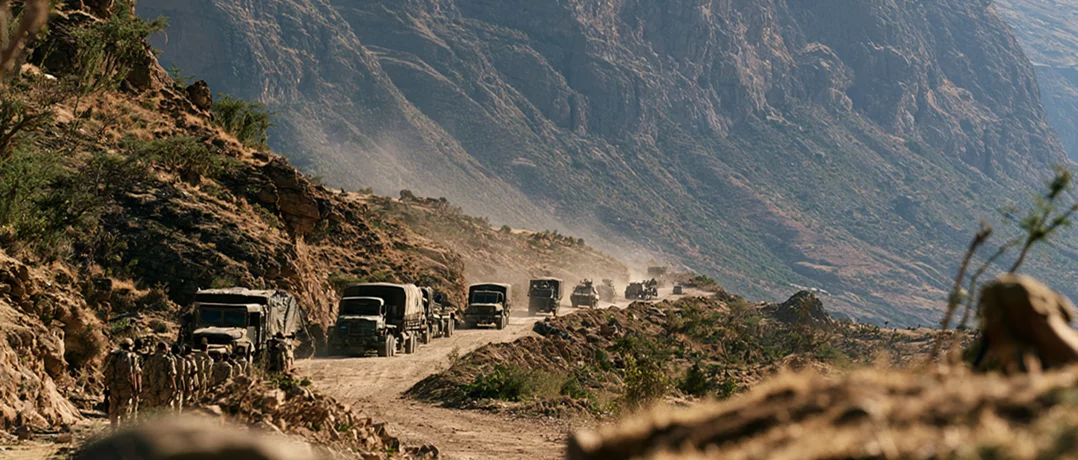
For the residents of Adigrat, it could have felt as though they went to sleep in October 2026 and woke up in November 2020. Eritrean soldiers were reportedly back in the northern Ethiopian city, moving in trucks carrying heavy weapons. Further sightings placed them in Idaga Hamus and near Zelambesa, as Ethiopian federal forces advanced through Tigray.
But the resemblance ends there. In 2020, Eritrean troops entered Tigray alongside Ethiopia's army. Six years later, the former allies risk confronting one another on the very ground where they once fought together.
Two Armies, One Corridor
Renewed fighting between Ethiopian federal forces and the Tigray People's Liberation Front (TPLF) began on September 23. Government troops, supported by allied Tigrayan militias, entered Mekelle in early October after rebel forces withdrew. Yet the capture of the regional capital did not end the offensive. Airstrikes and artillery fire continued across Tigray, and by October 7, federal forces had reportedly taken Agula, about 35 kilometers northeast of Mekelle.
These advances have brought the fighting closer to Eritrea's doorstep. Eastern Tigray is crossed by a corridor connecting Mekelle to Adigrat and the Eritrean border at Zelambesa. Control of these approaches determines how far Ethiopian forces can advance toward Eritrea's southern frontier. Each additional gain reduces the territory separating the federal army from its northern neighbor.
It is along this same axis that Eritrean forces have reportedly moved in the opposite direction, allowing them to confront any Ethiopian advance before the fighting reaches Eritrean territory.
The Peace That Unraveled
The rupture between Addis Ababa and Asmara marks a return to a much older rivalry. Following Eritrea's independence in 1993, disputes over their border erupted into war in 1998. Fighting ended two years later, but hostility persisted between President Isaias Afwerki's government and Ethiopia's TPLF-dominated leadership.
That changed in 2018, when Abiy Ahmed became Ethiopia's prime minister. He reconciled with Isaias, restored diplomatic relations and ended two decades of hostility, earning the Nobel Peace Prize the following year. Their shared opposition to the TPLF eventually brought their armies together during the 2020–2022 Tigray war.
Yet the partnership began unraveling with the Pretoria peace agreement in November 2022. Eritrea was excluded from the negotiations, while the TPLF survived as a significant political and military force. Relations deteriorated further as Abiy increasingly demanded access to the Red Sea, raising fears in Asmara over Ethiopia's territorial ambitions.
The breakdown culminated on October 1, 2026, when Ethiopia expelled ten Eritrean diplomats and closed its embassy in Asmara. Eritrea responded by severing diplomatic relations, bringing their rapprochement to an abrupt end.
The Logic of the Buffer
For Eritrea, the value of northern Tigray extends beyond the distance separating Ethiopian forces from its border. As long as the region remains contested, Addis Ababa must devote troops, equipment and resources to maintaining control inside its own territory. A Tigray hostile to Addis Ababa could therefore serve as a buffer without requiring Eritrea to occupy or administer it.
This calculation helps explain Asmara's increasingly unlikely convergence with the TPLF. Despite their bitter history, both now have an interest in preventing the Ethiopian government from consolidating its control of the north. Reports of high-level contacts between Eritrean and TPLF officials date to early 2025, while Eritrean military officers appeared publicly in Tigray in August 2026. The Critical Threats Project describes an alliance of convenience, although Asmara denies Ethiopian accusations of supporting the insurgency.
The military implications are significant. Tigrayan armed formations retain a presence across eastern Tigray, particularly around Idaga Hamus and Adigrat. Their continued resistance could complicate federal efforts to secure these approaches, tying down forces that might otherwise be available along Eritrea's frontier. The loss of Mekelle has made this calculation more urgent, narrowing the territory separating Ethiopian federal forces from Eritrea.
Yet this approach carries considerable risks. On October 7, ACLED reported that Ethiopian drones targeted Eritrean troops near Guada as they moved toward Idaga Hamus. If confirmed, the incident would indicate that the confrontation has already escalated into direct military action between the former allies, increasing the risk of retaliation.
The Shadow of Assab
Behind Eritrea's concerns over Ethiopia's military advance lies another unresolved dispute: the port of Assab. Located on Eritrea's southern Red Sea coast, Assab once handled much of Ethiopia's international trade, even after Eritrean independence in 1993. That arrangement ended with the 1998 border war, leaving Addis Ababa heavily dependent on Djibouti.
For Abiy Ahmed, securing maritime access has become an increasingly prominent national objective. On October 5, as he began another term in office, he reiterated that Ethiopia's development required an outlet to the sea, pledging to pursue one through negotiation and mutual benefit. Yet Asmara fears that Ethiopia could eventually seek to take Assab by force, despite Addis Ababa's stated commitment to peaceful means.
Eritrean officials have explicitly linked the fighting in Tigray to Ethiopia's maritime ambitions. On October 7, Information Minister Yemane Gebremeskel accused Addis Ababa of constructing a justification for military aggression aimed at securing access to the Red Sea. He cited alleged remarks by an Ethiopian general describing Mekelle as a stopover on the way to Assab, although those remarks remain independently unverified.
The Alamein Alignment
Eritrea's response to its deteriorating relationship with Ethiopia has also extended into regional diplomacy. On October 4, just three days after Asmara severed diplomatic ties with Addis Ababa, President Isaias Afwerki met Egyptian President Abdel Fattah el-Sisi, Somali President Hassan Sheikh Mohamud and Sudanese leader Abdel Fattah al-Burhan in New Alamein. The summit brought together four governments whose separate disputes with Ethiopia have increasingly given them reasons to coordinate.
The resulting Alamein Declaration reaffirmed that governance of the Red Sea should remain exclusively in the hands of coastal states, rejected unilateral measures affecting downstream Nile countries and opposed any recognition of Somaliland. The leaders also pledged support for Sudan's national institutions and established a mechanism for continued consultations.
Behind these commitments lie different strategic concerns. Egypt remains locked in a dispute with Ethiopia over the Grand Ethiopian Renaissance Dam, while Sudan has disagreements involving the Nile and their shared border. Somalia opposes challenges to its territorial integrity, particularly regarding Somaliland, where Ethiopia has pursued maritime arrangements. For Eritrea, these overlapping tensions offer an opportunity to strengthen its position against a larger neighbor.
The coordination may also extend beyond diplomacy. According to Egyptian officials, the leaders agreed to coordinate military and intelligence efforts if the conflict reached Ethiopia's borders with Eritrea, Sudan or Somalia. The published declaration, however, contained no such commitment.
For Asmara, the significance lies in reducing its strategic isolation. Closer coordination with Egypt, Sudan and Somalia could provide additional diplomatic support and increase the political costs of confrontation for Addis Ababa, even without a formal military alliance.
Yet the immediate danger remains in Tigray, where the two countries' competing security objectives risk drawing them into direct conflict. What Ethiopia considers the restoration of control over its own territory may be perceived in Eritrea as a threat requiring military intervention. Under such circumstances, even measures intended to strengthen security can bring the two countries closer to war.
-
-

-
Nami El KhazenJournalistFocusing on geopolitics and international affairs.
-
