



Poland’s economic rise shows how freedom, foreign investment, a skilled workforce and strong institutions transformed a post-communist economy into one of Europe’s fastest-growing success stories.
Europe is stalling. Why is Poland rising?

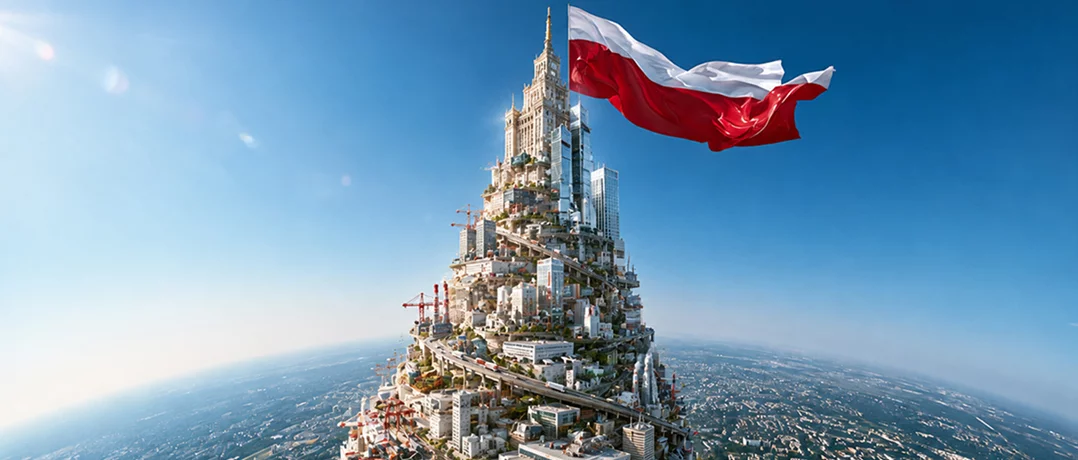
When I moved to Poland in 1993, its economic output per person, adjusted for purchasing power, was less than a third of Germany’s. The idea that I might live to see Poland catch up would have seemed absurd.
Poland then achieved 30 years of uninterrupted economic growth, with COVID-19 causing the only annual contraction. Across those three decades, it grew faster than any other large EU economy, with growth on a par with the Asian Tigers: South Korea, Singapore and Taiwan.
Today, my own analysis suggests Poland could catch Germany in a little less than a decade. The London-based Centre for Economics and Business Research points in the same direction, forecasting that Poland could overtake the United Kingdom in income per person by 2035.
Forecasts are forecasts. But such comparisons show how far Poland has come and raise the more interesting question: What did Poland do differently while much of Europe began to stall?
How Poland turned freedom into growth
It is tempting to explain Poland’s rise through foreign capital and EU funding. They mattered, but money alone does not create success. The real question is what lasting capability a country builds with it. Other countries had similar opportunities without achieving the same result.
Three differences stand out.
Releasing the power of economic freedom
Compare Poland today with the country I entered in 1993, after almost half a century of Soviet-imposed socialism. The contrast shows the power of economic freedom in a nutshell. The whole country seemed to be awakening from a deep sleep. When I arrived in Warsaw, there were perhaps three to five restaurants people recommended to a foreigner. Just imagine that today.
Leading a team in Poland gave me another perspective. I had naively wondered whether communism might have suppressed personal initiative. I found the opposite. People were well-educated and eager to learn, assume responsibility and build a better future.
Two things were fundamental to Poland’s transition: reforms reached people quickly, and state wealth did not end up in the hands of a small group of oligarchs.
That was the institutional foundation. But the country still needed capital and people to turn freedom into growth.
Building capitalism without capital
Leszek Balcerowicz, the architect of Poland’s shock therapy, summed up the challenge as building capitalism without capital. His point was that attracting capital from abroad was the only way to transform the country in some 30 years rather than 300.
Poland created an investor-friendly environment, privatised state-owned companies, including banks, and welcomed foreign investment. Capital brought technology, management systems and access to markets.
An investor-friendly environment also requires an independent court system. In the early years of the transformation, I came across data showing that businesses and private individuals won more than half of their disputes with public authorities.
Joining the European Union in 2004 opened Poland to the free movement of goods, services, people and capital. It became a master at absorbing EU funds and putting them to work. Most projects required Polish co-financing, which meant the country had its own money at stake. The results were visible in roads, railways and other infrastructure, first in the cities and increasingly across the countryside.
Capital alone explains only half the story. It arrived just as an unusually large generation of young Poles entered the labour market. When I once asked why, I received a dry explanation. During martial law in the early 1980s, restrictions kept people at home, while television offered little beyond General Wojciech Jaruzelski in uniform. Then came the baby boom.
Behind the joke lay a powerful economic force. Those children came of age after communism had fallen. They were the first post-war generation free to take their destiny into their own hands. Capital met millions of young Poles hungry to build, and that coincidence became one of the country’s great growth engines.
Turning opportunity into capability
Many economies grow through inexpensive labour and foreign investment, then stall as wages rise.
Poland avoided the middle-income trap. It turned foreign capital into local skills, productivity and leadership, moving from low-cost work towards higher-value production and services.
I experienced that transformation inside IKEA Poland, which had only one 3,000-square-metre start-up store when I joined in 1993. By 2007, it had seven stores, six shopping centres and a regional distribution centre. Beyond that, Poland had become IKEA’s second-largest sourcing country, behind only China. Our IKEA story was unusually large, but versions of it were unfolding in businesses large and small across the country.
Poland’s Global Business Services sector followed the same path. International companies came for lower costs but stayed and expanded for the skills they found. When I later led IKEA Group Shared Services, we treated our Poznań centre as an entry point into IKEA and a talent pool, not just a transaction centre.
The same development was visible across IKEA, where many Poles built international careers. Perhaps the most prominent is Jakub Jankowski, who joined IKEA in Poland in 2001 and is now CEO of Inter IKEA Group.
Poland had moved from importing foreign capital and knowledge to exporting products, capabilities and leaders.
Can Poland sustain its rise?
Poland’s rise is one of Europe’s great success stories. But are the forces that brought it this far strong enough to meet the very different challenges ahead?
Security is the first test. Poland’s proximity to Russia makes defence both essential and expensive. Poles remember that the post-war order was decided over their heads. It taught them that alliances must be backed by their own strength. Defence spending approaching 5% of GDP reflects that self-reliance and patriotism.
The second test is demographics. The large generation that powered Poland’s rise is ageing. But highly skilled Poles are returning with international experience, and Poland has integrated around one million Ukrainians remarkably well. Among Ukrainians of working age, 69% are employed.
At the same time, Poland has taken a restrictive approach to asylum migration from Muslim-majority countries. I believe Poland’s strong Catholic identity is the main reason. The challenge is to attract enough people to sustain growth without losing social cohesion.
Energy is the third test. Poland remains heavily dependent on coal. Lower fuel taxes help keep prices down, but they do not solve the long-term problem. The challenge is to move away from coal while keeping energy secure, competitive and affordable.
Poland’s sharp political divide is widely seen as a threat. I see the advantage of this rivalry in how it keeps society politically awake. Twice, mobilising people who had previously stayed home was decisive in shifting power from PiS to Civic Platform and its allies.
Europe faces an uncomfortable question. If war, energy prices and geopolitics explain stagnation, why does Poland continue to grow despite often facing the same pressures even more directly, while major economies such as Germany stall?
Poland’s rise shows what freedom, capital and people can achieve together.
-
-
-
Peter ThommenColumnistFinance-rooted Futures Strategist with 30 years of international leadership experience at IKEA, including 25 years in C-level and board roles across Finance, Strategy and Global Business Services.
-
