



Brussels has opened the door to an unprecedented idea: Canada as the EU’s first associate member, potentially reshaping ties far beyond trade.
Europe opens a new door to Canada

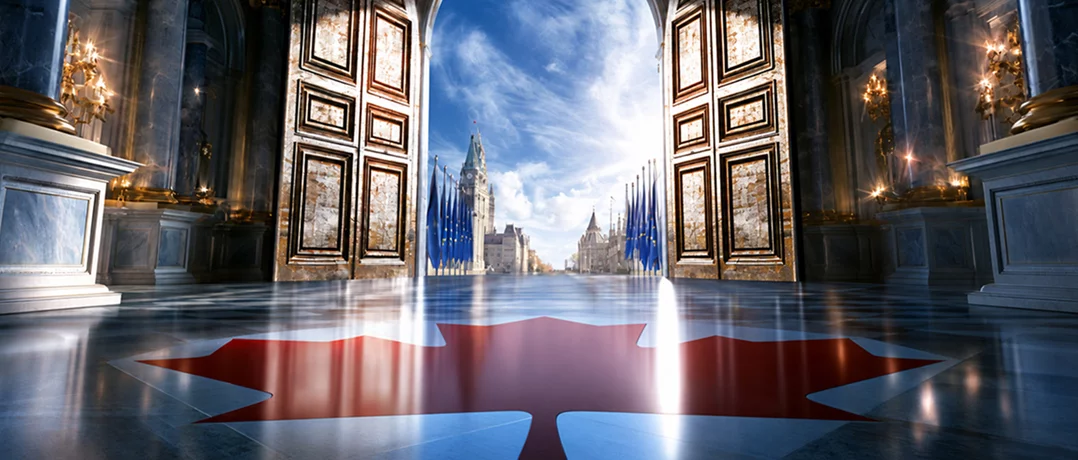
“I would like to work with you on opening the door for Canada to be the first associate member of the EU.”
With those words in Strasbourg, European Commission President Ursula Von der Leyen placed an unexpectedly ambitious idea at the center of the Canada–European Union relationship.
For years, Canada and the European Union had steadily expanded their ties through trade, diplomacy and security cooperation. But the language surrounding that relationship had now changed.
The proposal opened a much larger question: what had brought Canada and Europe to the point where such an arrangement could even be contemplated and what kind of relationship were they now preparing to build?
From trade partnership to strategic relationship
The current debate over associate membership did not emerge from an empty relationship. For years, Canada and the European Union had already been building one of the EU’s deepest partnerships with a non-European country, initially through trade and investment. The Comprehensive Economic and Trade Agreement, or CETA, created the economic foundation for a relationship that has since made the EU Canada’s second-largest trading partner, with bilateral trade in goods and services reaching roughly €130 billion in 2025.
The relationship then began to move beyond commerce. At the Canada–EU summit in June 2025, the two sides launched a new Strategic Partnership of the Future and signed a Security and Defense Partnership covering areas including maritime security, cybersecurity, space, hybrid threats, military mobility and defense-industrial cooperation.
That shift became more concrete in 2026 when Canada entered the EU’s SAFE defense framework, becoming the first non-European country permitted to participate. The move brought Canadian companies directly into a European defense-industrial mechanism backed by up to €150 billion in loans for joint procurement and production.
By the time Von der Leyen raised associate membership, Canada and the EU had already built much of the institutional foundation for a relationship extending beyond trade.
An undefined membership model
Von der Leyen’s proposal, however, moved faster than the institutions behind it. The European Union has no established category of “associate member,” leaving the rights and obligations attached to such a status undefined. Nor had the idea been agreed with member states before it was announced. Several European diplomats were surprised by the proposal, while Germany has since called for the terminology to be reconsidered even as it supports closer ties with Canada.
Ottawa has been similarly careful about the label. Speaking before the European Parliament, Carney welcomed Von der Leyen’s “ambition” but did not endorse associate membership itself. Instead, he focused on what a deeper relationship could contain, including cooperation on defense, critical minerals, artificial intelligence, energy, space and digital trade.
That caution reflects how much remains unsettled. Ten EU countries have still not ratified CETA, while three have yet to approve the EU-Canada Strategic Partnership Agreement. Any attempt to create associate membership through an EU treaty change would require unanimity among all 27 member states and ratification at the national level. Deeper access to the Single Market would create another trade-off: Canada would have to bring more of its regulations into line with EU law, potentially accepting rules over which it would have no vote.
Washington changes the calculation
The uncertainty surrounding associate membership raises a more immediate question: why are Canada and the European Union willing to explore such an unusual arrangement now? One reason is the degree to which both remain structurally exposed to the United States, although that exposure takes very different forms.
For Canada, it is deeply embedded in the country’s economy and security architecture. In 2025, 71.7 percent of Canadian merchandise exports still went to the U.S., while defense ties run through NORAD, intelligence cooperation and deeply integrated continental supply chains. Europe’s dependence is different, but particularly pronounced in defense, where concerns over Washington’s long-term commitments have accelerated efforts to strengthen European industrial capacity and diversify suppliers.
Recent tensions have therefore given both sides stronger incentives to widen their options. Carney has framed closer ties with Europe in terms of resilience and strategic autonomy, while stressing that Canada is not seeking to build a rival bloc.
Trump’s reaction nevertheless showed how strategically significant Washington considers the shift. He warned that if he viewed deeper Canada–EU integration as hostile, the U.S. could impose “very serious tariffs” on Europe. Brussels, for its part, responded that the initiative was directed against no one.
The emerging approach would give both sides greater room for maneuver during periods of tension with Washington.
Canada beyond the EU framework
Canada’s European strategy is also developing outside the formal EU framework.
The clearest example is the Canada-led Defence, Security and Resilience Bank. Backed by eight other countries, including several EU members, the proposed institution would mobilize public and private capital for defense production and provide long-term, lower-cost financing across allied supply chains. Its founding articles were negotiated in Montreal, Canada was chosen to host its headquarters, and operations could begin as early as 2027.
The initiative also gives Canada a role in shaping, rather than simply joining, Europe’s emerging security architecture. Britain is now exploring how its own defense-financing mechanism could work alongside the DSRB, while the two governments have described the projects as highly complementary.
Von der Leyen has also proposed creating a European Security Council bringing together EU leaders with non-EU partners including Canada, Britain, Norway and Ukraine. The idea would give Canada a place in a high-level forum focused directly on the continent’s security, even while Ottawa remains outside the Union itself.
From overture to negotiations
The next challenge will be turning political ambition into something both sides can approve. Carney has already acknowledged that any eventual arrangement would face debate and a vote in Parliament. That would force Ottawa to define what deeper integration would give Canada and what legal, regulatory and political obligations it would require in return.
Ottawa would also have to contend with Canada’s federal structure. Under the country’s division of powers, provinces and territories are responsible for implementing international obligations that fall within their jurisdictions; CETA itself required them to make any necessary changes to their statutes, regulations and policies.
That makes the coming negotiations more consequential than the initial symbolism in Strasbourg suggested. Carney has described the process as only the “start of a road,” with Canadian and European officials expected to begin working through the substance of the relationship at their next summit in Montreal in late October.
The question will then move from how ambitious the relationship sounds to how much integration both sides are actually prepared to formalize.
-
-

-
Nami El KhazenJournalistFocusing on geopolitics and international affairs.
-
