



The division and fracturements within the EU are visible in its relationship with Israel.
Europe's divorce from Israel

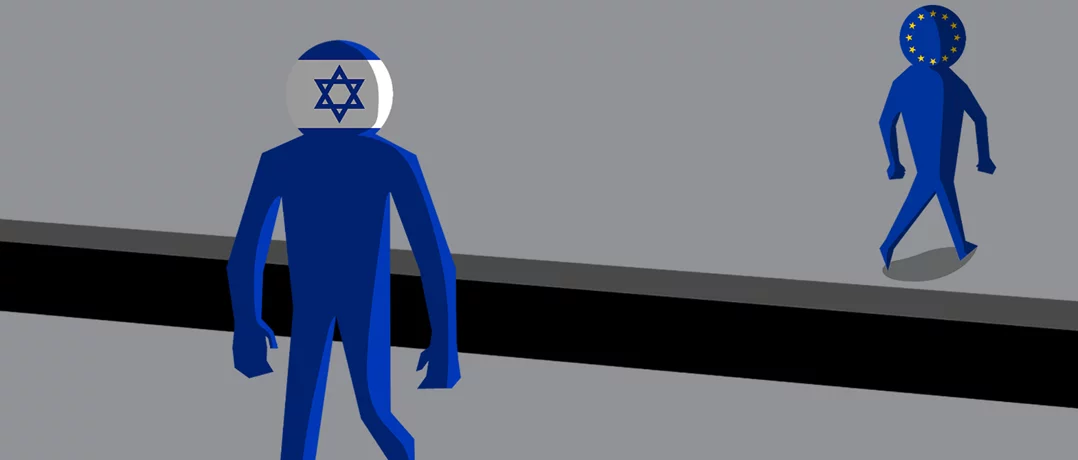
Illustration by Karim Dagher
Israel's relationship with Europe is now fracturing in ways that would have been unthinkable just a few years ago. A convergence of legal pressure, moral outrage, and geopolitical calculation is pushing Europe toward a fundamental reassessment of its ties with Israel.
Europe is collectively Israel's biggest trading partner, its biggest source of tourists, and its second biggest supplier of weapons after the United States. Europe, in other words, is what has historically transformed pro-Israel sentiment from an American niche into a broad Western coalition.
The early divorce signals came in April 2024, during the height of Israel's military campaign in Gaza. With international experts raising the spectre of genocide and the International Criminal Court preparing war crimes charges, the United Nations held a non-binding vote on Palestinian membership to provide opportunity for countries to declare where they stood. A number of nations that had previously aligned with Israel in a similar 2011 vote reversed course: Australia, New Zealand, Japan, South Korea, and several African and Caribbean nations. Most strikingly, a cluster of European countries, Denmark, Poland, Portugal, and Estonia among them, broke from their earlier positions and voted against Israel's preferred outcome. The message was sent.
Since then, the trend has accelerated dramatically. On May 11, the European Union finally broke a lengthy deadlock and agreed to impose sanctions on violent Israeli settlers in the West Bank. EU foreign policy chief Kaja Kallas declared that "violence and extremism carry consequences." The move was made possible after Hungary's newly formed pro-EU government lifted the veto that its predecessor under Viktor Orbán had long maintained on such measures. Yet even this step was criticised as insufficient. Barry Andrews, chairsman of the European Parliament's development committee, called it a welcome but merely symbolic "baby step," arguing that only a full review, and potential suspension, of the EU-Israel association agreement would have genuine impact.
The sanctions debate has exposed deep fractures within the bloc.
France and Sweden have pushed for tariffs on goods produced in illegal settlements, a step France's foreign minister Jean-Noël Barrot publicly backed, describing Israeli settler organisations as guilty of "extremist and violent colonisation." Sweden's foreign minister Maria Malmer Stenergard called settlement tariffs "the most realistic proposal." But imposing a full ban on settlement goods requires unanimity among all 27 member states, a threshold that remains out of reach. EU foreign policy chief Kallas acknowledged that she could not even draft a proposal for tariffs because the political consensus was not there.
Beyond sanctions, individual member states have taken unilateral steps that collectively amount to a meaningful diplomatic rupture. Spain, Ireland, and Belgium have led the charge among governments calling for an EU-wide boycott of Israel. Italy suspended a defence cooperation agreement with Israel. And France, in what analysts have described as the most significant single act, closed its airspace to US cargo flights carrying weapon shipments intneded to Israel. Israel responded by halting all arms purchases from France, a move widely interpreted as a face-saving pre-emption of what might have come anyway. The practical result, as the viral geopolitical commentary notes, is "effectively a quasi-self-imposed French arms embargo on Israel," joining a formal Spanish arms embargo imposed months earlier.
These developments did not emerge from a vacuum. Marwan Muasher, Vice President for Studies at Carnegie Europe, has long argued that the EU's passive approach to the Israeli-Palestinian conflict was never a neutral stance, it was a choice with consequences. He observed that the EU has "consistently insisted that it will not recognise any changes to the 1967 borders unless agreed to by the two parties," and has nominally supported a two-state solution for decades. But he argued that paying lip service to that position while acquiescing to Israeli settlement expansion was self-defeating. The latter being comparable, in his memorable phrase, to "two people arguing over a slice of pizza while one of them is eating it".
Muasher's analysis pointed to a deeper structural contradiction in European policy: the EU has been the largest donor to the Palestinian Authority for years, yet has allowed Israel to continue reshaping the facts on the ground without meaningful consequence. The continued expansion of settlements, he wrote, was making the two-state solution "less likely" with every passing year. Europe's reluctance to challenge Washington's positions, particularly during the Trump administration's 2020 "Peace to Prosperity" plan (which would have permitted annexation of roughly 30 percent of the West Bank), effectively gave Israel a green light.
Now, with that trajectory increasingly apparent, European patience appears to have run out. The Iran war of 2026 provided a further catalyst, intensifying debates across the continent about whether supporting Israel's current government is compatible with European values or interests. 452 Former senior EU diplomats and officials, including former prime ministers Guy Verhofstadt of Belgium and Stefan Löfven of Sweden, signed a declaration in May 2026 calling for sanctions against all individuals and entities involved in illegal settlements, warning that the proposed E1 settlement alone would "cut the West Bank in two and so wreck any prospects of a viable Palestinian state".
What makes this moment historically significant is not any single policy decision but the cumulative direction of travel. Muasher anticipated this reckoning. If the possibility of Palestinian statehood continues to diminish, he wrote, Palestinians will increasingly demand equal rights within the territories they inhabit with Europe facing an impossible question: can it deny Palestinians both a state and equal rights while maintaining that it stands for international law and human dignity? "How will it accommodate a situation where Israel maintains two separate and unequal legal systems within the territories they occupy, a textbook definition of apartheid?"
Europe does not yet have a coherent answer and the divorce is not yet complete. The sanctions agreed in May 2026 are modest, the bloc remains divided, with unanimity requirements giving individual member states the power to water down collective action. But the direction is clear. Countries that once offered reflexive political cover to Israel are stepping back.
-
-

-
Peter ChouayfatiPolitical Analyst and Researcher
-
