



As AI demand drives a race for data centers and compute, Europe faces a new sovereignty challenge: whether its clean power can help build domestic technology capacity or mainly power platforms controlled abroad.
Europe’s AI sovereignty test

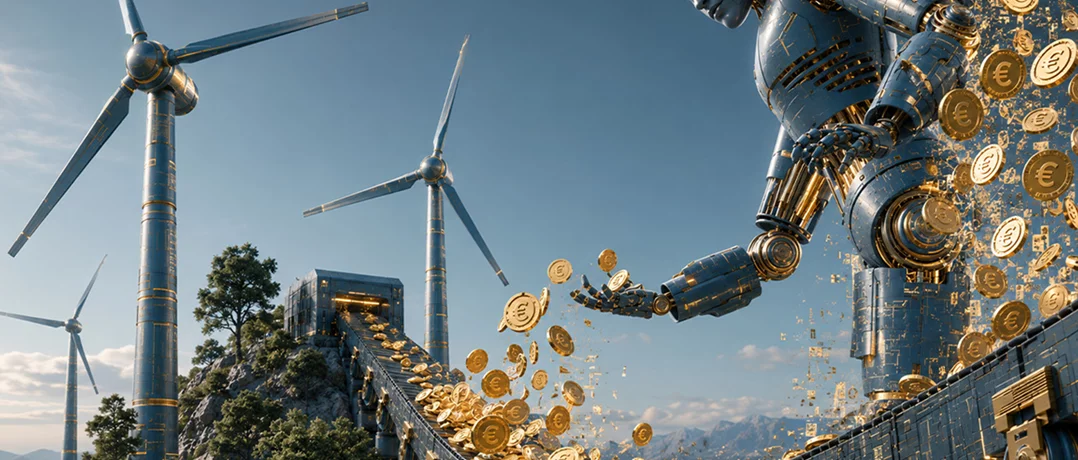
Europe has spent years trying to reduce the energy dependencies that left it exposed to Russian gas, volatile fossil fuel markets and geopolitical pressure. That effort was rooted in a hard lesson that control over critical inputs can quickly become a source of political leverage. It has also begun to produce measurable results. In 2025, wind and solar generated more electricity than fossil fuels in the European Union for the first time, reaching 30.1 percent of EU power generation compared with 29 percent from all fossil sources, according to energy think tank Ember’s European Electricity Review 2026.
As artificial intelligence becomes central to government, defense, industry and economic productivity, Europe is confronting a parallel vulnerability in digital infrastructure. If the most important technology systems of the next century are governed from abroad, Europe may use AI only on terms set by others.
That risk became harder to dismiss on June 12, when the U.S. government ordered Anthropic to suspend access to two of its most advanced AI models, Fable 5 and Mythos 5, for foreign nationals. Although the ban was lifted two weeks later, the episode showed European companies, governments and researchers that even paying customers can lose access to frontier systems because of decisions made in Washington.
Europe’s clean energy buildout gives it one possible advantage, but only if electricity becomes a foundation for domestic AI capacity rather than another input sold into systems controlled elsewhere. As AI drives demand for data centers and compute, the question is whether abundant low-cost clean power can help Europe build AI industries, or whether the continent will export electricity while importing expensive American AI services.
AI’s physical economy
Artificial intelligence still appears to many as a software revolution. In practice, it is becoming one of the world’s most capital-intensive infrastructure races. The World Economic Forum estimates that capital spending by major technology firms on AI infrastructure will reach $700 billion in 2026, up from $410 billion in 2025, while the IEA found that energy-sector investment for global data center buildout exceeded $100 billion in 2025, surpassing total energy investment across Africa that year.
The pressure is expected to grow quickly. WEF projections said global data center electricity use could rise from 415 terawatt-hours in 2024 to 945 TWh by 2030, exceeding the current electricity consumption of Germany and France combined, while global data center water consumption could reach 450 million gallons per day.
AI is no longer just a software race, but a contest over the physical infrastructure and value chains that will determine who controls it.
Clean power and the sovereignty question
Europe enters this debate with a meaningful energy opening. Since 2020, EU investment in renewable power generation has almost doubled to more than $105 billion, while anticipated spending on clean energy sources in 2026 is almost 30 times higher than spending on fossil fuels, according to the IEA’s 2026 World Energy Investment report.
That investment is critical because clean electricity changes the nature of energy dependence. Fossil fuels require continuous imports, while renewable infrastructure, once installed, increases domestic production capacity for years. For a continent still exposed to imported LNG markets, more domestic wind, solar, batteries and grids can reduce outside leverage.
Tom Harrison, an electricity transition analyst at Ember, said Europe should not treat energy security as a retreat from global trade, but as a balanced approach that distinguishes risky dependencies from trade relationships that strengthen capacity.
“Our report focuses on how Europe can strengthen security in the generation and consumption of electricity,” Harrison said.
On the generation side, it’s about expanding renewable energy capacity and identifying where reliance on imported renewable technologies could create vulnerabilities, then minimizing those risks.
But AI raises a harder question. If clean electricity becomes a core input of the AI economy, energy sovereignty alone does not guarantee economic sovereignty. France, for example, may export electricity at wholesale prices while its companies and public institutions buy high-margin AI services from OpenAI, Google, Anthropic, Microsoft or Amazon. The value is captured higher up the stack, in cloud platforms, model access and enterprise software.
The hyperscaler bargain
Europe has recognized that clean electricity alone will not secure its place in the AI economy. It also needs compute, the processing capacity required to train, run and deploy advanced AI systems. The European Commission’s April 2025 AI Continent Action Plan aimed to expand capacity through AI factories, gigafactories and data centers, while its June 2026 Cloud and AI Development Act proposal seeks to triple EU data center capacity.
Yet more data centers do not automatically mean more sovereignty. A July 2025 value-chain description for the Important Project of Common European Interest on Artificial Intelligence (IPCEI-AI) states that 70 percent of worldwide AI compute capacity is deployed in the United States, while Europe accounts for only 4 percent. It also warns that Europe’s AI capabilities remain fragmented and that many AI solutions are locked into proprietary ecosystems, limiting users’ ability to choose providers independently.
That imbalance gives American hyperscalers particular leverage. For European governments, large cloud platforms such as Microsoft Azure, Amazon Web Services and Google Cloud offer capital, speed and technical capacity. For critics, they also risk deepening Europe’s dependence on proprietary U.S. ecosystems.
Cristina Caffarra, a professor at University College London and co-founder of the CEPR Competition Research Policy Network, warned that Europe could deepen its dependence by subsidizing the very companies whose dominance it is trying to reduce.
“We urgently need enormous amounts of compute” she said.
But the idea that it all has to be built by the hyperscalers would only further entrench their dominance in Europe.
Her warning centers on demand. A data center may be located in Europe, connected to a European grid and powered by European clean electricity. But if European enterprises are not ready to buy compute from European providers, the facility can end up leased to a U.S. platform, which then controls the customer relationship, software layer, data environment and long-term dependency.
What’s missing in Europe is the demand,” Caffarra said. “This isn’t a case of ‘build it and they will come.’ You can build a data center, but if the demand isn’t there, all you end up doing is leasing the capacity to Microsoft.
Kai Zenner, digital policy adviser in the European Parliament, described a similar risk from inside the policy debate. Europe is pushing to build data centers, AI factories and superfactories, he said, but digital policymakers often fail to ask practical questions about electricity, water and whether these projects make economic sense for European companies.
That leaves European governments and companies facing an uneasy trade-off.
“We increasingly see these companies saying, ‘You’re struggling to finance this infrastructure. We’ll build it for you, but in return you’ll commit to using Microsoft Azure for the next 10 years,’” Zenner said.
They’re providing investment, but they’re also locking customers into their ecosystems.
Where Europe can still compete
Europe does not need to copy the full American AI stack to capture value. It needs to identify where it has leverage, industrial depth or strategic necessity, and build markets around those strengths.
Zenner said Europe’s first problem is that it has not mapped the AI ecosystem as one system. Policymakers examine semiconductors, cloud, foundation models, raw materials, energy and industrial applications separately, but rarely as one connected chain.
“Nobody has combined the entire picture,” he said.
No one in Europe has examined critical raw materials, semiconductors, computer and foundation models together.
That fragmentation obscures European strengths. Europe lacks companies across every layer of the AI value chain, but it retains critical positions in specialized industrial technologies. Zenner noted that NVIDIA depends heavily on ASML in the Netherlands, which relies on components from German suppliers such as ZEISS. Yet Europe rarely uses these strengths strategically.
Europe’s opportunity may be less in trying to beat OpenAI, Anthropic or Google DeepMind at general-purpose frontier models and more in building sovereign capacity around industrial AI, secure data systems, cloud-to-edge infrastructure, sector-specific models and deployment tools for European companies.
Europe’s own policy framework points in the same direction. The IPCEI-AI document identifies value-chain components including data processing and orchestration, sovereign foundation models, industry-specific models, AI deployment, open AI platforms and sector-specific use cases. It also emphasizes strong European industries, including automotive, aerospace, pharmaceuticals and machinery, where domain-specific AI could improve productivity.
Caffarra makes a similar point from the market side. Europe’s weakness, she argues, is not a shortage of research, talent or ideas, but the failure to turn those assets into scaled companies with reliable customers and sufficient capital behind them.
“Europe has incredible research capabilities, advanced universities and a talented population of 450 million people,” Caffarra said.
We already have plenty of innovation in Europe. The problem is that we don’t scale it, and we don’t scale it because the demand isn’t there.
For her, the answer is not a state-led attempt to exclude American firms, nor a fantasy of full technological autarky. It is a shift in private capital, procurement and enterprise demand toward European technology providers.
“EuroStack is not adversarial toward the United States,” she said. “We have no desire to decouple, nor do we want to exclude American companies from the European market.”
But she argued that the current balance leaves Europe with too little control over its own market. European companies do not need to account for most of that market, she said, but a larger share would give the continent a stronger base for reinvestment and competition.
That will require more than infrastructure targets. Markets will not emerge unless European companies buy European tools, investors finance European providers and major industrial firms treat AI sovereignty as a procurement choice rather than a slogan.
Caffarra applies the same logic to U.S. “sovereign cloud” offerings. European branding or local hosting, she argued, does not make a service sovereign if the provider remains subject to U.S. law.
“These services are not sovereign,” Caffarra said.
They remain subject to the U.S. CLOUD Act, U.S. executive orders and the authority of the U.S. administration, regardless of how many corporate or legal layers they put in between.
The Anthropic episode points to the practical consequence of that dependence. For Europe, sovereignty means having credible alternatives when access, terms or prices change elsewhere.
The next sovereignty test
Europe’s clean energy transition has improved its strategic position, but AI shows that energy sovereignty is only the first layer of technological control. If cleaner power mainly attracts foreign-owned data centers, Europe could provide the electricity and land while American firms capture the cloud revenues, model subscriptions, enterprise contracts and data relationships.
Europe has leverage, including energy assets, industrial capacity, research institutions, regulatory influence and critical semiconductor links. What it lacks is a strategy that connects those strengths across the AI value chain. The test is not whether Europe can build every frontier model itself or shut out American companies. It is whether it can avoid lock-in, create demand for European providers and retain more value in its own market. Clean electricity can strengthen Europe’s position in AI, but only if it builds European capacity rather than merely powering systems controlled elsewhere.
-
-

-
Katharine SorensenReporterSpecializing in global affairs, technology and economics, with a focus on on-the-ground investigative reporting.
-
