



Europe is spending hundreds of billions on defense, but reliance on American weapons and procurement systems dominated by established national contractors are complicating its push for greater military autonomy.
Europe’s American arsenal

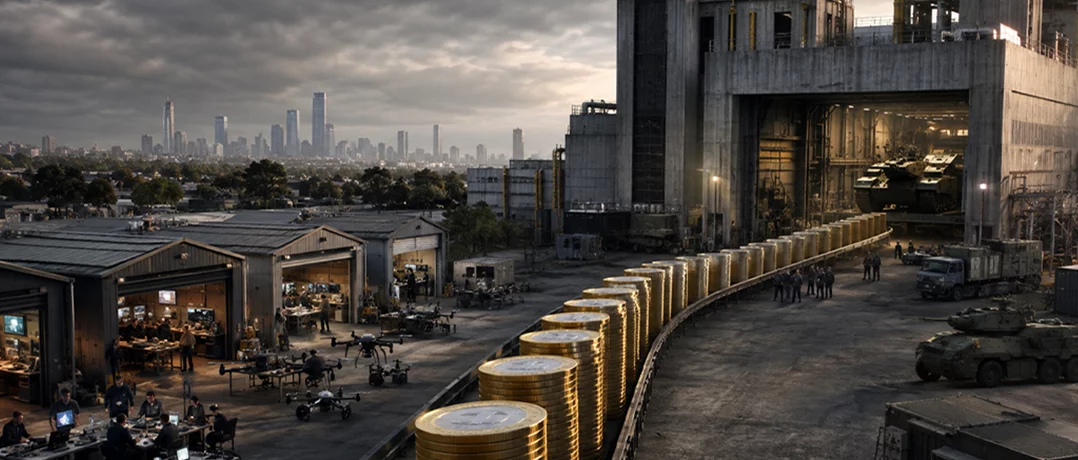
Europe is in the midst of its largest military buildup in decades. Russia’s invasion of Ukraine and doubts over U.S. security guarantees have pushed governments across the continent to spend far more on defense. NATO said in July that defense expenditure among its European members and Canada rose by nearly 20% in 2025 alone, while the European Union has outlined plans intended to mobilize as much as €800 billion for defense through its Readiness 2030 initiative. Yet much of that spending has exposed a paradox. Europe is investing heavily in its own security while remaining dependent on American manufacturers for some of its most advanced weapons. New research by economists at Bruegel, a Brussels-based economic policy think tank, shows that U.S. Foreign Military Sales notifications to Europe jumped from $28.6 billion in 2022 to $76.4 billion in 2024. At the same time, European procurement remains concentrated among established contractors, making it difficult for younger technology companies to compete. “There are two major problems in European defense procurement,” Javier Ospital, an economist at Bruegel and co-author of the research, told The Beiruter. Europe’s military ambitions may be advancing faster than its defense industry can adapt. Europe’s dependence on American weapons predates the war in Ukraine, but the conflict accelerated it considerably. The Bruegel database tracks U.S. government notifications of proposed Foreign Military Sales between 2008 and 2025. The figures represent potential transaction values rather than completed deliveries, but show a pronounced rise in European demand for American military equipment following 2022. The dependence is particularly significant at the technologically sophisticated end of the market. European governments generally source standardized equipment, including ammunition, domestically, Ospital said, while turning to the United States for high-value systems European suppliers cannot readily provide. “The reason European governments continue to purchase from the United States is that certain capabilities simply are not available elsewhere,” he said, pointing to the F-35 and the software, support and maintenance required to operate it. The Stockholm International Peace Research Institute’s March 2026 analysis found that European states’ imports of major weapons rose 210% between 2016-20 and 2021-25. The United States supplied 58% of imports by European NATO members during the latter period. Even without political disagreements with Washington, dependence on a dominant supplier leaves Europe vulnerable to production constraints and competing geopolitical demands. “Relying on a single supplier is always a risk,” Ospital said. Buying more European weapons would appear to offer one solution. Yet Europe faces another problem: its procurement system often struggles to turn promising technology companies into major defense suppliers. Research by Ospital, Ethan Kapstein and Guntram Wolff, found that the 10 largest contractors captured roughly 67% to 90% of military procurement in Germany, Poland and the United Kingdom between 2020 and 2025. In the United States, the comparable figure was below 40%. Europe also has a smaller emerging defense technology ecosystem. The researchers identified roughly 300 defense startups across Europe, including Ukraine and the UK, compared with about 770 in the United States as of January 2026. “Defense markets don't function like most other markets because, ultimately, there is only one buyer: the state,” Ospital said. A startup developing autonomous aircraft, military software or AI-enabled systems cannot scale simply by finding thousands of private customers. It ultimately needs governments to buy its technology. Yet European procurement has traditionally favored established contractors with long records of delivering complex military systems. That pattern is beginning to change. Ospital and his co-authors point to significant German drone orders with Helsing, Quantum Systems and Stark Defence in 2025. Expanding those opportunities, however, will require changes to how governments award contracts. “That is an area where Europe still has considerable room for improvement,” Ospital said. European defense procurement remains largely organized along national lines, with governments favoring established domestic suppliers rather than treating the continent as a single market. “In most major European countries, defense procurement is dominated by large domestic suppliers,” Ospital said. For emerging companies, that fragmentation limits access to scale. A German startup, for example, may compete primarily for German contracts rather than across the EU’s 27-member market. Defense remains one of the least integrated areas of European policymaking, according to Ospital, with governments reluctant to transfer authority over military spending and procurement to the EU. More cross-border procurement could give technology companies access to a larger market and greater scale, but would require governments to relinquish some national control. While Europe debates procurement reform, Ukraine has demonstrated the possibilities of a different approach, accelerating the adoption of relatively inexpensive drones, autonomous systems and software while taking a more market-oriented approach to purchasing new technologies. The lesson, Ospital said, is not that inexpensive drones can replace fighter aircraft or missiles, but that new technologies can sometimes achieve military objectives more cheaply and with less risk to personnel. “The greatest risk is failing to absorb the lessons of Ukraine,” Ospital said. Continuing to prioritize long-term contracts for expensive conventional platforms could leave European militaries invested in systems that prove less effective against cheaper technologies such as drones, wasting resources while leaving them less prepared for future conflicts. Avoiding that outcome will require Europe to reconsider not only what it buys, but who is able to build it. Without a more competitive defense industry, greater spending could leave the continent dependent on American technology for some of its most sophisticated capabilities rather than delivering the strategic autonomy European governments are seeking.The first is the heavy reliance on U.S. weapons production, which has increased markedly since Russia's full-scale invasion of Ukraine. The second is the overreliance on a very small number of large defense contractors.
The American dependency
As Europe has increased defense spending, its dependence on one supplier has become a supply chain bottleneck.
Why Europe struggles to build challengers
Bringing more small, technology-oriented companies into the defense sector requires deliberate government policy.
Europe is still not one defense market
Governments generally prefer to buy from companies under their own jurisdiction because they view domestic production as an important element of national sovereignty.
What Ukraine changed
European countries can learn a great deal from Ukraine, particularly which technologies work best in asymmetric warfare, which can deliver similar battlefield outcomes at lower cost, and which reduce risks for military personnel.
-
-

-
Katharine SorensenReporterSpecializing in global affairs, technology and economics, with a focus on on-the-ground investigative reporting.
-
