



The Beiruter reached out to both Yeghia Tashjian and Thibaut de La Tocnaye to better understand Europe’s involvement in Lebanon’s current conflict which is reflected through active diplomacy but limited strategic leverage.
Europe’s contribution and influence in Lebanon’s conflict
Europe’s contribution and influence in Lebanon’s conflict
By The Beiruter | April 15, 2026

Reading time: 5 min
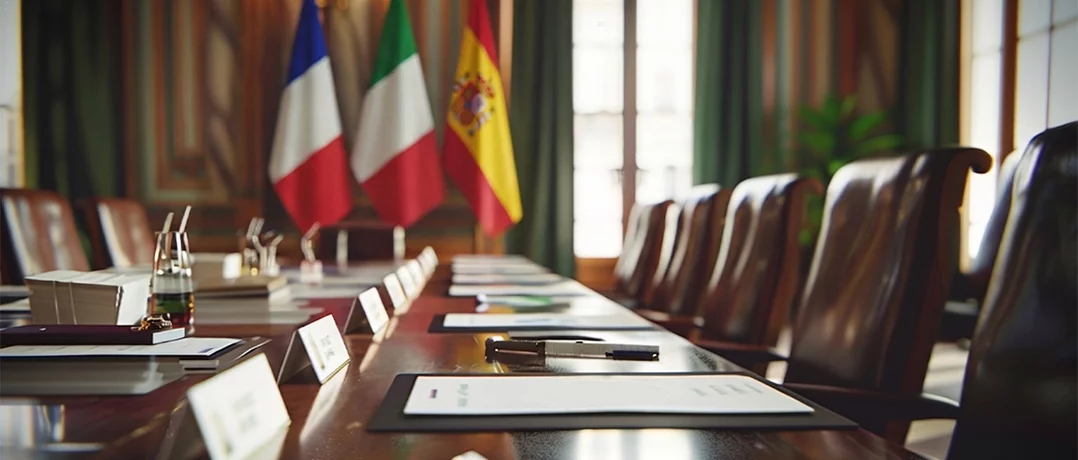
Europe’s role in Lebanon’s evolving conflict has been shaped by a persistent gap between political concern and practical influence. As armed conflict persisted along the Lebanese front between Israel and Hezbollah, European governments found themselves increasingly engaged in diplomatic messaging while remaining constrained in terms of hard power.
Their approach has combined calls for de-escalation, selective policy adjustments, and growing pressure, yet without a unified strategy capable of decisively shaping outcomes on the ground in Lebanon.
European latest engagement with the Lebanese front
In the most recent phase of escalation along the Lebanese front, European states have maintained an active but merely diplomatic posture, marked by joint statements, selective policy adjustments, and increased engagement within multilateral frameworks. As hostilities between Israel and Hezbollah remain ongoing, European governments increasingly stressed the need to prevent the conflict from expanding further across the region, particularly into Lebanon.
In fact, following Israel’s so-called “Operation Eternal Darkness” against various Lebanese territories (including the capital Beirut), which was considered the deadliest day of fighting since the start of the war on 2 March 2026 (when over 200 people were killed), the European Union (E.U.) reiterated in a joint statement on 8 April 2026 that any ceasefire arrangement, particularly the recently announced 2-week ceasefire between the United States (U.S.) and Iran, must include Lebanon, warning that separating the country from broader de-escalation frameworks would weaken the credibility of ongoing diplomatic efforts. This position has been echoed by several member states, including the United Kingdom (U.K.), Germany, and Spain, which have stressed that a geographically fragmented ceasefire risks institutionalizing instability rather than resolving it.
Moreover, one of the most tangible policy developments has emerged from Italy, which suspended the automatic renewal of its defense cooperation framework with Israel, signaling a conditional reassessment of bilateral military ties in light of developments in Lebanon. This decision was influenced in part by security concerns involving European personnel deployed under the mandate of the United Nations Interim Force in Lebanon (U.N.I.F.I.L.), highlighting the direct exposure of European actors operating in southern Lebanon.
Yeghia Tashijian’s take on Europe’s influence and role in Lebanon’s current conflict
In an interview with The Beiruter, Regional and International Affairs Cluster Coordinator at Issam Fares Institute for Public Policy & International Affairs (I.F.I.) at the American University of Beirut (A.U.B.), Yeghia Tashijian, believed that Europe has been diverse more than ever, countries such as France, Spain, and Italy have shifted their traditional pro-Western foreign policy due to several factors:
First, the scale of destruction and civilian casualties in Gaza has reached a threshold that European governments find increasingly difficult to politically justify or ignore. This has pushed many E.U. leaders to shift from cautious diplomacy to more open criticism and calls for restraint or ceasefire.
Second, there is growing domestic pressure on these governments, especially by the youth due to growing influence of civil society, student movements, and human rights groups.
Third, there is value issue, European states, unlike the U.S., these days, place strong emphasis on international law and humanitarian norms.
Finally, which is highly strategic, is related to E.U.’s strategic autonomy from the U.S. There is a growing effort within Europe, especially from France, to assert independent foreign policy positions. This was clear during the Hormuz Crisis where Paris refused to assist Washington, and the sidelining of France in the trilateral talks between Israel and Lebanon led by the U.S.
All these factors, as noted by Tashijian, push major E.U. to take a stance towards Israel (except Germany and other E.U. members) to detach Lebanon from the U.S.-Iranian talks. It is worth mentioning that the E.U. has geo-economic interests in the Eastern Mediterranean, and instability in Lebanon would threaten these interests (which include energy security, refugees, and poverty).
In addition, Tashijian stated that there are certain discussions regarding the possible replacement of U.N.I.F.I.L. with contributions from the E.U. in the future (referring to sending boots on the ground). Given that the union is a highly bureaucratic regional organization, Tashijian hinted at a small monitoring force that trains the army and provides humanitarian aid. Indeed, there are cases which are successful recently implemented by the E.U. mission in Armenia near the border with Azerbaijan. Of course, the Lebanon-Israel border is more complicated, however there are discussions on the table prior to the United Nations Security Council (U.N.S.C.) meeting in June that may address the issue of U.N.I.F.I.L.
France’s Role in Lebanon: A Critical Perspective from Thibaut de La Tocnaye
To better comprehend France’s role in Lebanon, The Beiruter reached out to Thibaut de La Tocnaye, writer, French politician (mayor and regional councilor), and Vice President (V.P.) of Chrétienté Solidarité, contended that France’s reduced influence in Lebanon is largely due to its failure, under President Emmanuel Macron, to fully recognize Hezbollah’s disarmament as the indispensable condition for restoring stability and prosperity. He argued that Paris has also weakened its position by adopting an overly cautious approach toward Iran, particularly regarding its nuclear ambitions, thereby diminishing its credibility with Israel.
Nevertheless, de La Tocnaye maintained that France can still play a constructive, albeit indirect, role. In his view, Paris should focus on reaffirming the strategic importance of Lebanon’s Christian community, which he described as a central pillar of balance, neutrality, and long-term stability within the country’s fragile political system. He warned that large-scale displacement, especially from southern Lebanon, could disrupt this equilibrium and accelerate the emigration of Christians, ultimately reshaping Lebanon’s identity.
While supporting efforts to dismantle Hezbollah’s military infrastructure, de La Tocnaye cautioned against the widespread destruction of southern Lebanon, arguing that such actions would prevent displaced populations from returning and risk deepening instability.
He also criticized President Macron’s perceived inconsistency and limited understanding of the region’s complexities, particularly Lebanon’s delicate power-sharing arrangement. More broadly, he expressed concern about regional strategies, including those associated with U.S. President Donald Trump, warning that unclear policies toward Iran and escalating military dynamics could further destabilize Lebanon.
Hence, Europe’s recent actions reflect a pattern of heightened diplomatic activity combined with limited coercive tools. While there is growing convergence on the need to prevent further escalation in Lebanon, the absence of a unified enforcement mechanism continues to limit Europe’s ability to translate political concern into decisive strategic impact.
-
-

-
The Beiruter
-
