



The mortality of language opens onto larger questions about living with loss, building from the debris of war and the limits of what words can name, explored through the ideas of Lebanese artist and professor Walid Sadek.
Every language is a mutation

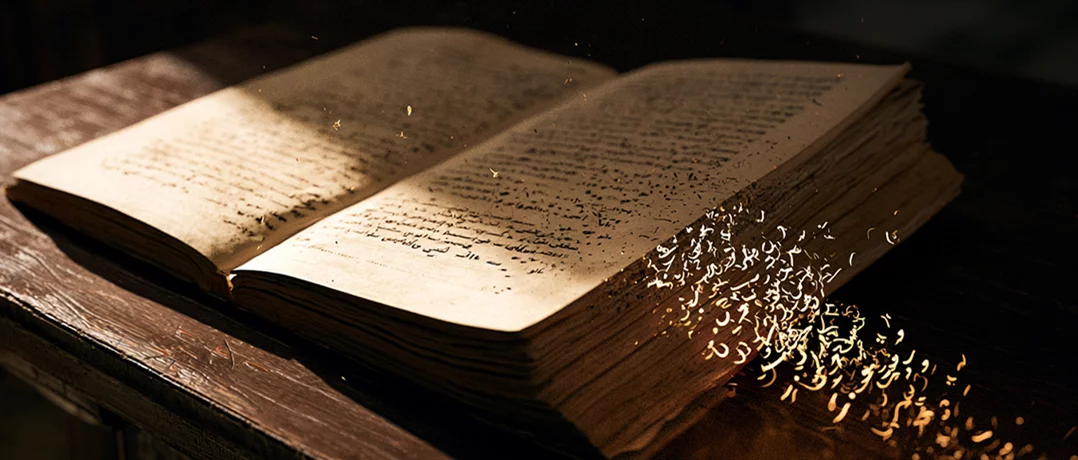
Living languages behave as though they will live forever. They name the world around them, determining what can be said, described and understood. Yet even the most powerful languages are mortal. Latin once governed an empire. Syriac was spoken across much of the Middle East. Languages that appear permanent can recede, fragment or disappear. “There’s an assumption that if you are writing in a living language, this living language is almost eternal,” Walid Sadek, an artist and professor at the American University of Beirut, told The Beiruter. The harder question is whether a language can recognize that mortality while it is still alive. In his How to Speak Dead, Sadek gives that possibility an unusual name. To “speak dead,” he argues, is not to speak a dead language, but to speak from within a living one while recognizing its mortality. The same tension extends beyond language to how people and societies confront what cannot be recovered. Survival creates a temptation to imagine that what has been damaged can be restored, the past put away and something whole constructed in its place. But what if living requires something else: accepting that whatever comes next will be made, at least partly, from the debris of what has been lost? Language ordinarily promises a kind of mastery. To name something is to distinguish it from everything else, to place it within a world that can be described and understood. “Language is usually taught as power,” he said. Loss complicates that claim to mastery. Before something lost can be mourned or lived with, it must first be recognized and named. In Lebanon, that process remains incomplete. More than three decades after the Civil War ended, Lebanon has no shared account of its dead and no common ritual through which to mourn them. “The Lebanese did not agree on who died, who was a martyr, and the value of their death,” Sadek said. What follows from recognizing loss, however, is not necessarily restoration. Sadek instead distinguishes between what destruction leaves behind and what can be made from it. Debris is what remains. A ruin is what is built from it, carrying the loss rather than erasing it. “Whatever we build will always have the traces of the war,” Sadek said. Lebanon, like language, carries a long history of loss. Its successive wars have repeatedly left people to build from what remains, making the past part of the material of whatever comes next. Languages, too, are built from remnants. Words survive migrations, conquests and the disappearance of the worlds that once gave them meaning. In How to Speak Dead, that relationship emerges through Syriac and Arabic. Sadek describes a dying Syriac giving way to and, in part, “begetting” the Arabic that would flourish after it. The inheritance poses a problem: What does a living language owe the language that came before? Recognition would seem to offer an answer. Arabic can acknowledge its debt to Syriac and preserve its words. But recognition alone does not produce reciprocity. The living language still determines the terms on which the dying one survives. Once a language is dead, that imbalance becomes absolute. Its words can be borrowed and repurposed, but the language itself can no longer resist their use. It can be mined without challenging the authority of the language that absorbs it. Yet that authority is temporary, even if the living language behaves as though it were permanent. What, then, does it owe the language that came before? “I think the first thing it owes it is to recognize that it's also a dying language,” Sadek said. To speak dead, then, is to relinquish some of the permanence a living language claims for itself, speaking without assuming that its names are final, its categories fixed or its authority over the world assured. To acknowledge language's mortality is also to acknowledge its limits. No language names the world completely or with absolute certainty. A word can identify something without ever becoming identical to it. Description can become more precise, but some distance between language and the world always remains. What would happen if that distance disappeared? Sadek finds one answer in Sufi traditions that long for the dissolution of the self into the oneness of the creator. At the moment of complete union, there is nothing left to approximate or represent. “You reach that certainty, and there’s no language needed anymore,” Sadek said. The possibility reverses an ordinary assumption. Linguistic uncertainty can appear to be a weakness, something to overcome through greater precision or more exact description. But complete certainty would eliminate the very distance that makes speaking possible. Perhaps the value of language lies partly in its failure to deliver certainty. Neither language nor life after loss can restore everything that came before. To speak dead is to accept that limit and, in doing so, leave room for the world to be named differently.It’s not within the imagination of a living language to foresee its own death.
What survives loss
Language is how we distinguish, divide and categorize, how we use it to control and to belittle.
We live in a country where the dead have not yet been buried.
Our future, if we are ever able to build one, is, for us who have lived through wars, necessarily a ruin.
A language that cannot die
Living languages deny their mortality, which lurks within them. Maybe speaking dead is to speak the mortality in the language, not the power in the language. It is a way of recognizing your own mortality.
The uncertainty of language
Epiphany, in this sense, offers liberation from the uncertainty of language. But it does so by making language unnecessary.
-
-

-
The Beiruter
-
