



After 17 years of waiting, the Maronite Church of the Baptism of Jesus Christ at Al-Maghtas in Jordan is finally moving from plans to construction. This exclusive report reveals new details about the project and plans to expand the Maronite presence across Jordan.
Exclusive to The Beiruter: A growing Maronite presence in Jordan
Exclusive to The Beiruter: A growing Maronite presence in Jordan
By Michella Rizk | August 28, 2026

Reading time: 8 min
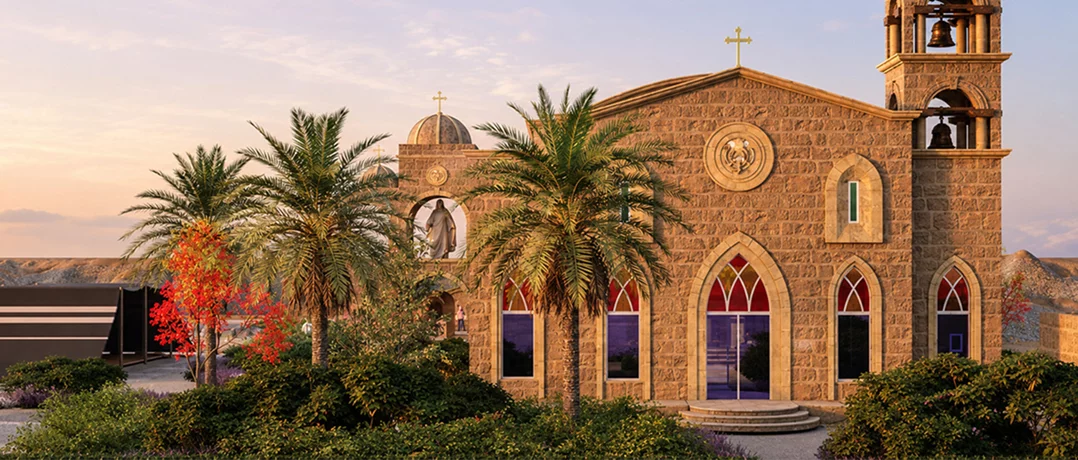
After 17 years of waiting, a Maronite project at one of Christianity’s most significant sites is finally moving from cornerstone and architectural plans to construction.
The journey of the Maronite Church of the Baptism of Jesus Christ at Al-Maghtas, Jordan’s Baptism Site, began in 2009. Its cornerstone was laid in 2012, but more than a decade would pass before the engineering, administrative and financial requirements needed to build it fell into place. Funding has now been secured, and construction is expected to take around 18 months.
What will rise at the site traditionally associated with the baptism of Jesus Christ by John the Baptist is more than a church. The plans envision a fully integrated complex with facilities for pilgrims, parishioners, accommodation and activities.
And Al-Maghtas is only part of a much larger story.
In an exclusive interview with The Beiruter, Father Joseph Soueid, the Patriarchal Vicar of the Maronites in Jordan, reveals that
preparations are also underway for a new church dedicated to Saint Rafqa in Fuheis, Jordan, on a plot of approximately 11,000 square meters.
Together with Saint Charbel Church in Amman and the new church at Al-Maghtas, the third project could, in Father Soueid’s vision, become another step toward consolidating the Maronite presence in Jordan and eventually developing it into a more established Maronite ecclesiastical structure.
A project 17 years in the making
The story began in 2009, when King Abdullah II bin Al-Hussein allocated a plot of approximately 4,000 square meters at Al-Maghtas to the Maronite Church.
The project was initiated during the tenure of the late Maronite Patriarch Nasrallah Boutros Sfeir. It entered a new phase under Patriarch Bechara Boutros Al-Rahi, who laid the cornerstone at the site in 2012.
 Maronite Patriarch Cardinal Bechara Boutros Al-Rahi with Father Joseph Soueid, Patriarchal Vicar of the Maronites in Jordan.
What followed was a lengthy process involving land registration, documentation, approvals and the development of architectural plans suited to the religious and archaeological sensitivity of the Baptism Site.
In 2024, the Maronite Patriarch tasked Father Soueid with directly overseeing the project. His work included completing the planning and documentation files, while coordinating with Jordanian and ecclesiastical authorities, the Lebanese diaspora, Christian communities abroad and relevant diplomats to secure the funding required to launch construction.
On the Jordanian side, Prince Ghazi bin Muhammad, the King’s adviser for religious and cultural affairs, was among the key figures following the project.
After years of planning and attempts to secure financing, the project has now reached the point its supporters had waited for: actual construction.
A site designed to stand out
The significance of the project lies not only in being located at Al-Maghtas, but also in where the Maronite church will stand within the site.
In another important detail revealed to The Beiruter, Father Soueid says the Maronite Church was given a prominent position at the entrance to Al-Maghtas, making its façade one of the first visitors will see as they enter.
He places that decision within the context of the longstanding relationship between Jordan’s Hashemite royal family and the Maronite Patriarchate, stretching from the reign of King Hussein bin Talal to King Abdullah II.
That relationship will also be visible in the architecture.
Father Soueid reveals that
Prince Ghazi bin Muhammad asked for the façade of the Al-Maghtas complex to draw inspiration from the Maronite Patriarchal See in Bkerke.
The result will give the Maronite complex at the entrance to Al-Maghtas a direct architectural reference to the seat of the Maronite Patriarchate in Lebanon.

More than a church
Calling the project a “new church” does not fully capture its scale.
The church will form part of a larger complex designed for pilgrims, parishioners, accommodation and activities. Plans include an underground theatre, spaces for residents and members of the parish, and a “Ruth Tent,” named after the biblical Ruth, who appears in the genealogy of Jesus.
The aim is to create a site capable of hosting pilgrims and religious and cultural activities rather than limiting its function to the celebration of Mass.
Ten years of plans
Reaching the construction stage was preceded by years of architectural work. Engineer Osama Tawal has accompanied the project since its early stages, studying the site from historical, spiritual and engineering perspectives and developing its plans over roughly a decade.
One of the central challenges was finding a design that could preserve the architectural identity envisioned for the complex while complying with the regulations governing Al-Maghtas and UNESCO requirements.
With the project now moving into construction, engineer Habib Haddad and his team are overseeing its engineering and on-site implementation, in coordination with Tawal and the other parties involved.
The funding breakthrough
For years, financing remained the main obstacle standing between the architectural plans and an actual building.
That changed when Lebanese businessman Sheikh Sarkis Elias Sarkis agreed to fully fund the project.
Father Soueid described the contribution as having “restored hope in a project that has been waiting since 2009,” stressing that
the objective was not simply to build a church, but to create a house of prayer, a beacon of faith, a destination for pilgrims, and a bridge of love and encounter between peoples.
With the financing secured, construction can finally begin. Under the current schedule, the work is expected to take around 18 months.
The significance of that support is amplified by the site itself. "Al-Maghtas is traditionally identified as the place where Jesus was baptized by John the Baptist, where the heavens opened, the Holy Spirit descended and the voice of the Father was heard: “This is my beloved Son, with whom I am well pleased.”"
From the Baptism Site to the Lebanese diaspora
For the Maronite Church, choosing Al-Maghtas carries a meaning that extends beyond expanding its geographical presence in Jordan.
The site is associated in Christian tradition with the baptism of Jesus by John the Baptist in the Jordan River and the Gospel scene bringing together the Son, the descent of the Holy Spirit and the voice of the Father.
Father Soueid captures its significance in a simple phrase: “Heaven and earth met there.”
But the spiritual identity of the project does not mean it is intended for Maronites alone.
While unmistakably Maronite, the complex is also envisioned as a destination for Lebanese visitors, including the diaspora, and for pilgrims arriving from Lebanon and Lebanese communities around the world.
Father Soueid describes it as
a church for all of Lebanon and the Lebanese abroad.
 President Joseph Aoun with Father Joseph Soueid, Patriarchal Vicar of the Maronites in Jordan, during a meeting highlighting the continued cooperation between Lebanon’s leadership and the Maronite Church.
On the agenda: from the opening to the 2030 Jubilee
The plans do not end when construction is completed.
In information shared with The Beiruter, Father Soueid says the Maronite Patriarchal Vicariate in Jordan is preparing to connect the opening of the complex with preparations for the 2030 Jubilee, marking roughly 2,000 years since the preaching of John the Baptist, the baptism of Jesus and the beginning of Christ’s public ministry.
Ahead of the Jubilee, plans are being developed around three major milestones intended to form part of a single program:
- celebrating the 30th anniversary of Saint Charbel Church in Amman,
- inaugurating the Church of the Baptism of Jesus Christ at Al-Maghtas,
- laying the cornerstone for a new church project in Fuheis.
The ambition is for these occasions to extend beyond local church celebrations, drawing religious and civil leaders, pilgrims, and Lebanese visitors from both Lebanon and the diaspora while reconnecting them with Jordan’s historic Christian sites.
Father Soueid’s vision extends further, to 2033. Rather than allowing pilgrimage activity to end with the 2030 Jubilee, he envisages the following years continuing to mark milestones associated with the life and ministry of Jesus, culminating in those connected to his death and resurrection.
Within that vision, Jordan and Lebanon could form part of a broader pilgrimage route for visitors to the region, connecting historic Christian sites across both countries rather than treating them as separate destinations.
Exclusive: Saint Rafqa Church
In information revealed for the first time to The Beiruter, Father Soueid says preparations are underway for a church dedicated to Saint Rafqa in Fuheis, on an 11,000-square-meter plot he says King Abdullah II bin Al-Hussein allocated to the project.
Unlike Al-Maghtas, which has reached the construction stage, the Fuheis project remains in its early phases and has yet to secure funding. But its significance goes beyond adding another church.
With Saint Charbel Church already in Amman and the Church of the Baptism of Jesus Christ moving into construction at Al-Maghtas, Saint Rafqa Church would further expand the Maronite footprint across Jordan. Its location in Fuheis, one of the kingdom’s most prominent Christian population centers, would also give it a distinct role from both Amman and the pilgrimage complex at Al-Maghtas.
If the project moves forward, the laying of its cornerstone is planned as one of three major milestones marking the next phase of the Maronite Church’s presence in Jordan.
From a church to a broader presence
Seventeen years after the project first began, the Maronite complex at Al-Maghtas is finally moving from plans to construction.
But what is taking shape around it points to something larger than a single new church: a Maronite presence stretching across Amman, Al-Maghtas and potentially Fuheis, connected at the same time to pilgrimage and to Lebanese communities at home and abroad.
Some of those plans are already becoming construction sites. Others still need financing and further steps before they can become reality.
For now, Al-Maghtas is the beginning.
-
-

-
Michella RizkContent Manager/WriterFocusing on social affairs.
-
