



On the fourth anniversary of Russia’s invasion of Ukraine, Ambassador Roman Goriainov reflects on the war’s evolution, Ukraine’s resilience, and the global stakes for sovereignty and international order.
Exclusive to The Beiruter: Ukraine’s Ambassador on four years of war
Exclusive to The Beiruter: Ukraine’s Ambassador on four years of war
By Josiane Hajj Moussa | February 24, 2026

Reading time: 7 min
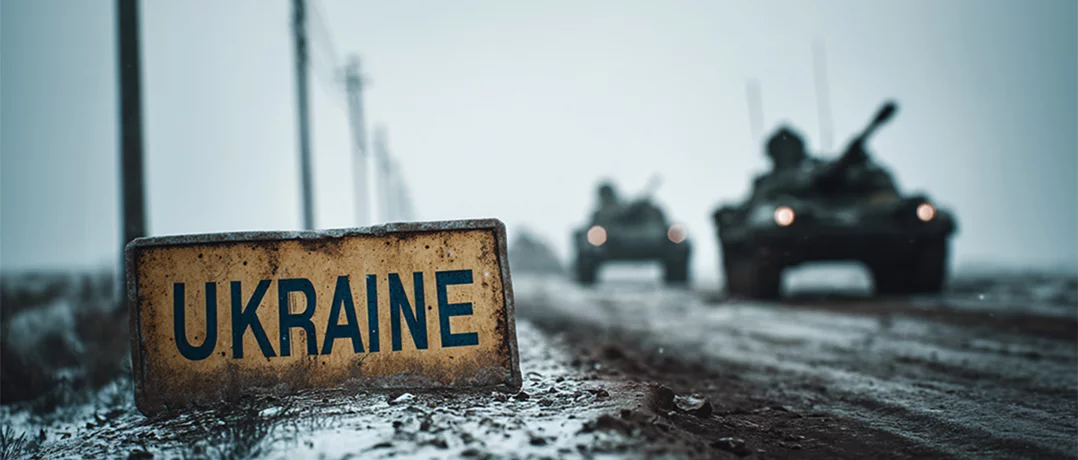
4 years after Russia launched its full-scale invasion of Ukraine on 24 February 2022, the war has entered what Ukrainian officials describe as a prolonged and defining phase not only for their country, but for the international order.
In an interview with The Beiruter marking the 4th anniversary, Ukraine’s Ambassador to Lebanon, Roman Goriainov, assessed the evolution of the conflict, the resilience of Ukrainian society, the military reality in 2026, and the broader geopolitical implications for Europe, the Middle East and smaller states navigating an increasingly polarized world.
A conflict dating back prior to 2022
“This war did not start in 2022,” the ambassador said. He described the full-scale invasion as a continuation of Russia’s actions that began in 2014, when Moscow “illegally took over Crimea and parts of eastern Ukraine,” framing it as part of a longer pattern aimed at preventing Ukraine from charting its own path.
Russia, he said, expected Ukraine to collapse quickly.
But the opposite happened. Ukrainians united. Our government kept functioning, our army defended the country, and society came together to protect our independence.
According to Goriainov, the war has reshaped Europe’s security architecture and demonstrated that peace cannot be preserved by appeasement or yielding to an aggressor. The principles of sovereignty and territorial integrity enshrined in the United Nations Charter, he said, “are not just ideals; they are essential for global stability,” a point he noted is especially meaningful for countries such as Ukraine.
What Russia envisioned as a rapid offensive has, in his view, become a protracted conflict. Moscow failed to overthrow Ukraine’s government, he said, while Kyiv continues to defend its territory, strengthen its defense industry and build international partnerships.
He also underscored the war’s global repercussions, from food security and energy supplies to international politics. Ukraine, he said, has worked to keep grain exports flowing, particularly to the Middle East and North Africa (MENA), recognizing their humanitarian importance.
Ukraine’s stated objective remains "a just and lasting peace based on restoring all Ukrainian territory and holding Russia responsible for its aggression.” A frozen conflict, he argued, would not produce stability and would instead risk renewed aggression.
From survival to strategic endurance
For Ukrainians, the 4th anniversary is “above all a day of remembrance and gratitude,” Goriainov said, honoring soldiers, civilians and families whose sacrifices have sustained the country.
On 24 February 2022, shock quickly turned into unity, he said, as people across regions, languages and religious backgrounds chose to defend their independence. At the outset, “victory” meant survival: keeping the state functioning, protecting Kyiv, and preventing the collapse Russia anticipated within days.
4 years on, he said, Ukrainian society has become more experienced and strategic. Victory is no longer defined solely by battlefield outcomes but by restoring territory, ensuring accountability, securing strong guarantees, rebuilding communities, and integrating politically, militarily and economically into Europe.
Resilience, initially spontaneous in 2022, has become institutional, he said. Ukraine has strengthened its military, expanded defense production, stabilized the economy, and maintained democratic institutions despite the war.
Confronting misconceptions
The ambassador identified several persistent international misconceptions. Among them is the notion that the war is a “regional dispute” or a clash between equal sides. “It is a clear act of aggression by a nuclear-armed state against its sovereign neighbor,” he said.
Another misunderstanding, he added, is that the war began in 2022, overlooking the 2014 annexation of Crimea and the conflict in eastern Ukraine. He also rejected the idea that Ukraine is merely a proxy in a broader geopolitical rivalry, arguing that Kyiv is fighting for its own freedom and territorial integrity.
The suggestion that war fatigue will push Ukraine to accept a compromise peace, he said, ignores the risks of rewarding territorial conquest. Ukrainian society, he added, has demonstrated unity and civic responsibility across regions and communities.
 Residents ride a scooter in front of an apartment building hit by a Russian air strike in the town of Komyshuvakha, amid Russia's attack on Ukraine, in Zaporizhzhia region, Ukraine February 20, 2026. Andriy Andriyenko/Press Service of the 65th Separate Mechanized Brigade of the Ukrainian Armed Forces. Source: Reuters.
Military strategy and innovation in 2026
Goriainov described Russia’s current military strategy as combining sustained pressure along the front lines with long-range attacks on civilian infrastructure, particularly energy facilities during winter.
On the battlefield, he said, Moscow pursues incremental territorial gains through artillery, glide bombs, drones, and infantry assaults. Away from the front, strikes on power plants and heating systems seek both military and psychological effects, aiming to disrupt logistics and weaken morale.
Ukraine’s response, he said, has included strengthening air defense systems supplied by Western partners, decentralizing energy production and expanding long-range strikes against military targets in occupied territories and inside Russia. Diplomatically, Kyiv continues to characterize attacks on energy infrastructure as violations of International Humanitarian Law (IHL).
Modernization and innovation, including battlefield analytics and Artificial Intelligence (AI), have become strategic necessities rather than future ambitions. In a highly monitored battlespace shaped by drones, satellites and precision weapons, he said, “the force that innovates faster will have a better chance not only to withstand pressure, but to shape the course of the war itself.”
Ukraine’s most urgent needs, he added, are interconnected: air defense, ammunition, long-range systems, and credible long-term security commitments. Specifically, air defense remains the top short-term priority to protect cities and critical infrastructure.
Diplomacy, guarantees, and the conditions for peace
Addressing President Volodymyr Zelenskyy’s statement that a US-Ukraine security guarantees agreement is “100% ready,” Goriainov said such an arrangement would be significant politically and strategically, even if it differs from NATO’s collective defense commitments.
Ukraine expects structured, multi-year military assistance, defense industrial cooperation, intelligence sharing, and pre-agreed sanctions mechanisms that would activate in the event of renewed aggression. Predictability, he said, is as important as the scale of support.
Diplomacy and resistance, in Kyiv’s view, advance together. “Military resistance strengthens diplomacy, and diplomacy helps sustain military resistance,” he believed, arguing that negotiations without a strong military position risk freezing the conflict on Russia’s terms.
For a sustainable peace, Ukraine identifies 3 pillars:
- Territorial integrity within internationally recognized borders.
- Accountability for war crimes and reparations.
- Credible, long-term security guarantees to prevent renewed aggression.
While international support has grown more structured through multi-year packages and security assurances, he acknowledged it remains vulnerable to political changes in partner countries.
Global stakes and NATO’s future
If Russia’s invasion were normalized or left unresolved, Goriainov warned, it would weaken core principles of sovereignty and territorial integrity, potentially encouraging similar actions elsewhere, including in fragile regions such as the Middle East.
Economically, he said, a prolonged conflict affects food and energy markets and diverts resources from development. The outcome of the war will influence whether the international order remains rules-based or shifts toward a system where power outweighs law.
From Ukraine’s perspective, NATO’s future deterrence posture must reflect the lessons of large-scale war, stressing readiness, defense investment and political unity.
 The President of Ukraine Volodymyr Zelenskyy, his wife Olena Zelenska, the President of Lithuania Gitanas Nauseda and his wife Diana Nausediene attend 'Raising the Flag for Ukraine in NATO' event and concert in Vilnius, Lithuania on July 11, 2023. President Zelenskyy arrived to Lithuania to attend NATO Summit in Vilnius and support Ukraine in becoming a member of NATO. Source: AFP.
Reconstruction and international partnership
Despite ongoing hostilities, Ukraine continues planning for reconstruction. By 2026, priorities include strengthening institutions, improving the judiciary and anti-corruption measures, modernizing the economy and restoring civilian life, including support for displaced persons and veterans.
International partners, including non-European states, have a role to play through financing, technical expertise and trade integration. Multilateral institutions such as the World Bank and the International Monetary Fund (IMF) remain central to stabilizing public finances and coordinating recovery efforts.
Lebanon, sovereignty and shared lessons
On Lebanon, Goriainov described a country under heavy strain from overlapping crises but retaining regional relevance as a social, cultural, and commercial crossroads. He characterized Lebanon as a reliable partner in multilateral forums, particularly at the UN.
Ukraine’s experience, he suggested, offers lessons on sovereignty under both direct and indirect pressure. Strong institutions, public trust, economic stability, and active civic participation are essential to resisting external influence.
Opportunities for Ukrainian-Lebanese cooperation, he said, exist in diplomacy, trade, education, and cultural exchange, supported by diaspora ties and complementary economic strengths.
A message on 24 February
Marking the anniversary, the ambassador expressed gratitude to Lebanon for its solidarity and stressed that Ukraine’s fight is not only for its territory, but for the principle that borders cannot be changed by force.
As Ukraine enters another year of war, he called for continued political, economic, and humanitarian support, credible deterrence against aggression, and a firm commitment to international law and accountability. Supporting Ukraine, he said, helps defend principles that benefit all nations, including those in the Middle East.
Alas, 4 years into the conflict, the political stakes are clear. The war has become a measure of whether the international community will consistently uphold sovereignty and territorial integrity as enforceable norms. The manner in which states respond will not only shape Ukraine’s future, but will also influence the credibility of the rules-based order in regions far beyond Europe.
-
-

-
Josiane Hajj MoussaReporter
-
