



As displacement surpasses one million, a coordinated network of local kitchens and aid groups is delivering meals at scale across Lebanon, even as financial strain threatens its sustainability.
Feeding at scale in Lebanon’s war

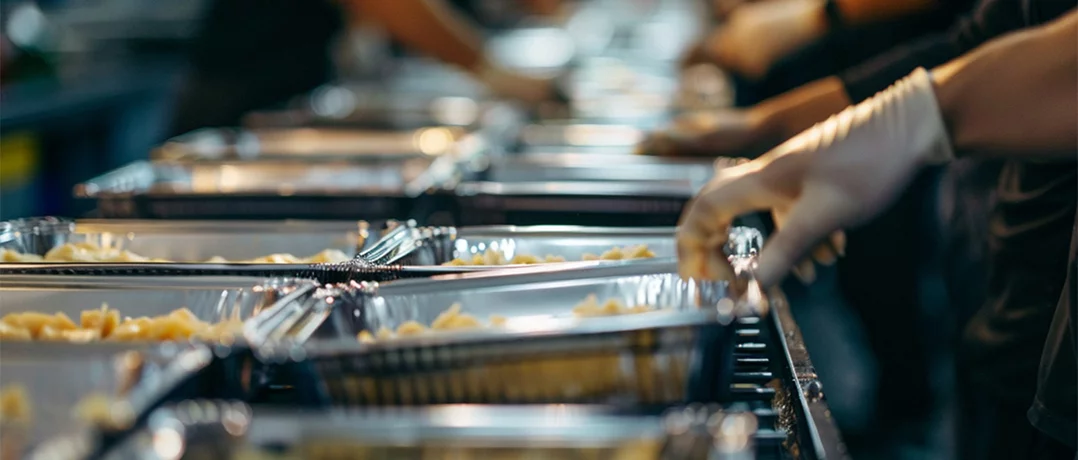
Feeding Lebanon’s displaced has emerged as one of the central humanitarian challenges of the war.
Since the escalation between Israel and Hezbollah began in early March, more than one million people have been displaced across Lebanon. Of those, over 140,000 are currently living in collective shelters spread across more than 680 sites nationwide, according to the most recent government data.
The distribution is uneven. Beirut and Mount Lebanon account for the largest share, with roughly 49,000 people in shelters in the capital and nearly 47,000 in Mount Lebanon. That concentration has intensified pressure on local infrastructure, reshaping how aid is delivered.
To meet the demands of feeding the displaced, the response now operates nationwide through an expansive network of local kitchens, NGOs, and international actors, working in close coordination with the government to assign, track, and distribute meals across hundreds of shelters.
Feeding through local networks
At the center of this network is World Central Kitchen (WCK), which is currently producing meals for approximately 25,000 families per day through a network of 12 kitchens across Lebanon.
“WCK’s strength is its ability to adapt,” said chef Aline Kamakian, who leads the organization’s response in Lebanon, speaking to The Beiruter.
Because we operate lightly, we can adapt and move fast.
The model reflects what Kamakian described as an “entrepreneurial mindset,” centered on speed and flexibility. Rather than building new infrastructure or importing supplies, it works through existing kitchens and restaurants, sourcing ingredients from Lebanese farmers and distributors and adjusting menus based on availability.
The support of Lebanon’s chefs, restaurateurs, and farmers is central to WCK’s efforts. Participating kitchens not only produce meals but help sustain livelihoods, keeping staff employed and local supply chains active even as the crisis escalates.
“We work within the local ecosystem,” Kamakian said. “This is the Lebanese feeding the Lebanese.”
Most partner kitchens are women empowerment community kitchens particularly in more remote areas such as Zahle and Baalbek, an important and often under-recognized pillar of the response.
WCK’s focus on supporting and sustaining local chefs is reflected in the quality of the meals produced. For many recipients, it is the only meal of the day. Ingredients are sourced seasonally, and meals are designed to be both efficient to produce and substantial enough to sustain the recipients throughout the day.
During The Beiruter’s recent visit to WCK’s Mayrig kitchen in Bsalim, staff prepared plaki with rice—a dish of white beans, parsley, carrots, and tomatoes—distributed in single-compartment containers designed to preserve the integrity of the meal, allowing the rice to absorb the sauce.
When a dish includes a salad, or components are not meant to mix, Kamakian explained, meals are instead packed in two-compartment containers.
For Kamakian, WCK’s work in Lebanon is also personal. Wounded in the Beirut port explosion and displaced herself then, she first encountered the organization as a recipient of aid before later joining its efforts.
“I was a receiver of WCK, and now I am a giver,” she said.
I felt on my skin how important it is, as an individual and as a chef.
At the kitchen level
At one partner kitchen, Souk el Tayeb’s Community Kitchen in Sinn el Fil, the model is carried out at scale. Since the first week of the war, the kitchen has been producing approximately 3,500 meals per day, seven days a week, serving a set network of shelters across Beirut and its outskirts.
The operation runs with around 50 staff—20 full-time employees and 30 volunteers—many of whom joined through word of mouth or local networks in the immediate aftermath of the escalation.
“Volunteers came very fast,” said Christine Codsi, head of Souk el Tayeb, during The Beiruter’s visit to the Sinn el Fil kitchen.
Neighbours, friends, and people who saw volunteer opportunities online. Practically, we never lack.
Among the kitchen’s staff is Mariam, who was displaced from the south and later from Dahiyeh, and now lives in a sports center converted into a shelter. She had worked at Souk el Tayeb before the war and has since returned, spending her days in the community kitchen.
“We have to act as one Lebanese people who are here to work together,” she said.“How else can we manage?”
Others have moved into roles they did not previously hold.
Fadi, a former Lebanese soldier, began his time at Souk el Tayeb working a range of jobs, from valet to office assistant. When a cook failed to show up one day, Codsi recalled, he stepped in, saying he knew how to cook. He later managed Souk el Tayeb’s Tawlet operations and now oversees much of the community kitchen’s large-scale preparations, applying his experience cooking in volume to the effort.
That kind of movement has become routine. Staff shift across roles as needed—waiters into procurement, waitresses into accounting—as the operation adjusts to demand.
Over time, working side by side under pressure has created a different kind of bond. “They’re like family,” Codsi said.
A more coordinated response
The scale of the response has required a level of coordination that was largely absent in previous crises. Organizations like WCKand their partner kitchens now operate within a broader, government-coordinated framework, working in close cooperation with the Ministry of Social Affairs.
For those involved, the shift is clear. Kamakian described the expanded role of the state as a defining change from previous responses, pointing to a new level of coordination and cooperation.
Codsi echoed that assessment, noting that the difference from 2024 is evident in how the system is organized and implemented.
We are much better organized compared to the 2024 war. The government is active this time.
At the operational level, that coordination is highly structured. Distribution is organized through shared Excel sheets that map which organization is responsible for which shelter, how many meals are required, and where food is going, ensuring every shelter is covered while preventing duplication.
The response follows a fixed daily schedule. Kitchens begin preparing meals as early as 6 a.m., with trucks leaving by around 11 a.m. To ensure meals arrive hot, partner kitchens are typically located within a 20 to 25 minute radius of the shelters they serve, a logistical constraint that affects both where kitchens operate and how routes are planned.
“Everything is monitored and precise,” Codsi said. “We report the number of meals, where they go, and the waste.”
Oversight has also expanded. A government hotline has been established for complaints related to food quality, while shelter data is updated continuously, allowing the network of NGOs and kitchens to adapt more quickly to changes in displacement patterns.
Rising costs, shrinking support
But while coordination has improved, the financial strain has intensified. “The operations themselves are not the problem,” Codsi said. “It’s the cost.”
Fuel prices have doubled since initial budgets were drawn up, Codsi said, raising the cost of producing a single meal at Souk el Tayeb from roughly $2 to about $2.50. At the same time, much of the response remains privately funded.
In 2024, Kamakian explained, Gulf countries and the international community were providing more direct funding and food aid, leading to a greater reliance on ready-to-eat (RTE) meals and broader financial support for operations. During the current escalation, as international attention has turned toward developments in Iran, funding has tapered off.
“There is a huge fund fatigue,” Kamakian said. “This is a threat in the long term.”
The result is a response that is more structured and efficient than in 2024, but increasingly constrained by the cost of sustaining it. While the network of local kitchens and partner organizations has demonstrated its ability to feed at scale under pressure, sustaining that effort as displacement continues and costs rise will require continued funding and coordination.
In the absence of both, the displaced in Lebanon’s shelters are at risk of losing consistent access to meals.
-
-

-
The Beiruter
-
