



A humanoid robot deployed in eastern China is assisting traffic police by monitoring intersections, identifying violations, and issuing real-time warnings as part of the country’s broader push toward AI-powered smart cities.
First AI humanoid police robot

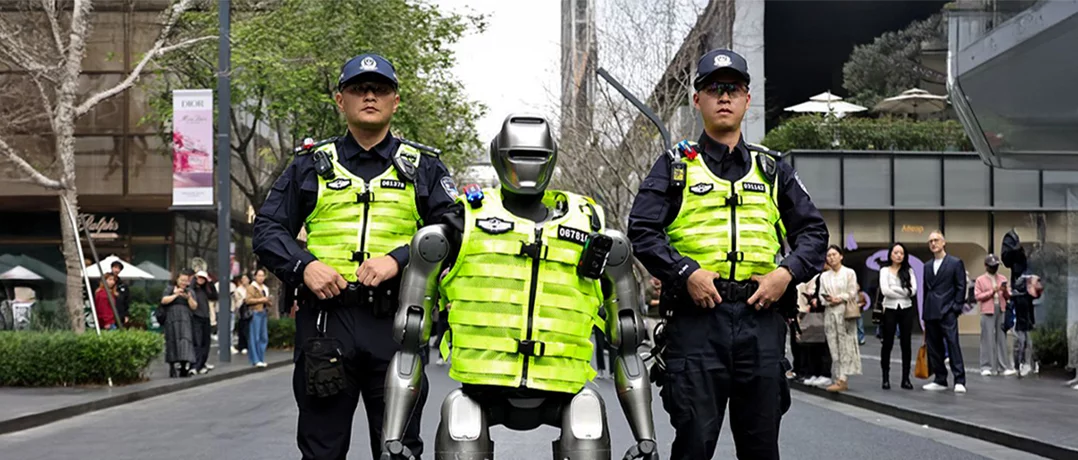
In the eastern Chinese city of Wuhu, authorities have deployed a humanoid robot to assist traffic police at a busy intersection, marking another step in the country’s push toward AI-driven urban management.
The robot, named Intelligent Police Unit R001, has been stationed on a traffic safety island, where it issues real-time voice warnings to pedestrians and cyclists who violate traffic rules. Wearing a police uniform, reflective vest and white cap, the robot closely resembles a human officer from a distance.
Equipped with high-definition cameras and an intelligent voice broadcasting system, R001 is connected to the city’s traffic signal network. It performs standard traffic-control gestures synchronized with traffic lights and uses large-model algorithms to automatically identify violations by pedestrians and non-motorized vehicles, issuing warnings on the spot.
Beyond its stationary role, the robot is capable of autonomous movement to designated locations. It can monitor traffic conditions in real time and identify illegal parking, expanding its function beyond simple signaling to broader traffic supervision.
The deployment comes amid rapid growth in China’s embodied intelligence sector, which focuses on robots designed to operate in human environments. According to the Development Research Center of the State Council, the industry is projected to reach 400 billion yuan (approximately $57.1 billion) by 2030 and exceed 1 trillion yuan by 2035.
Officials see the Wuhu experiment as part of a broader push toward smart cities, where AI-powered systems are expected to enhance efficiency, improve compliance and reduce the need for human officers to perform routine monitoring tasks.
As cities worldwide explore the use of artificial intelligence in public safety, deployments such as R001 offer a glimpse into a future in which human officers and intelligent machines operate side by side. While the technology remains in an early stage, China’s experience is increasingly being viewed as a potential reference point for other countries considering AI-assisted traffic management and urban policing.
-
-

-
The Beiruter
-
