



Lebanon and Israel have included civilian representatives in their 2024 ceasefire committee, signaling a cautious shift toward broader dialogue while stopping short of peace talks.
First direct civilian talks between Lebanon and Israel
First direct civilian talks between Lebanon and Israel
By The Beiruter | December 05, 2025

Reading time: 5 min
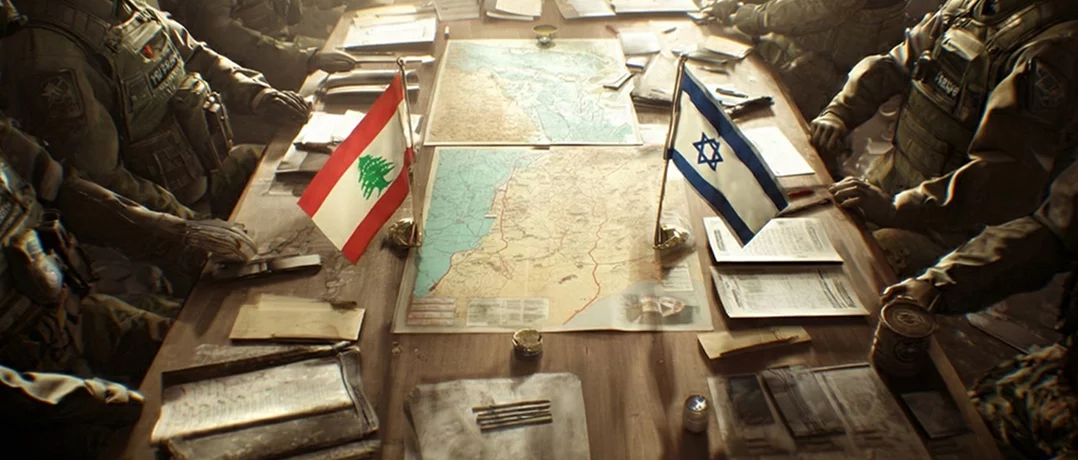
For the first time in years, Lebanon and Israel have sent civilian representatives to join a committee originally created to supervise their 2024 ceasefire.
What began as a strictly military coordination platform is now cautiously expanding into a broader channel of communication, one shaped by American mediation, regional tensions, and lingering fears of renewed violence along the southern Lebanese border.
While the step does not amount to peace negotiations, it signals a potential shift in how the two manage their fragile relationship.
Who is Simon Karam?
Simon Karam was born in Jezzine, South Lebanon and studied law in the Sain Joseph University of Beirut (USJ). He held the position as the Governor of Bekaa in 1990 and Beirut in 1991, before resigning due to disagreements with Syrian Ghazi Kanaan. He was also appointed as ambassador to the US in 1992, before also resigning in 1993.
Karam was a prominent figure in the opposition front against the Syrian occupation of Lebanon, as well as a staunch critic against Hezbollah and its arms (most recently sparking outrage from the group’s supporters during his intervention regarding the repercussions of the “Support Front” that Hezbollah launched against Israel on 8 October 2023).
From military mechanism to civilian presence
Until now, the ceasefire committee had been the domain of military officers from both sides, joined by representatives from the United States (US), France, and United Nations (UN) peacekeeping forces (referring to UNIFIL). The recent decision to include civilian envoys marks a notable change in tone and structure.
Lebanese President Joseph Aoun appointed former ambassador Simon Karam to represent Beirut after being informed that Israel would also send a non-military official. On the Israeli side, Prime Minister Benjamin Netanyahu instructed Gil Reich, affiliated with the National Security Council, to take part in the session. The two envoys met under American supervision near the Blue Line, the informal boundary separating the two, in a meeting that lasted several hours.
Participants described the development as a constructive move, with statements highlighting the importance of blending political and military dialogue in order to stabilize a historically volatile frontier.
While Israel framed the encounter as the opening of a possible path toward regional cooperation, Lebanese leaders were quick to draw boundaries around its significance. Prime Minister Nawaf Salam clarified that these exchanges should not be interpreted as peace negotiations or normalization of relations. Instead, he stressed that they remain part of a technical, ceasefire-related process. Meanwhile, Lebanese Information Minister Paul Morcos confirmed that appointing a civilian figure within the Mechanism committee comes purely within an administrative and organizational framework and does not in any way conflict with the Lebanese state’s efforts to preserve its sovereignty and protect its national decision.
What is the meaning and significance behind Karam’s appointment?
In an exclusive interview with journalist Daoud Rammal, the latter claimed that “the selection of a civilian to head the Lebanese delegation to the ‘Mechanism’ committee represents a calculated shift, reflecting the Lebanese state’s understanding that the phase the committee has entered has moved beyond a purely military character, and that the real battle has now become one of how to construct a political-legal narrative that preserves Lebanon’s position and rights, and prevents the trajectory of the cessation of hostilities from sliding into arenas it does not want.”
According to Rammal, “the inclusion of a civilian figure at the level of head of the delegation, specifically former ambassador Simon Karam, comes in response to a new negotiating reality and to political discourse being shaped at the committee’s table, after recent developments showed that the other side is using the inclusion of civilians as a gateway to expanding the discussion to economic and cooperative files that may exceed the ceiling of the cessation of hostilities.”
Rammal noted that “statements by officials on both sides of the divide have clearly revealed a fundamental divergence in approaches to the committee’s mission.” While the Lebanese side affirms that the mechanism meetings remain a framework for implementing the declaration of the cessation of hostilities and are in no way peace negotiations or an entry point for political or economic normalization, Rammal claimed that “the Israeli side is trying to push toward a different reading, by speaking about the possibility of laying the groundwork for an ‘economic relationship’ in the future. The introduction of a political-diplomatic figure with extensive legal expertise at the head of the Lebanese delegation is a direct response to this effort, as it allows Lebanon to recalibrate the boundaries of discussion within the committee and prevent it from drifting toward what the other side wants.”
Rammal added that “the choice of Simon Karam in particular is linked to a set of considerations, chief among them his long experience in dealing with international and regional institutions, and his deep knowledge of the nature of the legal systems that govern disputes and international agreements. The presence of an experienced civilian figure provides greater capacity to manage complex discussions that require skill in deconstructing terminology and defining the legal and political framework for each session and each item, especially now that it has become clear that the next phase will witness greater focus on issues related to disarmament, verification mechanisms, and the role of the committee in assessing any potential violation of the ceasefire.”
Furthermore, Rammal revealed that “Lebanon also used Karam’s selection to send a message to the sponsoring party that Lebanon wants to retain control over the ceiling and limits of negotiations, and that it does not accept turning the committee into a platform for soft normalization or for imposing an economic agenda before addressing the political basis for peace, which is a clear commitment to the 2002 Arab Peace Initiative, which for the Lebanese state constitutes the sole framework for any subsequent discussion.”
Hezbollah factor and continued tensions
The dialogue takes place against a backdrop of deep mistrust and instability. Hezbollah has consistently rejected any form of negotiation with Israel, labeling such efforts as deceptive. At the same time, Israel continues to launch periodic strikes, claiming they are aimed at stopping Hezbollah from rebuilding its military infrastructure. Lebanon, in turn, is caught in the midst of these violations of its sovereignty (internally and externally).
There is growing concern in Beirut that Israel could widen its military campaign if it becomes dissatisfied with the pace of weapon seizures and security reforms in southern Lebanon. This looming threat underscores the delicate balance the committee must maintain between diplomacy and deterrence.
However, despite the uproar in the Amal-Hezbollah duo that was witnessed yesterday, it should be noted that the President’s move came in coordination with Parliament Speaker Nabih Berri. This leads us to question whether the latter is truly apposed to this decision or rather in agreement with Aoun.
In conclusion, the presence of civilian envoys inside the ceasefire mechanism may not rewrite history, but it does mark a subtle and meaningful change in tone. For two parties shaped by decades of conflict, even limited dialogue carries weight.
-
-

-
The Beiruter
-
