



Fragmenta brings together more than fifty creators to reimagine the shirt through contemporary design, craftsmanship and Lebanon’s textile heritage.
Fragmenta brings Lebanon’s creative heritage to life
Fragmenta brings Lebanon’s creative heritage to life
By The Beiruter | November 27, 2026

Reading time: 5 min
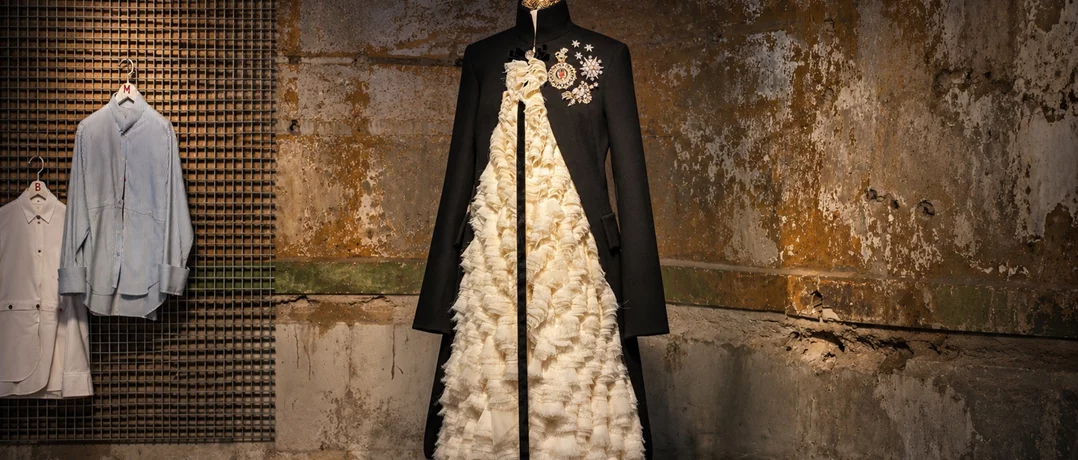
Across the floors of the former Kassem Sugar Refinery, the past has not been cleared away. Molasses and caramelized sugar still stain the concrete, and pulleys and chutes remain where the workers left them.
Built in stages from the 1950s to the mid-1960s to designs by architect Edgard Sisto, the plant belongs to the Kassem family and has stood idle for years. Now it hosts the centerpiece of a six-site program across Lebanon: the second edition of Fragmenta, which gathers more than fifty contributors under the title Qamīs: Fragments of Dress.
The shirt, that most ordinary of garments, is the starting point. Drawing on Lebanon’s deep textile history, the edition brings contemporary design, craftsmanship, and industry into the same room, and sets them against a building whose own industry has fallen silent.
It is not an easy theme, Nour Najem, co-founder alongside Guilaine Elias, admitted to The Beiruter. “We know it’s not an easy theme, and we know that we asked a lot of them, but they really did an outstanding job,” she reflected. The organizers sought out creators “who had something to say” and the sensibility to work with the brief. “All of them surprised us in ways that we did not imagine.”
The result was formidably unique. “We are extremely grateful to be able to do what we do because we absolutely love it,” she explained, describing the exhibition as a platform for designers and craftsmen “to show everything that we can accomplish together… for the long term.”
Nadeen Roufael: Under Tension
Nadeen Roufael’s Under Tension begins with the collar and works backwards through a shirt’s construction, from weave and thread. Ceramic rods, joined in a suspended lattice, hold two porcelain collars, each element depending on the others.
The collars mimic the Elizabethan era, and Roufael repeated the form in mirror image because it is “a piece that passes through time.” She invited visitors to touch the lattice and hear “the voice of clay music” that carries them back to the past. The porcelain is deliberately thin, evoking the silk and linen of the originals.
“In Lebanon we need this kind of exhibitions, just to show how creative the people are,” she insisted, welcoming their growing number. Fragmenta’s theme, she added, goes deeper than expected, the shirt is “something we see as very normal,” yet the show reveals pieces “really special, with each artist heading somewhere totally different.” In her words: “c’est la richesse.”
Richard Yasmine: In Borrowed Bodies
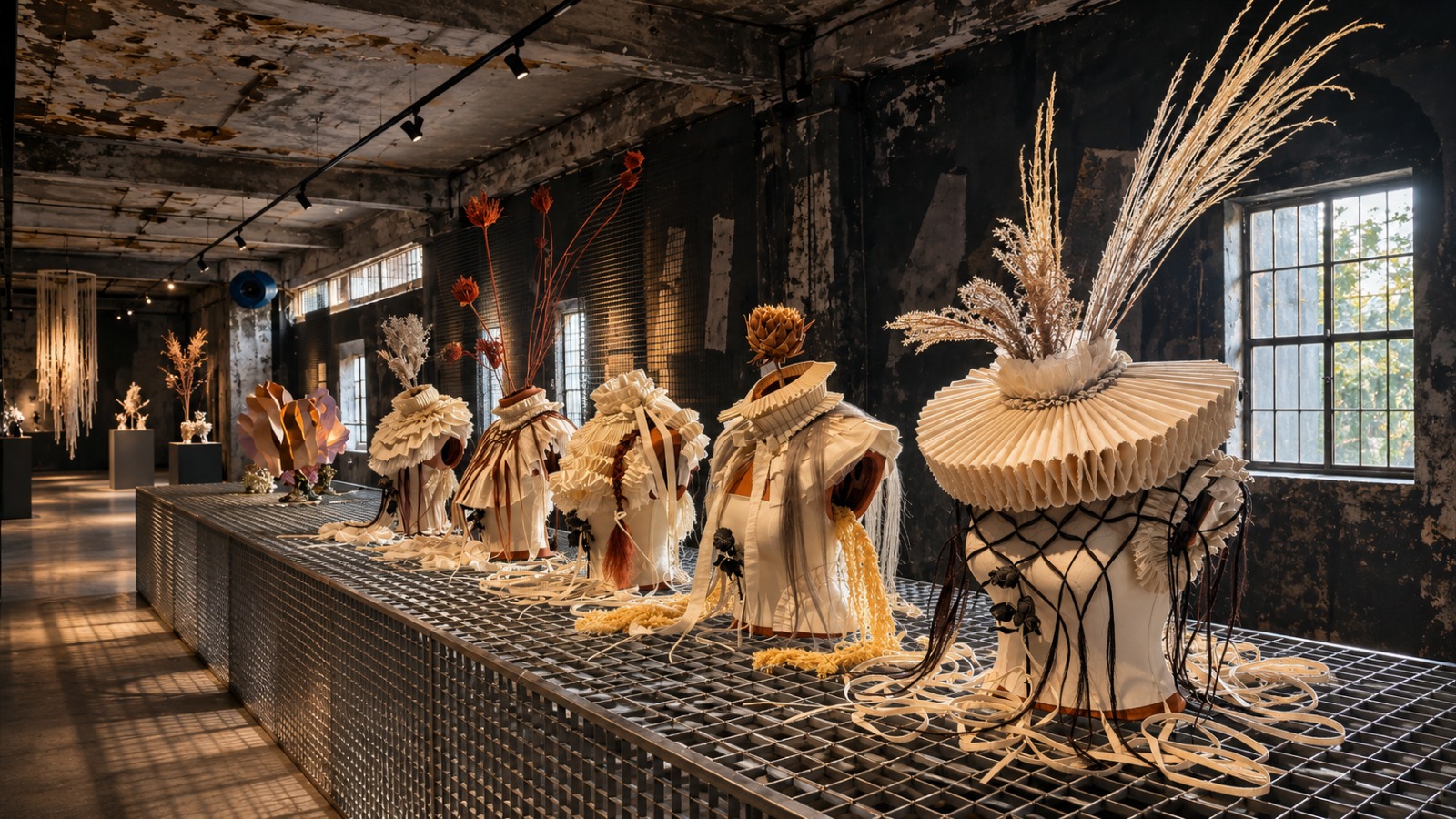
The Lebanese interior architect and product designer Richard Yasmine presents six terracotta vessels that are identical until dressed. The edition’s title, he explained to The Beiruter, alludes to takammos, the transmigration of the soul, and the vases embody it: “Without the clothes, they look similar. And when you give them a different dress with the collar, with the corset, they gain a personality, a persona, a character.”
He takes the logic further. “Without the soul, the body is nothing.” Each vessel wears a different shade of hair, “a trace of a certain memory of existence,” and a wilted rose sits where the heart would be, gesturing at mourning and rebirth together. The raw pins and loose threads left in view recall the couturier’s first draft. “We are in the state of being,” Yasmine reflected. “We are not yet complete, and we will never be complete.” Displayed as an installation, the six vessels are sold as unique pieces.
Tracy Jabbour: Les Furtifs
Tracy Jabbour’s route to Fragmenta began with a leap. Having served as head of design at a Lebanese fashion house, she resigned six months ago to learn flower-making, a craft kept alive by only three ageing practitioners in the country, one of them her mother, who makes blooms for couture names such as Zuhair Murad.
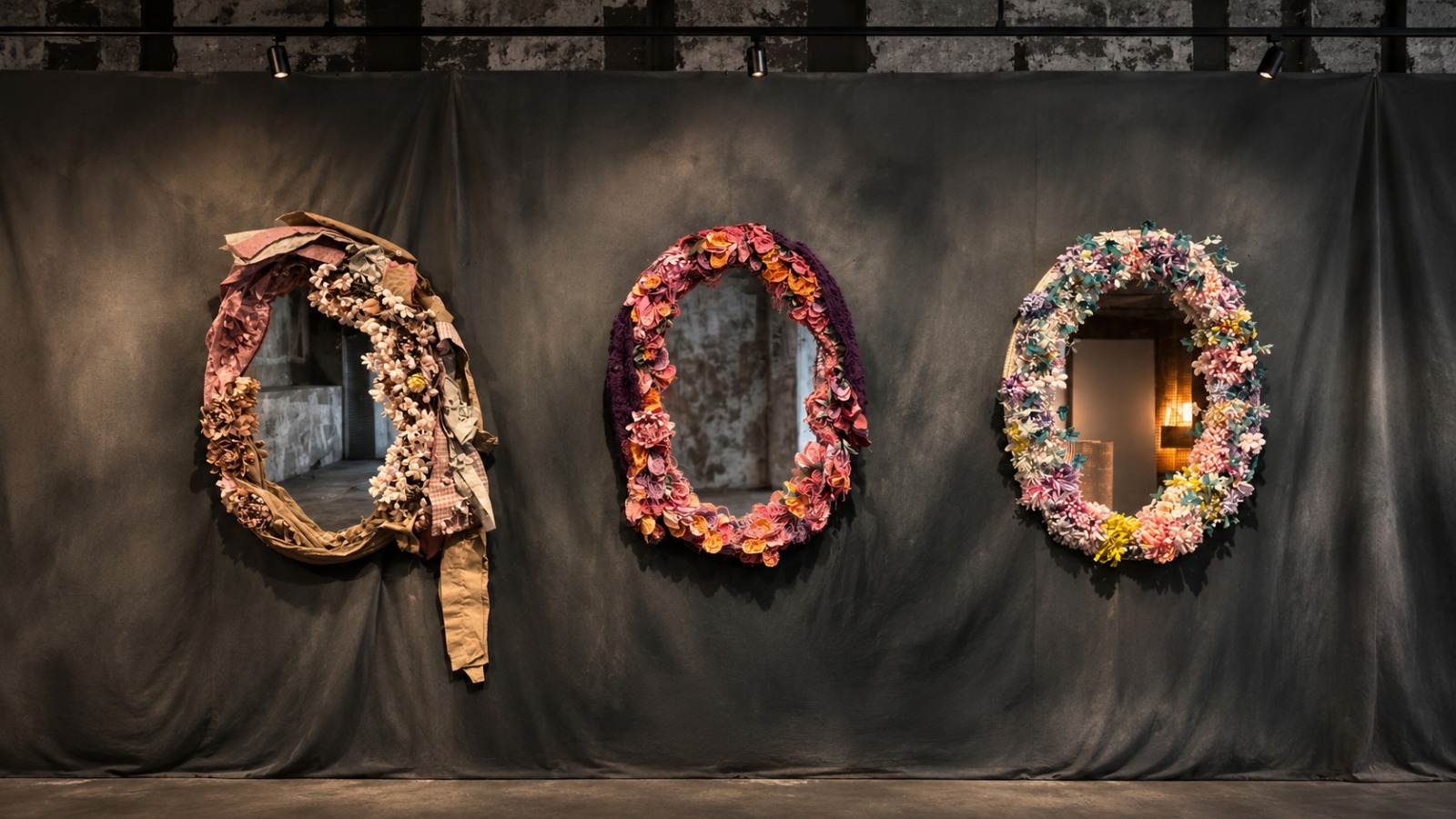
Les Furtifs marries the two worlds. “The flower making is a very luxury thing, and the shirts, everyone wears a shirt,” she observed. “So I wanted to merge this everyday fabric into this craft that is very luxurious.” She gathered shirts from flea markets and collected flawed deadstock from Lebanese shirtmakers, including fabric marked by coffee stains and holes, then starched, painted, cut and molded each petal. Thread from Tripoli, where shirts are traditionally made, was dyed to match. Some pieces were dipped in plaster to unify their color.
The process was instinctive. “You don’t think you’re working, you just work, and you tell yourself, okay, this works here.” The mirrors keep traces of their source shirts while growing into objects of lavish intricacy.
Iwan Maktabi: Before the Cut
For a family with three generations in traditional carpet-making, Iwan Maktabi’s contribution is a conversation between old and new. Before the Cut translates a shirt pattern into a handloom-quality wool carpet, carved and hand-stitched so that construction lines and annotations emerge in relief.
The idea draws on a Persian custom. Weavers in Iran, Maktabki told The Beiruter, would rehearse a design on a practice carpet before beginning the final one. “We created a piece like a dialogue between the old tradition and the new, between the carpet and the shirt,” she explained, likening the tailor who cuts a pattern before assembling a shirt to the weaver at his trial piece.
She is moved by Fragmenta’s larger purpose. Lebanon once had a textile industry that “suddenly disappeared,” yet “it’s a pity to leave this heritage.” She called the edition an important initiative for artisans who are still struggling, some forced into other work although the craft remains in demand. “If it is directed the right way, very beautiful things come out.”
Christina Battikha: Pockets of a Giant
Christina Battikha utilized the concept of the pocket and applied it to the geology of the Mediterranean. Her cabinet of wood and stainless steel holds small pockets made of salt, a nod to what she calls the Mediterranean Salt Giant, “a three-kilometer-thick structure that has pockets storing brine, petroleum, and gas.”
She told The Beiruter that salt is impermeable, a material that invites reflection on timescales stretching across millions of years. Against it she used the tuna can, a pocket of human making, born of “our activities in which we start to bore and dig.”
Taking part in Fragmenta, Battikha finds, is a chance to meet designers “with very different ideas and thoughts, all enthusiastic about design.”
Fragmenta found a place of industry, memory and unfinished business, now accompanied by clay, salt, wool and cloth, to depict the stories of human nature.
-
-

-
The Beiruter
-
