France leads Europe’s return to Syria as Macron’s historic visit signals renewed diplomacy, reconstruction efforts, and cautious engagement amid ongoing security challenges.




France leads Europe’s return to Syria as Macron’s historic visit signals renewed diplomacy, reconstruction efforts, and cautious engagement amid ongoing security challenges.

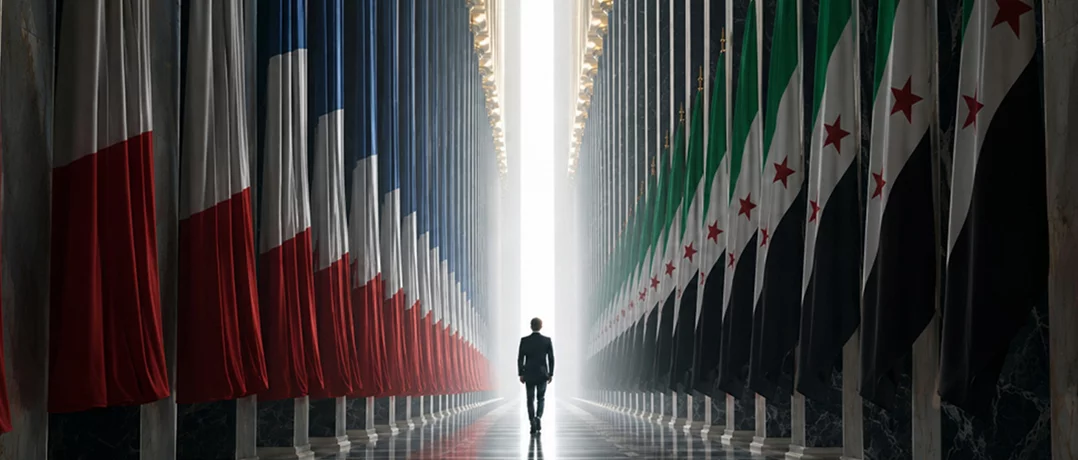
French President Emmanuel Macron’s landmark visit to Syria marks a defining moment in the country’s post-Assad transition and in Europe’s evolving approach toward Damascus. As the first major Western European leader to visit Syria since the fall of former president Bashar al-Assad on 8 December 2024, Macron’s trip symbolizes growing international recognition of Syria’s new leadership under President Ahmad al-Sharaa and signals a gradual reintegration of the country into regional and global diplomacy.
However, the visit also underscored the fragility of Syria’s security environment. Twin bomb explosions near Macron’s hotel in central Damascus, which injured 18 people, served as a stark reminder that despite political progress and improving diplomatic relations, Syria continues to face serious internal security threats.
Macron’s arrival in Damascus represents the most significant diplomatic breakthrough for Syria since the collapse of the Assad regime. While a number of foreign leaders, including Qatar’s Emir Sheikh Tamim bin Hamad al-Thani, European Commission President Ursula von der Leyen, and Ukrainian President Volodymyr Zelensky, have visited Syria after late 2024, Macron became the first leader from Western Europe or North America to officially travel to Damascus under the country’s new leadership; thus, elevating its symbolic and geopolitical importance. The last French president to visit Syria was Nicolas Sarkozy in 2009, during a brief period of rapprochement between Paris and Damascus that preceded the outbreak of Syria’s devastating conflict in 2011.
The visit builds upon the political momentum established in May 2025, when Macron welcomed President Ahmad al-Sharaa to Paris as well as hosted a major international conference in Paris in February 2025 to outline a roadmap for Syria’s recovery. That meeting marked the beginning of a gradual normalization process between France and Syria, with Paris becoming one of the leading European advocates for lifting international sanctions that had isolated Damascus for more than a decade.
Since then, many Western sanctions have been eased or removed, creating new opportunities for diplomatic engagement and economic cooperation. Macron’s visit therefore reflects not only France’s changing policy but also Europe’s broader reassessment of Syria’s role following years of civil war.
One of the visit’s most significant outcomes was the announcement that France and Syria would begin exchanging resident ambassadors, effectively restoring full diplomatic relations after years of strained ties.
The decision reflects growing confidence between the two governments and represents an important step toward Syria’s broader reintegration into the international community.
Macron also reaffirmed France’s support for a sovereign, united, pluralistic, and secure Syria. Meetings with civil society representatives demonstrated Paris’ intention to encourage political inclusiveness alongside economic recovery. This is especially true given that France has historically maintained ties with Kurdish groups, particularly the Syrian Democratic Forces (SDF), which played a key role in defeating ISIS in 2019.
A central objective of Macron’s visit was strengthening economic cooperation between France and Syria. He was accompanied by a delegation of senior executives representing major French companies, including shipping giant CMA CGM and energy company TotalEnergies.
The two governments signed 15 agreements covering sectors including civil aviation, healthcare, banking, water infrastructure, transportation, and reconstruction. Joint committees were established to facilitate future cooperation and oversee implementation.
President al-Sharaa highlighted Syria’s strategic geographical position as a gateway connecting the Mediterranean with the Gulf and Iraq. He argued that disruptions affecting global trade routes, including recent tensions surrounding the Strait of Hormuz and the Red Sea, have increased Syria’s importance as a potential logistics and transportation corridor linking Europe with the Middle East.
French investors, however, remain cautious. While opportunities for reconstruction are considerable after more than a decade of conflict, security risks continue to influence investment decisions, particularly for private companies seeking long-term stability.
Furthermore, what was notable was France’s commitment to return more than €50 million confiscated from Rifaat al-Assad, the late uncle of Bashar al-Assad. The funds, seized by French authorities after legal proceedings involving illicitly acquired assets, will now finance development projects benefiting the Syrian people.
The agreement carries considerable symbolic value. Rather than remaining within the French judicial system, the recovered assets will support reconstruction efforts inside Syria, reinforcing France’s message that its engagement is directed toward assisting the country’s recovery rather than merely restoring diplomatic relations.
Despite extensive security preparations, Macron’s visit was overshadowed by 2 explosions near the Four Seasons Hotel, where the French delegation was staying. According to Syrian authorities, one explosive device had been placed inside a parked vehicle while another was hidden in a garbage container. Officials stated that both devices detonated while security forces were attempting to dismantle them.
The attacks injured 18 people, including police officers and government officials, but did not alter Macron’s schedule. French authorities confirmed that the president was safe and proceeded with all planned meetings.
Nevertheless, the explosions carried symbolic significance. Their location, close to both Macron’s accommodation and the Ministry of Tourism, and their timing suggested an attempt to challenge the narrative that Syria has entered a stable post-war phase ready for reconstruction and international investment.
Rather than inflicting mass casualties, the apparent objective was to undermine confidence in Syria’s security environment at a moment when Damascus sought to present itself as a reliable political and economic partner.
Although no group immediately claimed responsibility for the Damascus bombings, the Islamic State (IS) remains widely viewed as the most significant security threat due to its continued opposition to Syria’s new government and its efforts to disrupt normalization with Western countries; especially in light of Damascus’s recent integration into the international anti-ISIS coalition in November 2025. Other possibilities include remnants of the former Assad regime, extremist networks opposed to the political transition, or localized groups seeking to undermine confidence in the government’s ability to maintain security.
For Damascus, therefore, establishing lasting security will be essential not only for protecting citizens but also for attracting foreign investment, encouraging refugee returns, and sustaining diplomatic normalization.
Macron’s engagement with Syria is primarily driven by broader geopolitical considerations. France seeks to maintain relevance in a region increasingly shaped by competing external powers, including the United States (U.S.), Russia, and regional actors in the Middle East.
By taking an early diplomatic lead, Paris aims to secure a meaningful role in shaping Syria’s transition while reinforcing its influence in Lebanese-Syrian relations and Eastern Mediterranean politics. In that sense, France’s approach combines strategic ambition with historical ties, particularly given its long-standing cultural and political connections in the Levant.
Nevertheless, the success of Syria’s reintegration will depend not only on diplomatic recognition and international partnerships but also on the government’s ability to deliver sustained security, strengthen state institutions, and create conditions that support long-term stability, reconstruction, and economic development.

