



Glucksmann won France's center-left primary, while Mélenchon embraced the student protests. Their rivalry exposes the left's divisions ahead of 2027.
France’s divided left

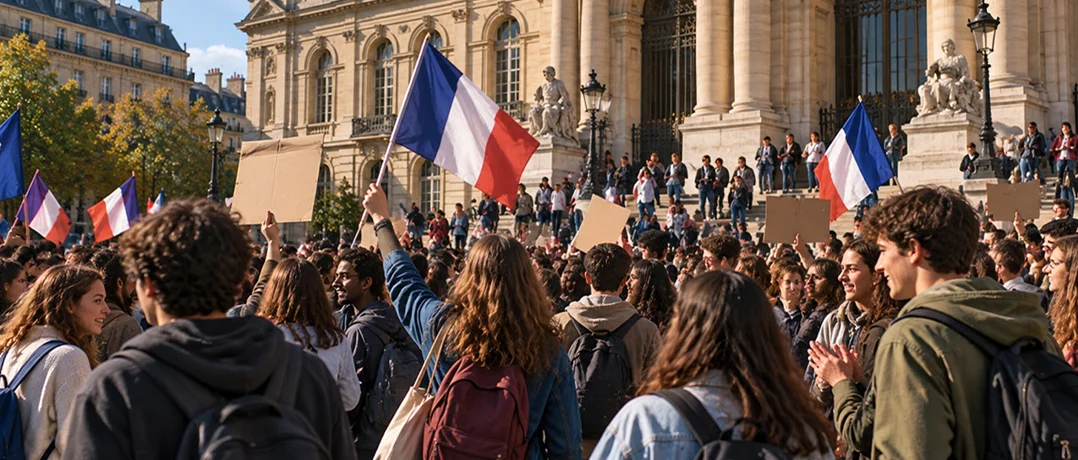
On 11 October, France's left presented two sharply contrasting political scenes. In Paris, Raphaël Glucksmann celebrated a decisive victory in the social-democratic presidential primary, winning more than 66% of the vote and defeating Socialist Party leader Olivier Faure. In Clermont-Ferrand, Jean-Luc Mélenchon welcomed student protesters onto his campaign stage, praising a movement that has swept through schools and universities in recent weeks.
The contrast extends beyond a rivalry between two presidential contenders. As France approaches the 2027 election amid widespread student unrest, the country's divided left faces a fundamental question: Can either candidate translate popular discontent into a political coalition capable of winning power?
A victory in a diminished party
The most consequential result of the primary was the rejection of the Socialist Party's strategy toward Jean-Luc Mélenchon's La France Insoumise (LFI). Under Olivier Faure, the Socialists joined the New Ecological and Social People's Union (NUPES) in 2022 and the New Popular Front in 2024, cooperating with LFI despite substantial ideological disagreements. Faure defended these alliances as necessary to maintain left-wing unity, while Glucksmann increasingly regarded them as an obstacle to rebuilding an independent social-democratic movement.
Faure's strategy reflected a long decline in the Socialist Party's electoral strength. In 2012, François Hollande returned the Socialists to the Élysée. Five years later, their presidential candidate, Benoît Hamon, secured just 6.36% of the vote, against 19.58% for Mélenchon. By 2022, Socialist candidate Anne Hidalgo had fallen to 1.75%, while Mélenchon received nearly 22%. Alliances with LFI thus offered the weakened party a route back to influence.
The primary strengthened Glucksmann's approach within the social-democratic camp, but the result does not establish his appeal beyond that electorate. Approximately 121,000 people participated, compared with more than 2.5 million in the Socialist presidential primary of 2011, although the two contests operated under different participation rules. While Glucksmann rejects future legislative alliances with LFI, sections of the Socialist Party remain open to cooperation. His victory therefore establishes a political direction without resolving the divisions over how the French left should organize itself.
Beyond these electoral calculations lies a deeper disagreement over political change. Glucksmann seeks to revive social democracy through public investment, ecological transformation and European integration, pursuing reforms within existing political institutions. Mélenchon advocates a Sixth Republic, greater economic redistribution and a fundamental revision of France's institutional framework. While both support stronger public services, their disagreement concerns the scale of reform and the importance of mobilization.
A revolt that belongs to neither party
The broader contest for influence on the left has become visible in France's growing student protest movement. The movement began in September in Créteil, on the outskirts of Paris, when high-school students blockaded entrances over teacher shortages, overcrowded classrooms and deteriorating facilities. As demonstrations spread across France, their demands broadened to include unequal educational opportunities and the university admissions platform Parcoursup. Teachers, parents and university students joined the mobilization, while clashes with police and allegations of excessive force introduced another source of anger.
Crucially, the protests did not originate with LFI or the Socialist Party. Student organizations formulated demands of their own and met Education Minister Édouard Geffray on 2 October, afterward calling for further demonstrations because they considered the government's response insufficient. Political support has not erased that independence.
The candidates' responses reveal how their competing ideas of political change operate in practice. Mélenchon has embraced the mobilization as an expression of political participation, appearing alongside demonstrators and condemning police repression. He has linked their demands to his broader program, promising to abolish Parcoursup and lower the voting age to 16. Although he subsequently urged nonviolence, he treats the students as political actors whose demands extend beyond education.
Glucksmann has also defended the protesters, rejecting government accusations that LFI orchestrated the movement and criticizing police tactics. Yet he has insisted that violence is never legitimate in a democracy. His response emphasizes institutional solutions, including greater investment in public education, smaller classes and reforming Parcoursup rather than abolishing it.
Mélenchon thus sees the protests as a potential force for transforming political institutions, while Glucksmann emphasizes reform through the institutions already in place.
The generational fault line
Those contrasting approaches meet an electorate divided sharply by age. An Ipsos survey conducted on 3–9 September placed Mélenchon at 41% among voters aged 18–24, compared with just 6% for Glucksmann, in a scenario featuring both candidates. Among voters aged 70 and older, the figures were almost reversed: Glucksmann received 17%, against 4% for Mélenchon.
A separate Ipsos survey, published on 6 October, revealed a broader crisis of political confidence among young French adults. Some 82% of respondents aged 18–29 considered political leaders disconnected from their realities, while 78% believed those leaders were failing to prepare their future. Yet 55% declared themselves certain to vote in 2027, suggesting that dissatisfaction with political leadership has not extinguished electoral engagement.
Both surveys were conducted before the protests began, so they cannot measure the movement's electoral effects. Many protesting high-school students are too young to vote, and the surveys do not establish demonstrators' preferences. Still, they expose distinct weaknesses: Glucksmann struggles to attract younger voters, while Mélenchon's strength with that generation contrasts with far weaker support among older voters. Neither can assume that sympathy with the protesters will solve those problems.
The limits of two electorates
This imbalance leads directly to the question of what either candidate can win in 2027. Under France's two-round electoral system, reaching the runoff requires sufficient first-round support to finish among the top two candidates. Winning the presidency then demands a much broader electoral coalition.
Glucksmann's strategy rests on expanding the social-democratic electorate, bringing together Socialists, Greens and moderate voters disillusioned with Macronism. Yet his refusal to cooperate with LFI complicates efforts to reunite the political forces that formed the New Popular Front in 2024. Mélenchon faces a different challenge: translating his support among younger and more radical voters into a coalition capable of reaching other generations and constituencies.
The far right further narrows their options. September Ipsos polling placed Marine Le Pen at 33–35% of first-round voting intentions, far ahead of either man. As 2027 approaches, even reaching the runoff may prove insufficient if the left cannot unite behind a candidate capable of attracting voters beyond its existing electorate.
-
-

-
Nami El KhazenJournalistFocusing on geopolitics and international affairs.
-
