



From a forced opening by American warships in the 19th century to one of Washington’s most important alliances today, the U.S.-Japan relationship has evolved through conflict, reconciliation and strategic necessity into a partnership shaping the future of the Pacific.
From gunboats to a shared Pacific order

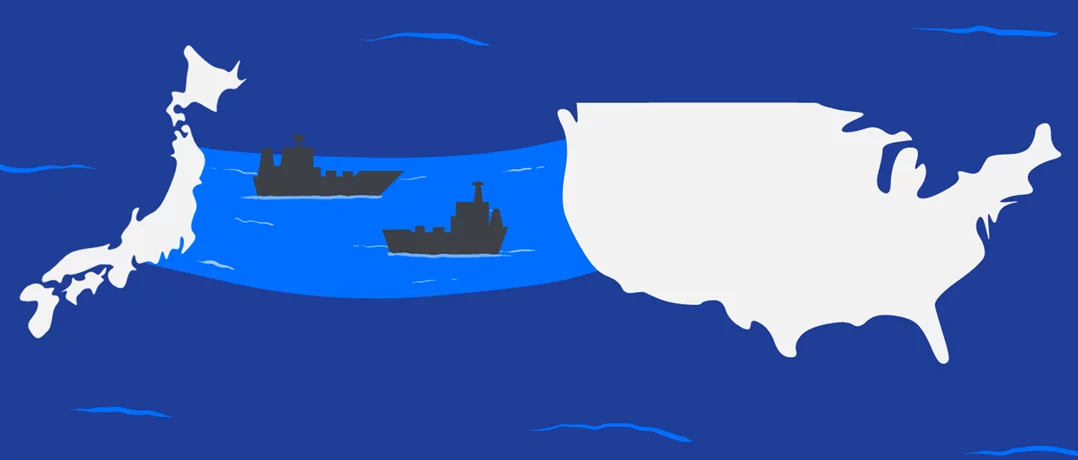
Illustration by Karim Dagher
On a notepad photographed at Camp David in July 2026, U.S. Treasury Secretary Scott Bessent had written an unusually direct instruction: buy between $5 billion and $10 billion in Japanese yen. The note preceded coordinated intervention by Washington and Tokyo to support the Japanese currency.
The operation captured how far the relationship between the two countries has evolved. Japan has become central to American power in Asia, while the United States remains indispensable to Japan’s security. Their alliance is arguably closer than at any previous point, but its strength rests less on complete historical reconciliation than on strategic necessity and growing mutual dependence.
That such a partnership emerged at all is remarkable, given that the first formal exchange between the two nations, in 1853, took place under the shadow of cannons rather than through diplomacy between equals.
Forced opening and Japan’s rise, 1854–1905
For more than two centuries, the Tokugawa shogunate had tightly controlled Japan’s contact with the outside world. This system, intended to preserve political stability and limit foreign influence, became known as Sakoku, meaning “closed country.”
That carefully controlled order was shattered in 1853, when American Commodore Matthew Perry entered Edo Bay with a squadron of warships and demanded that Japan open its ports for commerce, backed by the threat of force. Perry then withdrew, announcing that he would return the following year for an answer, but the intervening months gave the shogunate no means of overcoming the military imbalance his ships had exposed.
When he returned with a larger fleet in 1854, Japan reluctantly signed the Convention of Kanagawa, opening two ports to American vessels and beginning a wider series of treaties that granted Western powers privileges Japan could not yet demand in return.
Over the following decades, Japan built a modern army and navy, transformed its economy, and centralized the state. Victories over China in 1895 and Russia in 1905 marked the reversal. The country once forced open by American warships had become a major Pacific power whose ambitions Washington could no longer ignore.
From cautious cooperation to strategic rivalry, 1905–1941
By 1905, Japan had become too powerful for Washington to treat as a subordinate state. Theodore Roosevelt mediated the Treaty of Portsmouth ending the Russo-Japanese War, and Washington at times regarded Japan as a useful counterweight to Russia in Asia. Yet this cautious cooperation concealed a growing clash over the regional order.
Japan sought dominance over Korea and later Manchuria, while the United States defended the Open Door in China, its position in the Philippines and a balance of power in the Pacific. Anti-Japanese discrimination in the United States deepened the mistrust. The Gentlemen’s Agreement restricted Japanese labor immigration, while the Immigration Act of 1924 barred Japanese immigrants entirely. For a country that had modernized partly to gain recognition as an equal great power, exclusion reinforced the belief that the West would never fully accept Japan on equal terms.
The strategic conflict intensified after Japan occupied Manchuria in 1931 and expanded its war in China in 1937. Washington responded with mounting economic pressure, including restrictions on strategic exports and, in 1941, an oil embargo after Japan moved into southern French Indochina. Japanese leaders now faced a choice between retreating from their imperial expansion or seizing the resources of Southeast Asia before their reserves were exhausted. Japan chose expansion and attacked Pearl Harbor in December 1941.
War, defeat and occupation, 1941–1952
Pearl Harbor brought the United States and Japan into a total war that devastated much of the Pacific. After years of fighting, strategic bombing and the atomic attacks on Hiroshima and Nagasaki, Japan surrendered in August 1945.
The American-led occupation dismantled Japan’s imperial military system and imposed sweeping political and social reforms. A new constitution established democratic institutions and severely restricted the country’s use of force, while land reform and economic restructuring transformed Japanese society. Stripped of its empire and military power, Japan became dependent on the United States for reconstruction and security.
That policy soon changed direction. Rising tensions with the Soviet Union and the Communist victory in China made Japan increasingly valuable to Washington. The Korean War then turned the country into a crucial industrial and logistical base for American forces. The United States had defeated and disarmed Japan, only to conclude within a few years that its recovery was essential to American power in Asia.
The postwar bargain: security for bases and growth, 1952–1991
When the occupation ended in 1952, the relationship rested on a clear bargain. The United States provided Japan with military protection and access to the American-led economic order, allowing Tokyo to keep defense spending low and concentrate on reconstruction and growth. In return, Washington retained bases near China, Korea and the Soviet Union, securing a permanent forward position in East Asia.
Yet the arrangement remained politically contentious. The revised 1960 security treaty triggered enormous protests in Japan, while Okinawa continued to bear a disproportionate share of the American military presence even after its return to Japanese control in 1972. Yet the alliance endured because both governments considered its strategic benefits indispensable.
Economic success eventually created a different source of tension. Japan emerged as a manufacturing giant whose cars, electronics and semiconductors challenged American industries. Trade disputes, the 1985 Plaza Accord and rising “Japan bashing” reflected fears that an ally defeated in war had become an economic competitor capable of surpassing the United States. The rivalry was serious, but it never displaced the security relationship.
From protected ally to strategic partner, 1991–2020
After the Soviet Union collapsed, the alliance had to justify its purpose. Japan’s financial contribution to the 1991 Gulf War drew criticism because it sent money but few personnel, reinforcing accusations of checkbook diplomacy.
Tokyo gradually expanded participation in UN peacekeeping and logistical missions, while North Korea’s missile and nuclear programs and China’s rise gave the alliance new urgency. Missile-defense cooperation deepened, and Operation Tomodachi, the American response to the 2011 earthquake and tsunami, strengthened public trust.
Under Shinzo Abe, Japan moved further from its postwar restraint. His government widened the circumstances in which Japanese forces could support the United States and promoted a more active regional role through the Free and Open Indo-Pacific strategy and the revival of the Quad.
Abe also adapted skillfully to Trump’s transactional diplomacy, using their personal relationship to limit tensions over trade and defense spending. He began shifting Japan from a protected ally toward a more capable partner in preserving the regional order.
From strategic partnership to deep integration
Japan and the United States may now be closer than ever. Japan’s bases remain essential to American power in Asia, but Washington increasingly relies on Japanese industry and military capacity as it prepares for crises involving China and Taiwan.
Sanae Takaichi has pushed this transformation beyond the framework established by Shinzo Abe, concentrating on turning his vision into operational and industrial power. She accelerated defense spending to 2 percent of GDP, ordered a revision of Japan’s security strategy and oversaw the largest relaxation of arms-export restrictions in decades. Her statement that a Chinese attack on Taiwan threatening Japan could provoke a military response also made Tokyo’s position more explicit.
The political relationship has also become unusually direct. Trump publicly endorsed Takaichi before her February lower-house election victory and later praised her leadership at the White House. She has responded to his transactional diplomacy by presenting Japanese rearmament and investment as contributions to American as well as Japanese strength.
Their March agreements included up to $73 billion in Japanese-backed nuclear and gas projects in the United States, alongside deeper cooperation on critical minerals. The later joint intervention to support the yen showed that the alliance now reaches beyond defense and industry into financial coordination.
Closer than ever, but not without limits
Yet this unprecedented integration should not be confused with complete harmony. Trump’s tariffs continue to treat Japan as an economic competitor, even as Washington increasingly depends on Japanese bases, industry and military cooperation. Tokyo also remains uneasy about American unpredictability, particularly the possibility that Washington could strike agreements with China without protecting Japanese interests or divert military resources away from Asia.
Meanwhile, deeper operational coordination creates the opposite fear: that Japan could be drawn into a conflict initiated by the United States, especially over Taiwan or the Middle East. Longstanding disputes over the concentration of American forces in Okinawa, along with concerns over accidents, crime and the burden placed on local communities, further complicate the alliance.
These tensions do not negate the closeness of the relationship, but they reveal its political limits. The U.S.-Japan alliance is closer than ever, but its strength rests on strategic necessity as much as trust.
-
-

-
Nami El KhazenJournalistFocusing on geopolitics and international affairs.
-
