



The Lebanese University’s Faculty of Letters, Branch 1, in Beirut faces a delayed academic year after displaced families remained in university buildings following the war, prompting security intervention and raising concerns over alleged drug use, campus safety, damaged facilities and students’ ability to resume classes under appropriate conditions.
From lecture halls to drug concerns.. A campus in crisis
From lecture halls to drug concerns.. A campus in crisis
By Fatat Ayad | November 05, 2026

Reading time: 8 min
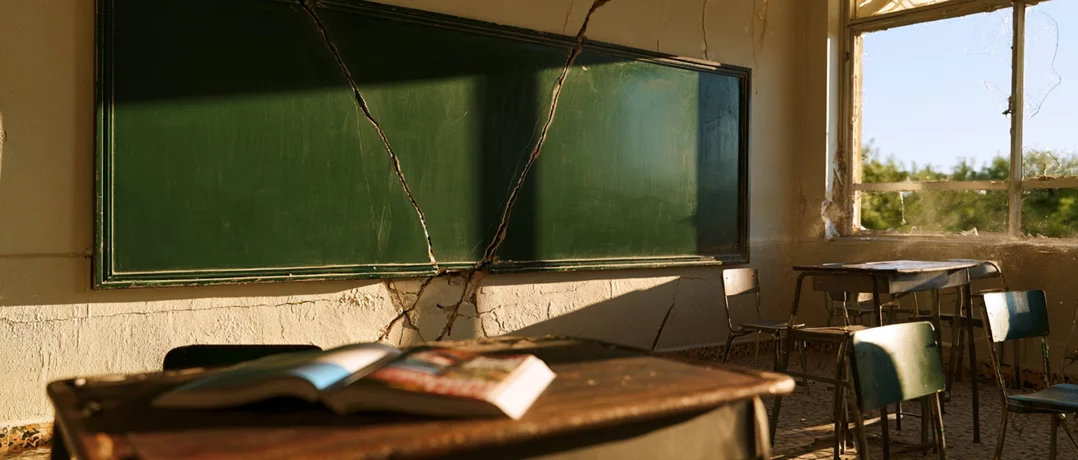
The start of the academic year at the Lebanese University’s Faculty of Letters, Branch 1, in Beirut has been delayed by a month after displaced families remained in university buildings following the end of the war, with efforts to secure their departure proving unsuccessful. The situation escalated following public threats against the faculty administration and the arrival of additional families, prompting the intervention of Beirut’s Intelligence Branch, which relocated the remaining occupants to a single university building in an effort to facilitate their gradual departure. However, students and professors fear that the move has merely shifted the problem from one building to another, particularly amid reports that some occupants use drugs, raising concerns over campus safety and the academic environment.
Students in psychology, geography, archaeology and philosophy have lost a month of their academic year, with classes in some departments only beginning gradually this week. Their return to university has also exposed unresolved concerns over suitable teaching conditions, students’ privacy, potential contact with drug users and the shortage of seats following damage to university facilities.
While the dean faces the challenge of managing the situation, the university administration has begun coordinating with security agencies and seeking alternative accommodation for displaced families.
Forced entry and an intention to stay?
During the war, displaced people entered the Faculty of Letters, Branch 1, at the Lebanese University’s UNESCO campus by force and without permission, occupying the faculty and its teaching buildings.
This contrasted with the situation at Branch 2, for example, where displaced families coordinated with the administration and agreed not to enter administrative offices or other restricted areas. That arrangement was not respected at Branch 1. Displaced people entered administrative offices and placed students’ examination files in one of the kitchens, violating the privacy of department heads’ offices, where academic records, grades, files and other university materials were kept.
After the war ended, some displaced families left Buildings 3 and 4 at Branch 1, following several attempts by the administration to encourage them to vacate the premises. Meanwhile, some second-session examinations and entrance exams had to be held at the Faculty of Information against the original arrangements.
However, occupants of the two remaining buildings informed the administration last week that they had no intention of leaving. They went beyond making threats and brought in what they described as “new displaced families”, eventually filling both buildings completely. One houses the geography, archaeology and philosophy departments, while the other accommodates the Turkish and Persian language departments.
Their latest justification for refusing to cooperate with the administration was their refusal to vacate one of the floors where several departments were preparing to resume classes, claiming that it served as a “food storage centre”.
Until yesterday, both buildings remained under the control of the displaced occupants. One building has since been evacuated, allowing philosophy, geography and archaeology classes to begin following the intervention of Beirut’s Intelligence Branch. The departments could no longer afford to wait under mounting pressure from students. The remaining displaced occupants have now been concentrated in a single building, which houses the Turkish and Persian language departments.
The Faculty of Letters, Branch 1, is the only branch that has experienced a full month's delay in starting classes compared with the university’s other branches.
This raises legitimate questions: How will semester examinations be coordinated across branches if their academic calendars are no longer aligned? Will the faculty receive a budget to repair the damage? Students and professors should not be expected to pay out of their own pockets to purchase seats or even repair bathrooms.
Psychology classes resume under difficult conditions
The rehabilitation of Buildings 4, which houses the psychology and Arabic literature departments, and 3, which accommodates the administration, history, French and English language departments, took more than a month.
The damage included broken desks, damaged telephones and disrupted electricity, among numerous other material losses.
Work on restoring Building 4, which has been undergoing rehabilitation since last September, included cleaning and spraying against fleas after an infestation spread throughout the premises. These measures were necessary to make the building suitable for students, particularly as the psychology department alone accounts for a substantial proportion of the Faculty of Letters, with more than 400 first-year students.
However, the difficult conditions have persisted even after psychology classes resumed, as rehabilitation work remains incomplete.
According to information obtained by Nidaa Al Watan, students were surprised to find an insufficient number of seats and out-of-service bathrooms.
Given that the budget allocated to the Faculty of Letters, Branch 1, is insufficient to cover the cost of repairing the damage, the destruction has further complicated an already difficult situation, effectively forcing students themselves to contribute to the rehabilitation work.
Students from the psychology department took matters into their own hands, searching for seats and bringing them into classrooms. Even after a number of professors agreed to resume teaching under these conditions, not all students had returned to class.
Some departments were handed back premises in deplorable condition, without desks or student seats.
How, then, will these material and logistical problems be addressed to ensure that the start of the academic year is not delayed any further?
Drug users and students sharing the same faculty
One of the most serious aspects of the displacement situation at the Faculty of Letters, Branch 1, is that a considerable number of those occupying the buildings belong to a group described by security sources as “thugs”. More specifically, some reportedly have extensive records with the security forces.
The reported behaviour of some occupants has affected other displaced families and threatens the university's educational environment. They are said to use drugs, treat the administration disrespectfully and behave as though they have the authority to impose their demands. They reportedly demand specific rooms, cause almost daily disturbances, including with residents of the surrounding neighbourhood, and have prompted several security patrols to visit the premises. Their latest alleged attempt involved demanding protection money from a nearby commercial establishment.
The risks extend beyond their current behaviour to the security records of some individuals. Certain occupants are reportedly wanted by the authorities. One individual, identified by the initials “A.C.”, had previously been imprisoned in cases involving drugs and public morals.
These allegations raise concerns about potential contact between individuals described as troublemakers, who are occupying the university under the pretext of displacement, and its students. They also place greater responsibility on the university to protect students from being exposed to such conditions.
This profile of a considerable number of those residing at the Faculty of Letters, Branch 1, has made it difficult for the dean to shoulder the responsibility of resolving the situation and securing their departure alone.
According to sources cited by Nidaa Al Watan, when displaced people initially entered the university, they were indeed families fleeing the conflict. However, they were soon joined by individuals described as troublemakers, who allegedly engaged in armed altercations and drug use.
They reportedly addressed the faculty dean, Badia Mazboudi, in a demanding and threatening manner, at times entering her office by force and making requests such as: “Find me a house in Dhour” or “Assign me room X, with specific specifications.”
The sources also noted that some families who had arrived in recent days had left their own homes to reinforce the presence of these occupants, raising concerns that some may have a premeditated intention to remain on campus.
Returning to the individual identified as “A.C.”, eyewitnesses reportedly claimed that he was supplying drugs to several of the displaced occupants.
How can university students continue their education amid such practices? And who would bear responsibility if a student, professor or displaced person were harmed?
University administration: We are coordinating with the relevant ministries
Sources within the Lebanese University administration told Nidaa Al Watan that the university presidency continues to work with security agencies and the relevant official authorities to address the presence of displaced families in some university buildings. The efforts aim to take their circumstances into account while ensuring suitable conditions for the start of the academic year.
Regarding an individual case that required particular attention, the sources explained that the university presidency had informed the relevant security authorities while taking into consideration the individual's family and social circumstances, particularly the fact that his wife and children were living with him. This approach, they said, would allow the matter to be handled calmly and responsibly, without escalation.
The sources added that efforts undertaken in cooperation with security agencies and the relevant authorities had so far secured alternative accommodation for several displaced families. Meanwhile, temporary arrangements had been made for the remaining families to stay in the building designated for teaching Turkish and Persian, until alternative housing could be found.
The university presidency is also continuing its coordination with the relevant ministries and authorities, particularly the Ministry of Education, with the aim of resolving the matter as soon as possible.
The sources concluded that the university was pursuing a humane and responsible approach that preserves the dignity of displaced families while ensuring the continuity of academic activities and the return of university life to normal.
