

How Lebanese taekwondo continues to thrive against the odds through the dedication of its athletes, federation, and Olympian doctor-athlete.
From local clubs to Olympic dreams

Taekwondo’s roots in Lebanon stretch back nearly half a century. Since joining the World Taekwondo Federation in 1977 and establishing its national federation in 1989, the sport has grown into one of the country’s most successful disciplines, with athletes competing on the world’s biggest stages and at nearly every Olympic Games since 2000.
Today, more than 10,000 registered athletes practice taekwondo in Lebanon. Yet despite its achievements, the sport finds itself fighting for its future.
The doctor who kicks
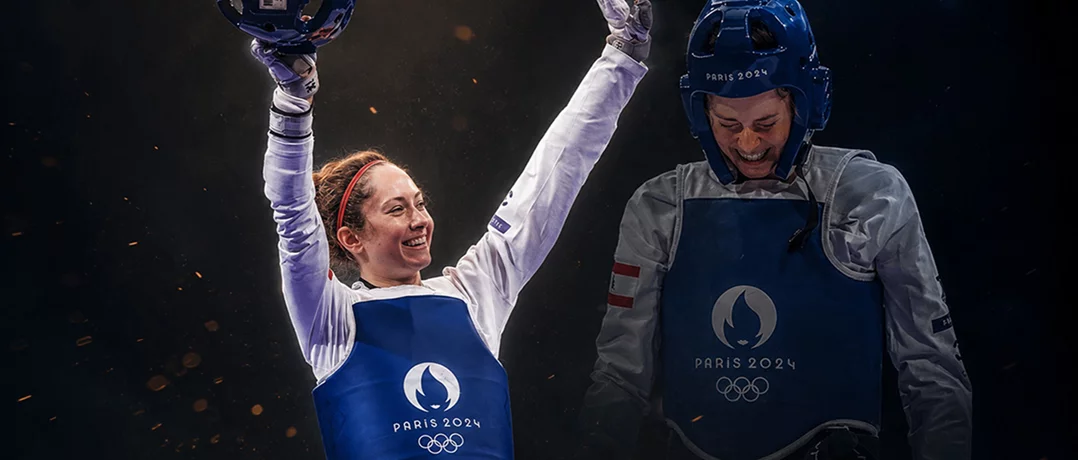
If any single figure captures what Lebanese taekwondo has been able to produce, it is Laeticia Aoun. At 25, she is already an Olympian, a medal contender who came agonizingly close to making history in Paris, and, as of this year, a qualified competitor at the upcoming Asian Games. She is also a freshly graduated medical doctor.
Speaking to The Beiruter, Aoun explains that she came to taekwondo the way many Lebanese children come to sport: trying everything, committing to nothing in particular. At 12, an invitation changed that. She had just earned her black belt when she was asked to compete at the first-ever Cadets World Championship. She lost. But the loss lit something. "I saw a potential. I had a vision," she recalls. Two months later, she won silver at the Turkish Open. A silver at the Asian Cadets Championship followed. A career had begun.
Through seven years of medical school, she trained. When hospital rotations demanded ten to twelve hours a day on the ward, she found two hours for taekwondo in the gaps. When she couldn't, she trained on weekends. "I never put taekwondo before my studies," she says. "Never." Medicine was always the priority. Taekwondo was, as she puts it, not quite a hobby and not quite a separate career it was simply part of who she is.
The lowest point came in 2023. Four months before Olympic qualification, she competed in back-to-back tournaments, a Grand Prix and the Asian Games, and came home without a medal from either. She was in the most demanding stretch of medical school. Something had to give. She put taekwondo on pause, steadied her studies, and then came back.
I knew it was just a hard phase. I kept on pushing.
Paris 2024 was the result of that persistence. Aoun reached the bronze medal match in the women's under-57 kg event at the Grand Palais, coming achingly close to becoming the first Lebanese female athlete to win an Olympic medal, and to giving Lebanon its first Olympic medal since 1980. She lost in the bronze match, but the performance announced her as a genuine contender at the highest level.
A qualification earned
Four months before the Olympic qualification, she competed on back-to-back tournaments, a Grand Prix and the Asian Games, and came home without a medal from either. She was in the most demanding stretch of medical school. Something had to give. She put taekwando on pause, steadied her studies.
The Asian Games qualification this year came with a choice that only someone with Aoun's particular biography could have faced: the qualification tournament fell on the same day as her medical school graduation ceremony. She chose the tournament. She won the match that put her through, beating a Chinese athlete who had placed third at the World Championships, and in that moment, she says, everything felt worth it. "I don't regret any of it."
Her message to herself going into the Asian Games is characteristically direct: don't be hard on yourself, enjoy it, do your best. She has been to the Olympics. She has trained through medical school. She has beaten ranked opponents when she needed to. Whatever the Asian Games bring, she has already proven that Lebanese sport, and Lebanese women in sport, can compete at the very highest level.
A federation running on will
The Beiruter spoke with Habib Zarife, president of the Lebanese Taekwondo Federation. The numbers he cites tell one story; the context behind them tells another.
More than 10,000 athletes are currently registered with the federation, men and women, children and adults. Zarife estimates roughly 40% women to 60% men, a ratio that stands out in Lebanese sport more broadly. Under normal conditions, the federation runs 18 black-belt national championships a year, a calendar that reflects genuine organizational ambition. This year, that number will fall to around 10. The war has interrupted training cycles, displaced clubs, and left some teams without players. "Some teams are destroyed," Zarife says plainly. "We have to give them time to prepare themselves."
The federation runs its operations through personal and organizational funding. Athletes travel to international competitions through a combination of club support and their own resources. Lebanon's Ministry of Youth and Sports provides moral support and goodwill, but little else. "There is no money in the ministry," says Zarife.
The international calendar that the federation built before the current conflict was genuinely impressive. Between 2018 and 2023, Lebanon hosted the Beirut Open five times. It hosted the Asian Open twice, in 2021 and 2023, a tournament Zarife describes as one of the biggest international events ever held in Lebanon. Those events brought the world's best taekwondo athletes to Beirut, put Lebanon on the global competition map, and gave local athletes home-ground experience at elite level. Since October 2023, all international hosting has been suspended. The goal now is to hold on, keep the athletes training, and aim for the next horizon: the Asian Games in Japan and Olympic qualification for 2028.
Zarife closes his interview with a simple request to the Lebanese public: when you see these athletes, say thank you. Not a lot, not more than that. Just acknowledgment.
What the sport is fighting for
Taekwando’s strength lies in the determination of the people who keep it alive, from federation officials working with limited resources to athletes like Laeticia Aoun, whose journey embodies discipline, resilience, and ambition. Lebanese taekwondo's greatest asset is the unwavering commitment of those who refuse to let it fall behind.
-
-

-
The Beiruter
-
