Artist Zeina Hamady transforms grief, nature, and memory into an immersive Beirut exhibition where biodegradable artworks invite visitors to heal, reflect, and reconnect through beauty.




Artist Zeina Hamady transforms grief, nature, and memory into an immersive Beirut exhibition where biodegradable artworks invite visitors to heal, reflect, and reconnect through beauty.

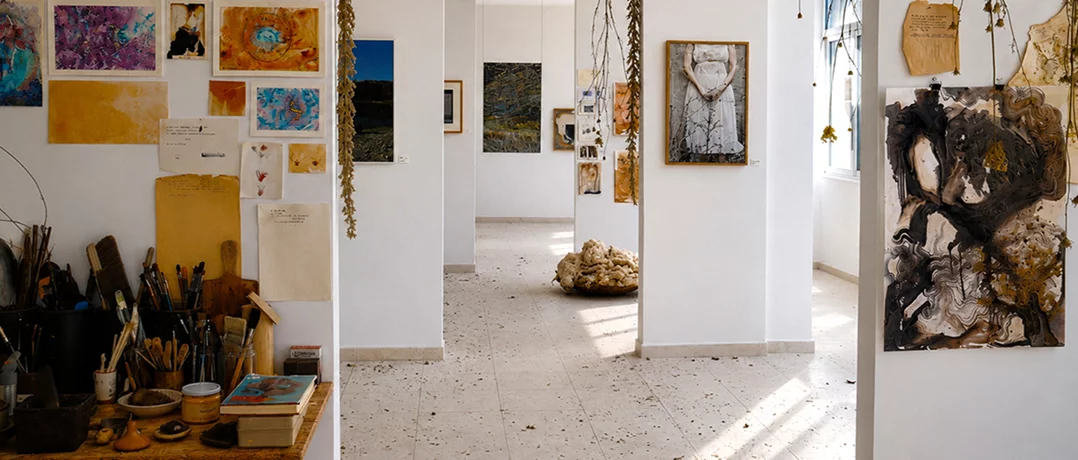
Artist Zeina Hamady brought her makeshift studio down from the Chouf mountains after more than a decade of seclusion, displaying her work in an art installation titled “The Day I Lost the Sun” at No Chef in the Kitchen during Beirut Art Days. For Zeina, creating art is a way of processing the world around her, from personal losses to the weight of war.
“I’m a maker, it’s how I grieve, it’s how I feel joy.”
The exhibition is immersive, bringing her love of the mountains to a rooftop in Gemmayze: the smell of petals first engulfs viewers, who can then walk among paintings created through sun printing, typewritten poetry on paper stained with walnut, and wool hung with flowers that bleed their colors into the natural fibers. Zeina’s artwork is complemented by an intimate photography collection shot by Pascale Laffé, documenting her emotional connection to the mountains.
Zeina’s art is disarming because of its profound vulnerability - viewers can sense her emotional reckoning with each spontaneous spray of color and confession through poetry.
“The Lebanese people have deep wounds and every time they are reopened, they bleed, again and again,” says No Chef in the Kitchen Founder Christine Abi Azar. “Being honest about these wounds and processing them together through art, through beauty, is a way for us to resist as a community.”
Zeina sees more trust and openness as the path toward healing a society scarred by violence. “By sharing my art, maybe that pain won’t be just mine anymore; by releasing it, maybe we can build community with that vulnerability,” she said. By at last bringing her art from the mountains to Beirut, her personal ritual has become a collective one, inviting viewers to grieve and find joy together.
Her materials are sourced directly from the Earth, and therefore can be easily returned to it, meaning all her work is biodegradable. She doesn’t buy synthetic paints, instead making inks over a woodfire stove with materials like walnut, sumac, and cypress, into which she dips parchment until it darkens. Rather than traditional canvases, she creates art atop wool transformed by craftsmen into felt. The wool was originally utilitarian in purpose, stretched along the walls of her handmade stone abode for insulation; soon, she began tying flowers to the fibers each time she was in mourning, until dried flowers cascaded around her, sprays of blue and red and pink staining the wool. Her studio of natural dyes and herbs, a loving monument to the land she sees as inseparable from her identity, was recreated in the No Chef in the Kitchen gallery, so that viewers could glimpse into her creative process of partnership with the mountains.
“Let art be living. Let it be in collaboration with the world, its materials, sunlight - it results in something even better than I could’ve seen with just my mind.” For Zeina, the tending of the land she loves begins with a remembrance of its beauty, a mission served by her art.
I hope to make this world available so that people, together, can allow in beauty again.
Focusing on political analysis, economic trends, and investigative reporting.
