



Netanyahu’s rejection of the U.S.-backed Gaza roadmap underscores persistent obstacles to peace, despite ongoing diplomacy, phased security proposals, and international mediation efforts.
Gaza’s elusive peace deal

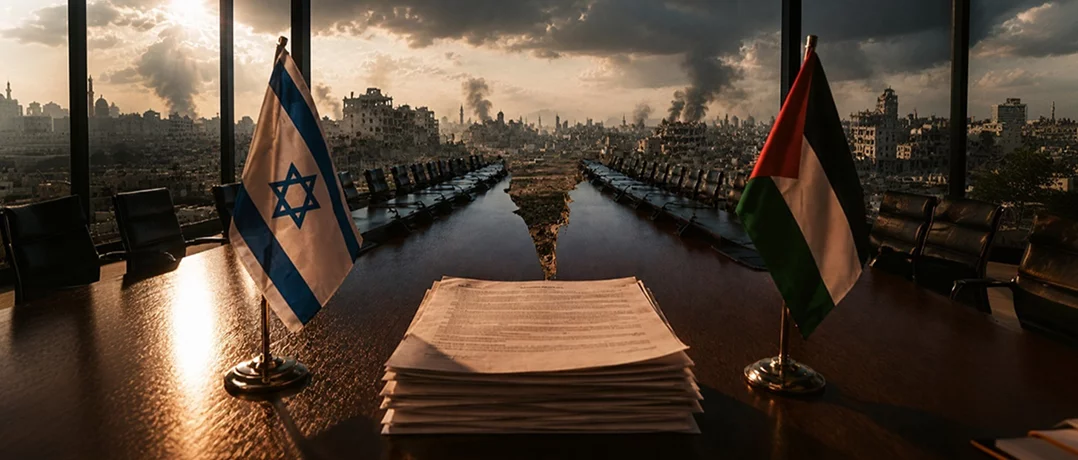
Israeli Prime Minister Benjamin Netanyahu’s public rejection of the United States (U.S.)-backed 15-point roadmap for Gaza has injected fresh uncertainty into diplomatic efforts aimed at ending nearly 3 years of conflict in the territory.
The proposal, developed under the auspices of the U.S.-led Board of Peace and endorsed by President Donald Trump, outlines a phased framework linking Hamas’s disarmament, Israel’s military withdrawal, the deployment of an International Stabilization Force (ISF), and the establishment of a new Palestinian technocratic administration.
The proposed roadmap
The 15-point framework represents the most comprehensive diplomatic initiative proposed since the outbreak of the Gaza war. It seeks to replace military confrontation with a phased political and security transition designed to address the core demands of both parties.
Under the proposal, Hamas and other Palestinian armed factions would gradually decommission their military capabilities under international supervision. Heavy weapons, military production facilities, tunnels, and weapons depots would be identified, inventoried, secured, and ultimately rendered unusable. Rather than transferring weapons to Israel, they would be placed under the authority of a Palestinian National Committee composed of independent technocrats.
The roadmap also calls for Hamas to relinquish governance responsibilities in Gaza, allowing the National Committee to assume civil administration. Security would gradually transition to a newly established Palestinian police force working alongside an International Stabilization Force composed of multinational troops.
In parallel, Israeli forces would withdraw incrementally from areas they currently control, with each phase tied directly to independently verified progress in disarmament. Reconstruction efforts would begin simultaneously, particularly in heavily devastated areas such as Rafah.
Netanyahu’s objections
Netanyahu’s rejection reflects longstanding Israeli security concerns rather than opposition to negotiations themselves. His government insists that no military withdrawal can occur until Hamas has undergone complete and verifiable disarmament.
Addressing his cabinet, Netanyahu stressed that Israel requires the elimination of all Hamas weaponry, not merely heavy weapons but also lighter arms and any remaining military infrastructure. He argued that Israel could not rely on symbolic or partial disarmament after the 7 October 2023 Hamas attacks, which remain deeply embedded in Israeli public consciousness.
Many Israeli officials also question whether Hamas would fully implement its commitments or retain hidden stockpiles capable of allowing it to rebuild its military capabilities in the future. These concerns have been echoed by members of both the governing coalition and parts of the opposition, although their objections often differ regarding the sequencing and verification of the agreement rather than its overall objectives.
Hamas’s position and conditional acceptance
Hamas has described its acceptance of the framework as a significant political decision while making clear that implementation depends on reciprocal Israeli compliance.
According to officials involved in the negotiations, Hamas has agreed in principle to surrender heavy weaponry, dissolve its governing authority in Gaza, and transfer administrative responsibilities to a technocratic Palestinian body. However, it maintains that these measures can proceed only if Israel simultaneously fulfills its obligations to halt military operations, withdraw forces according to the agreed timetable, and facilitate reconstruction.
The movement also insists that weapons should remain under Palestinian, not Israeli, control during the transition, with international verification ensuring compliance by all parties. Hamas has further requested guarantees that armed militias outside its control and pro-Israel local groups would also be addressed under any future security arrangements.
Political pressures in Israel and Washington
Domestic politics have become an important factor shaping public positions on the roadmap.
Netanyahu faces a highly consequential Israeli general election in October. His governing coalition depends heavily on right-wing and far-right parties that strongly oppose territorial withdrawals and advocate maintaining extensive Israeli security control over Gaza. Any appearance of compromising before achieving complete security objectives could expose the prime minister to political criticism during an already competitive election campaign.
At the same time, Netanyahu is keen on preserving Israel’s strategic relationship with the U.S. President Trump has invested significant political capital in presenting the Gaza initiative as a major foreign policy achievement. With U.S. congressional midterm elections approaching and declining approval ratings linked partly to broader regional tensions, the White House has its own incentives to demonstrate diplomatic progress in the Middle East.
The central challenge: Implementation and verification
Even if political agreement is eventually reached, implementation presents substantial practical obstacles.
The success of the roadmap depends on rigorous verification mechanisms capable of confirming that weapons have genuinely been surrendered and military infrastructure dismantled. Independent monitoring will be essential for building confidence among Israeli decision-makers while providing assurances to Palestinian factions that Israeli withdrawals occur according to agreed benchmarks.
Questions also remain regarding the composition of the ISF, the authority of the Palestinian National Committee, and the integration of thousands of civil servants previously employed under Hamas’s administration. Additionally, smaller armed factions operating independently of Hamas could potentially undermine implementation if they refuse to participate.
Therefore, with both Israel and the U.S. approaching politically significant elections, domestic political considerations appear to be shaping public rhetoric while behind-the-scenes diplomacy continues. Whether the roadmap ultimately succeeds will depend not only on the positions of Israel and Hamas, but also on the credibility of verification mechanisms, international guarantees, sustained diplomatic pressure, and the willingness of regional and international actors to sustain negotiations.
-
-

-
The Beiruter
-
