



Lebanon’s $3 billion private generator industry fills the gaps left by the public electricity system, leaving households with soaring bills, weak consumer protections and few alternatives.
Generators mafia, a $3bn industry built on state failure
Generators mafia, a $3bn industry built on state failure
By Christiane Tager | November 16, 2026

Reading time: 7 min
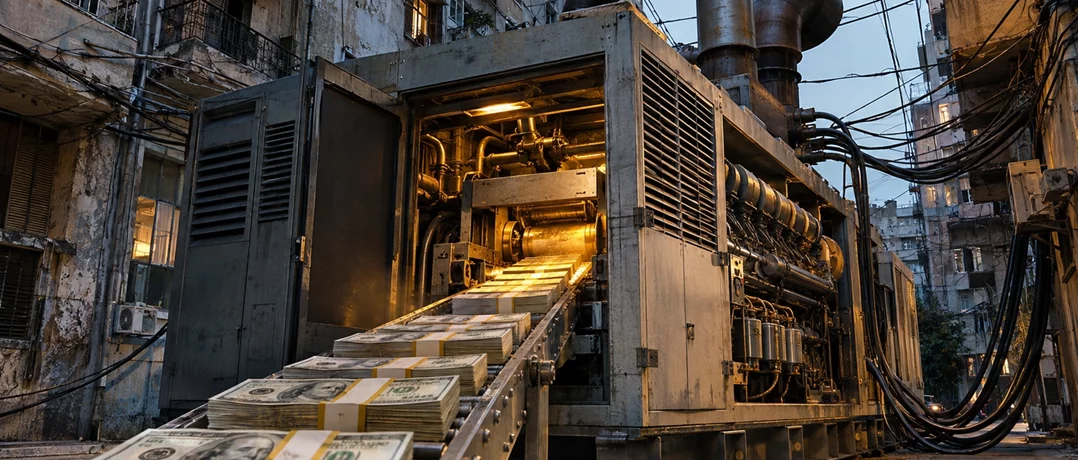
Lebanon's public electricity system remains crippled while its private generator industry thrives. With a market estimated at $3bn, monthly bills reaching $750 and enforcement still falling short, electricity has become one of the clearest symbols of the country's economic dysfunction.
As Lebanese households struggle with soaring electricity bills, a lucrative private industry continues to prosper from the chronic failures of the national power system.
Once an emergency solution, diesel generators have become indispensable, transforming electricity shortages into a multibillion-dollar business.
According to preliminary figures from the Lebanese Center for Energy Conservation (LCEC), private generators supplied approximately 50 per cent of Lebanon's electricity in early 2026, compared with just 31 per cent from the state-owned Électricité du Liban (EDL). The remaining 19 per cent came from solar installations and other sources. The LCEC suggested that EDL's share may have fallen further during the summer, although updated consolidated figures remain unavailable.
In a country where electricity should be a basic public service, half the supply now depends on private operators. And consumers are paying a heavy price.
A $3bn industry built on state failure
Lebanon's private generator market is estimated at nearly $3bn, according to expert assessments cited by Human Rights Watch (HRW) in March 2023. Although not a new annual valuation, the estimate remains widely referenced in 2026.
Approximately $1.1bn relates to generator operations, with a further $2bn generated by associated activities, including fuel imports, equipment sales, spare parts and maintenance.
An estimated 33,000 to 37,000 generators operate across Lebanon, many in densely populated residential areas. These historical estimates illustrate the scale of an industry built on decades of underinvestment, mismanagement and delayed reforms.
Between 2018 and 2023, EDL's electricity production fell by nearly 80 per cent, while the economic collapse that began in 2019, fuel shortages and deteriorating infrastructure deepened the crisis.
Private generators filled the vacuum. But a temporary necessity became a permanent industry, creating powerful economic interests around a failing public service.
The paradox is striking: the less electricity the state supplies, the more indispensable private operators become.
Electricity bills of $310, sometimes reaching $750
The financial burden on consumers has become increasingly severe.
According to an investigation published on October 14, 2026, the median generator bill among 12 people interviewed reached $310 in August. In one Beirut neighborhood, a 25-ampere subscription reportedly cost as much as $750, according to energy consultancy data.
These figures are alarming when compared with Lebanon's statutory monthly minimum wage of LL28mn, in force since July 2025 and equivalent to approximately $312 at an exchange rate of LL89,700 per dollar.
A single generator bill can therefore absorb an entire month's minimum wage. Households must also pay EDL bills alongside rent, food, transport, healthcare and education.
Businesses face similar pressures. Restaurants, hotels, supermarkets, workshops and offices cannot operate without reliable electricity. Yet rising generator costs erode profit margins and ultimately feed into consumer prices.
Electricity has become more than a household expense. It is a structural economic burden, leaving Lebanese consumers with an impossible choice: pay increasingly high bills or endure inadequate power.
Nearly 59 cents per kilowatt-hour: the official tariff
Generator operators point to diesel prices, international market volatility and maintenance expenses to explain rising bills. These costs are genuine, but they do not justify arbitrary surcharges.
On October 30, 2026, the Ministry of Energy and Water published the official tariffs for October consumption.
The indicative rate was set at LL52,622 per kilowatt-hour, approximately $0.59, for metered subscribers in standard urban areas. It rises to LL57,884, or $0.65, in higher-cost locations, including certain areas more than 700 meters above sea level.
Monthly fixed charges stand at LL385,000 for five amperes and LL685,000 for ten amperes, with an additional LL300,000 for each further five-ampere increment.
Although the basic tariff declined by 0.4 per cent from September, the reduction offers little relief to consumers.
The ministry insists that official tariffs already cover fuel, maintenance, lubricants, filters, equipment depreciation and operators' profit margins.
Additional maintenance charges, supplements imposed on solar-panel users and VAT collected without proper legal registration are therefore prohibited.
The problem is not a shortage of regulations. It is their inconsistent enforcement.
Missing meters and captive consumers
Electricity meters should protect subscribers by ensuring they pay for actual consumption rather than arbitrary flat-rate subscriptions.
Yet despite repeated government decisions requiring their installation, many households remain subject to fixed charges, making bills difficult to verify or contest.
In 2018, attempts to enforce metering and official tariffs met resistance from some operators, including temporary service suspensions that left entire communities without electricity.
Human Rights Watch has also documented meter tampering, restrictive agreements imposed on subscribers and cases involving overlapping interests between local officials and generator operators.
Not every operator engages in abusive practices; many provide an essential service under difficult conditions. But weak oversight and the absence of competing suppliers leave consumers with little bargaining power.
They are not simply customers. They are captive to a service they cannot live without.
43 generators seized as authorities tighten controls
Facing mounting complaints, Lebanese authorities intensified enforcement during the summer of 2026.
On September 4, a meeting at Beirut's Grand Serail established a monitoring mechanism targeting unjustified charges linked to rising fuel prices.
Economy and Trade Minister Amer Bisat called for stricter compliance with official tariffs and compulsory metering, involving ministries, municipalities, regional authorities, security services and the judiciary.
According to a ministry statement reported on September 8, 43 generators had been seized or placed under official supervision in less than a month, while 58 violation reports were issued for breaches of regulated tariffs.
Municipalities were tasked with overseeing the affected equipment and maintaining electricity supplies where necessary. Legal proceedings were also announced against non-compliant operators.
Similar inspections in Tripoli in October 2025 had already exposed excessive tariffs and missing meters, leading to several generators being placed under municipal control.
These interventions demonstrate that enforcement is possible. But they also raise an uncomfortable question: why did obligations introduced years earlier require another surge in bills before meaningful action was taken?
A few dozen seizures cannot transform a sector comprising tens of thousands of generators. What Lebanon needs is consistent, nationwide enforcement.
The hidden cost: pollution and inequality
The price of generator dependence extends far beyond electricity bills.
Operating close to homes, schools and businesses, diesel generators emit harmful particulate matter and other pollutants while contributing to persistent noise pollution.
Human Rights Watch has warned that vulnerable communities bear a disproportionate share of the environmental and health consequences.
The financial inequalities are equally striking.
In a survey of more than 1,200 households conducted between November 2021 and January 2022, HRW found that generator bills consumed an average of 44 per cent of monthly household income.
Among the poorest subscribed households, that figure reached 88 per cent, compared with 21 per cent among the wealthiest.
Although these figures reflect conditions during the survey period rather than current 2026 averages, they reveal the extent of the inequality.
Wealthier families can afford higher-capacity subscriptions, solar panels and battery storage. Lower-income households often have no choice but to ration electricity or go without reliable power.
A service essential to economic development has become another measure of Lebanon's social divide.
Reforming EDL: the only sustainable solution
Stricter inspections, mandatory meters and meaningful penalties are essential, but they cannot replace comprehensive reform of Électricité du Liban.
As long as households and businesses depend on private generators, operators will retain considerable economic power.
Lebanon urgently needs modernized power plants, upgraded networks, reduced technical and commercial losses, improved bill collection, transparent financial management and independent governance.
Renewable energy must also play a central role. The expansion of household solar systems demonstrates the desire to escape diesel dependence, but access to cleaner electricity cannot remain limited to those who can afford private installations.
The objective must be a reliable, affordable and less polluting electricity system, with the state gradually reclaiming responsibility for an essential public service.
The issue is not simply public versus private provision. It is ending a system in which the failure of one has become a source of lasting commercial advantage for parts of the other.
The price of inaction
Lebanon's generator industry has become more than a response to power cuts. It reflects decades of state failure and an economic model sustained by necessity, limited alternatives and weak enforcement.
Recent inspections are encouraging, but their impact will depend on sustained controls, effective sanctions and credible electricity reform.
In a country where a single electricity bill can consume an entire month's minimum wage, access to power cannot remain a privilege.
Lebanon does not simply lack electricity. It lacks a system capable of delivering it fairly, reliably and at a reasonable price.
Because in Lebanon, the real luxury is no longer owning a generator.
It is being able to switch on the lights without wondering how much it will cost, or whom one must pay for the simple right to live a normal life.
