



German President Frank-Walter Steinmeier visits Lebanon, reaffirming Berlin’s commitment to supporting Lebanese institutions and security amid concerns over UNIFIL’s future and regional stability.
Germany’s president renews support for Lebanon
Germany’s president renews support for Lebanon
By The Beiruter | February 16, 2026

Reading time: 3 min
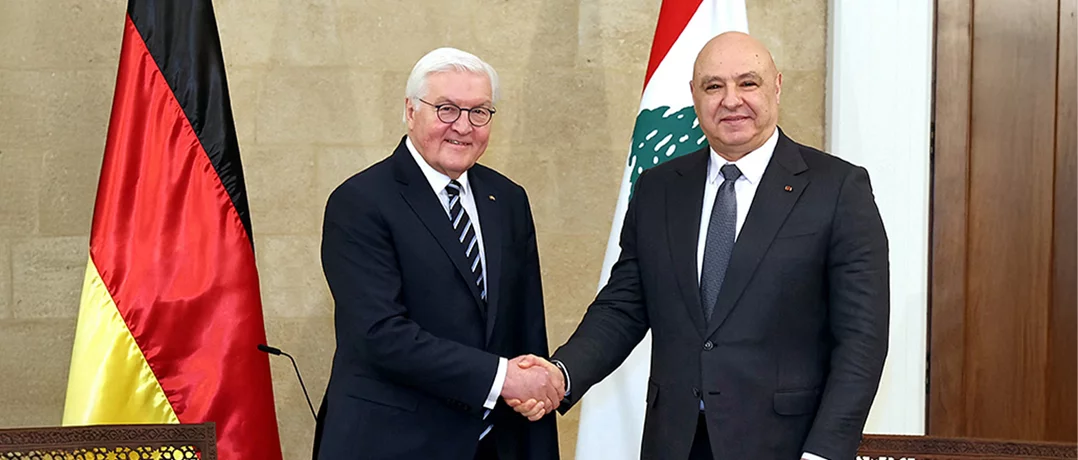
German President Frank-Walter Steinmeier began a high-profile visit to Lebanon, delivering assurances that Germany will maintain its support for Lebanese state institutions and stability even after the anticipated withdrawal of German forces serving within the United Nations Interim Force in Lebanon (UNIFIL).
The visit, which includes meetings with senior Lebanese officials, highlights growing international concerns about regional security dynamics and underscored Germany’s intention to remain a key partner for Lebanon amid political, military, and economic challenges.
Strengthening bilateral cooperation and institutional support
During joint discussions with Lebanese President Joseph Aoun, Steinmeier stressed Germany’s commitment to strengthening Lebanese state authority and enhancing institutional resilience. Speaking at the presidential palace in Baabda, the German leader stressed that Berlin considers stability in Lebanon a strategic priority, both for regional security and broader European interests.
Steinmeier confirmed that Germany would continue to assist Lebanon in reinforcing governmental institutions, particularly security agencies. He highlighted Germany’s longstanding involvement in training and equipping Lebanese military units, noting that cooperation between the German navy and Lebanese Armed Forces (LAF) is already underway to improve maritime monitoring and border security capabilities.
For Lebanese authorities, this support remains crucial as the country navigates the aftermath of recent military confrontations and ongoing economic instability. Aoun welcomed Germany’s continued engagement, describing bilateral relations as historically strong and essential for rebuilding state structures and restoring public confidence in national institutions.
UNIFIL withdrawal and security concerns in southern Lebanon
The German president’s visit coincides with growing uncertainty surrounding the future of international peacekeeping operations in southern Lebanon. The UNIFIL mission, which currently deploys approximately 7,500 peacekeepers, including German naval personnel, is scheduled to conclude its mandate by the end of 2026 after nearly 5 decades of monitoring the volatile Lebanon-Israel border.
Steinmeier acknowledged the significant role played by UNIFIL in maintaining relative calm along the southern frontier, particularly during recent escalations between Israeli forces and Hezbollah. However, he stressed that the anticipated withdrawal of international troops requires a coordinated strategy to prevent security vacuums and ensure the Lebanese state retains effective control over its territory.
While direct military deployment beyond the UNIFIL mandate appears unlikely, Berlin remains committed to strengthening Lebanon’s security infrastructure through technical assistance, training programs, and logistical support.
Calls for ceasefire implementation and disarmament measures
A central theme of Steinmeier’s visit focused on the implementation of ceasefire arrangements reached following the 2024 conflict involving Israel and Hezbollah. The German president urged all parties to fully respect the ceasefire agreement, highlighting that sustainable stability requires both the disarmament of Hezbollah and the withdrawal of Israeli forces from Lebanese territories.
Steinmeier framed these measures as essential prerequisites for strengthening Lebanese sovereignty and reducing the risk of renewed military confrontation. He also encouraged Lebanese authorities to pursue diplomatic channels to ensure compliance with international agreements and to safeguard the country’s territorial integrity.
Lebanese President Joseph Aoun echoed similar sentiments, stressing that Lebanon seeks peace without conditions and aims to avoid becoming entangled in broader regional conflicts. He underscored the heavy toll that previous hostilities have inflicted on Lebanon’s infrastructure, economy, and civilian population, reaffirming the country’s commitment to rebuilding and national recovery.
In conclusion, President Steinmeier’s visit to Lebanon represents a reaffirmation of Germany’s long-term commitment to the country during a period marked by uncertainty and regional volatility. By pledging continued institutional and security support beyond the UNIFIL mission, Germany signals its readiness to remain an active partner in Lebanon’s stabilization process. Nevertheless, the effectiveness of this cooperation will largely depend on Lebanon’s ability to strengthen state authority, implement ceasefire commitments, and pursue structural reforms that reinforce sovereignty and institutional capacity.
-
-

-
The Beiruter
-
