Nearly a century after his death, Gibran Khalil Gibran’s legacy endures as a timeless voice on identity, exile, and the universal human experience.




Nearly a century after his death, Gibran Khalil Gibran’s legacy endures as a timeless voice on identity, exile, and the universal human experience.

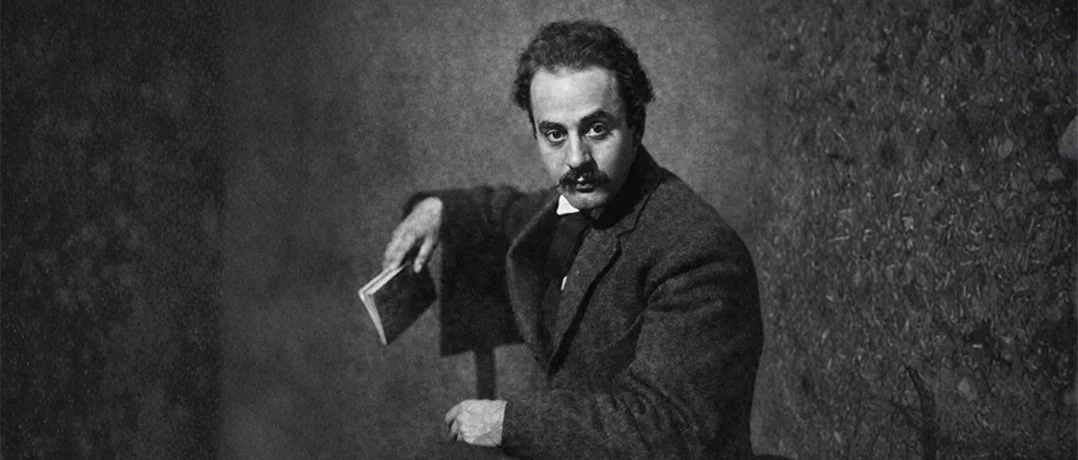
Few writers have crossed as many borders as Gibran Khalil Gibran.
Nearly a century after his death on April 10, 1931, his words continue to resonate across languages, cultures, and generations, speaking to enduring questions of identity, exile, and belonging. Counted among the most influential literary voices in history, Gibran is often cited as the third most-read poet after Shakespeare and Laozi.
Born in Bsharri, carved into the cliffs of Lebanon’s Qadisha Valley, Gibran was shaped by silence, mountains, and a quiet spiritual depth where nature became language and landscape became thought. But exile would define him just as much as origin. Forced to leave for Boston at a young age, he grew up suspended between East and West, never fully belonging to either, yet deeply shaped by both.
From that in-between space, his voice emerged, a voice shaped by distance, searching, and duality. And it is this tension that would become the essence of his work.
For Gibran, exile was never merely geographical. It was emotional, intellectual, and spiritual. His writing reflects a constant search, for home, for love, for meaning. This duality shaped a voice that could speak across cultures, resonating with readers far beyond Lebanon.
His life mirrors a broader condition that feels strikingly modern: the struggle between identity and belonging in a rapidly changing world. Gibran did not resolve this tension, he transformed it into art.
To call Gibran a poet is to reduce him.
He was a painter, sculptor, philosopher, and above all, a creator. His visual art, often overshadowed by his writing, sought to express what language could not. Influenced by figures like William Blake and Friedrich Nietzsche, as well as Sufi mysticism, his work exists at the intersection of literature, spirituality, and philosophy.
At the center of his legacy stands The Prophet.
Published in 1923, the book has sold over nine million copies in English alone and has been translated into more than 100 languages. It is one of the most widely read works of the 20th century, placing Gibran among the most influential literary voices in history.
Yet The Prophet is not simply literature. It is a philosophical guide, a spiritual reflection, and a meditation on life’s most fundamental questions, love, freedom, work, and death.
Gibran’s personal life reveals another layer of complexity.
His relationships with women played a profound role in shaping his intellectual and emotional world. His mother was a figure of protection and resilience. Mary Haskell, his patron and confidante, supported his artistic development and intellectual growth. May Ziadeh, a writer and intellectual in her own right, became his soulmate through years of correspondence.
Love, for Gibran, was never simple. It was layered, often unspoken, and deeply philosophical, mirroring the emotional depth found in his writing.
Gibran did not emerge in isolation. He was a product of a broader intellectual awakening.
The Arab Nahda, a cultural renaissance that swept across the Arab world in the 19th and early 20th centuries, created the conditions for his rise. It was a period marked by calls for modernity, reform, education, and self-determination.
Lebanese writers were at the forefront of this movement, bridging local traditions with global ideas. They redefined literature as a space not only for artistic expression but for political and social engagement.
In this context, Gibran became one of the movement’s most iconic voices.
In 1915, Gibran co-founded the Pen League (Al-Rabitah al-Qalamiyyah) in New York, alongside other Arab intellectuals in the diaspora.
The group sought to modernize Arabic literature and rethink its role in a changing world. They broke away from rigid classical forms, embracing individual expression, emotional depth, and philosophical exploration.
From abroad, these writers were not detached from their homeland. On the contrary, they were deeply engaged in shaping its intellectual future. Through their work, they addressed themes of freedom, identity, justice, and human dignity, ideas that continue to resonate today.
Gibran’s contribution stood out for its universality. His writing did not speak only to Arabs, or only to the diaspora. It spoke to humanity.
If Gibran’s words continue to travel the world, his presence remains rooted in Lebanon.
In Bsharri, overlooking the Qadisha Valley where he was born, the Gibran Museum stands as a living extension of his legacy. Housed in the former Mar Sarkis hermitage, a site dating back centuries, the museum is also where Gibran chose to be buried, carved into the rock between the valley and the cedars he so often wrote about.
Shortly after his death in 1931, the contents of his New York studio, manuscripts, personal belongings, his private library, and more than 400 original paintings, were transported back to his hometown. Today, they form the heart of the museum’s collection.
The space itself reflects the spirit of Gibran. Restored in the 1970s and designed to preserve a sense of seclusion, its stone walls and quiet corridors echo the same introspection that shaped his work. Across its halls, visitors encounter not only his writings, but his paintings, furniture, and the intimate traces of a life lived between art and exile.
At the end of the museum’s path, a few steps carved into the rock lead to his tomb.
It is here, in the silence of the mountain, that Gibran returned, not just as a memory, but as a presence. A reminder that while his words belong to the world, his roots remain unmistakably Lebanese.
More than a century later, Gibran’s words continue to move across languages, cultures, and generations.
He influenced musicians like John Lennon and David Bowie, inspired political figures, and shaped spiritual thought across continents. His legacy is not confined to literature, it lives in the way people think, feel, and understand themselves.
Gibran was not simply a writer of his time. He remains, unmistakably, timeless.

