



How global trade is shifting from open systems to controlled access, where power lies in who can insure, finance, and authorize movement.
Globalization is no longer free

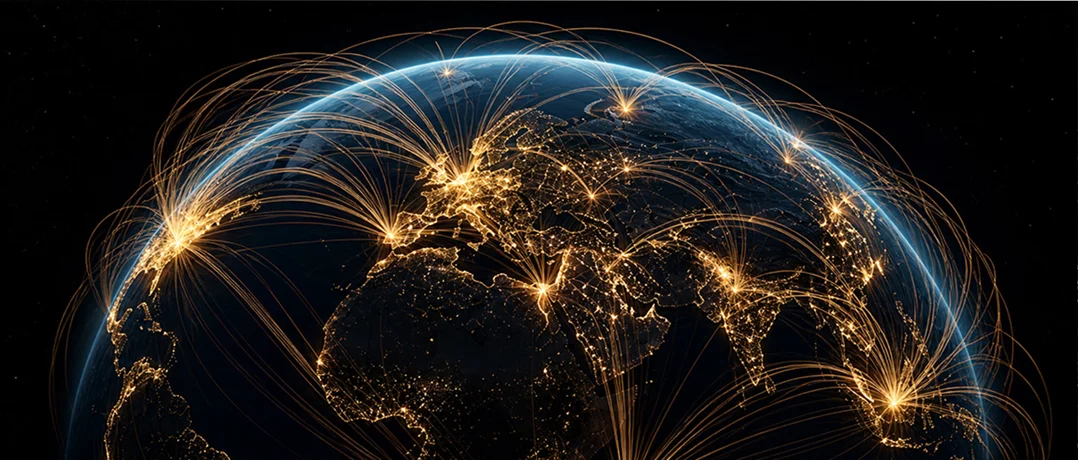
A ship that cannot be insured does not sail. A payment that cannot clear does not settle.
For years, global trade felt almost automatic. Goods moved, money flowed, and the system worked so quietly that most people stopped thinking about how it worked at all… Then something began to shift.
What is unfolding is not a collapse. It is something quieter and far more deliberate. Openness used to set the terms. Power has taken over.
Trade does not move on its own. It moves because routes stay safe, banks stay open, and institutions stay trusted. Behind that assumption stood a guarantor. For most of the past century, that guarantor has been the United States.
The U.S. is usually judged by what it does militarily. The system it built and still maintains gets far less attention. Stable shipping lanes. A reserve currency. Working courts. A rough understanding among allies. Even the loudest critics of American power use that system every day.
What is changing is not the framework. It is the way the framework is being used.
Access is becoming conditional. Routes stay open, but not equally. Participation is increasingly tied to alignment, trust, and political tolerance.
You can see it most clearly at the world's maritime chokepoints. Hormuz. Malacca. Bab el-Mandeb. Roughly a fifth of the world's seaborne oil moves through Hormuz alone. These are not just narrow waters. They are pressure points.
The hidden infrastructure of control
When Houthi missiles began striking ships in the Red Sea in late 2023, the response was financial. War risk premiums climbed, and shipping companies redrew their routes around Africa. The strait stayed open, but was no longer worth using.
That is the new shape of restriction. The path remains, and the cost of taking it changes everything.
The chokepoints at sea are easy to see. The ones that matter most are not. They sit inside the systems, in the rooms where trade is quietly run.
Shipping needs more than ships and fuel. It needs insurance. Without coverage, vessels do not sail and ports turn them away. London has sat at the center of this layer for generations, with the Lloyd's market and the protection clubs around it underwriting much of the world's marine insurance. That position gives Britain a kind of influence that most people never see.
When the G7 capped the price of Russian oil in 2022, the tool that gave it teeth was not a navy. It was insurance. Western insurers were prohibited from covering tankers carrying Russian crude that sold above the cap. Russia adapted by building a shadow fleet, but at a real cost in price, speed, and reliability.
A shipment that cannot be insured does not move at scale.
The system does not collapse. It narrows.
Money runs on the same logic. When several Russian banks were removed from SWIFT, the global payment system, the move accelerated something already underway. China's payment network expanded. Yuan settlements grew, and new channels formed outside the dollar. Russia was not isolated. It was forced to rebuild.
Transactions now pass through layers of screening, compliance, and political review, where whether a trade clears can depend as much on alignment as on price. The control is quieter. Not dramatic shutdowns, but delay, friction, and review until some players drift toward easier doors.
Globalization has not closed. It has been organized.
When control reaches the individual
But what happens when the same logic reaches into ordinary life? Sometimes restriction arrives wrapped in convenience.
Modern life flows through a small set of accounts and credentials. A bank login. A payment app. An identity tied to a real name. Each one makes daily life easier. Each one creates a switch that someone else can flip
This used to be theoretical. It is not anymore.
Banks close accounts on reputational grounds. Payment processors drop legal businesses they find inconvenient. Crowdfunding platforms freeze donations under public pressure. None of this requires a court order. The decisions are made inside the company, by people the customer will never meet.
The same logic shows up in travel and identity. Borders depend on databases the traveler cannot see. Biometric gates move people through quickly and remember everything they see. Digital wallets build a profile of how you live. Every purchase. Every place. Every habit. Every cause you support.
This is the citizen version of the chokepoint story. The passport is still valid. The account is still open. What has changed is the ease with which someone else can close them.
The convenience is real. But the wiring that makes life easier also makes restriction easier, and a switch built for one purpose rarely stays limited to it.
The freedom to participate has not been taken away. It has been quietly rewired.
Different powers are reading this moment in different ways.
Who shapes the system
China keeps expanding production and pushing trade corridors outward. Scale gives it weight, but not independence from the systems through which goods still travel.
The New Silk Road may be China’s vision, but the seas it depends on still belong to the U.S.
Europe is the more revealing case. It is deeply tied into the global economy, yet its instinct is to regulate rather than reshape, to legislate rather than position. It is easier to criticize the direction of a system than to bend it. At a certain point, resistance becomes self-sabotage.
Systems under pressure rarely correct themselves. The moment calls for a different kind of leadership. Less political theatre. Faster decisions. Sharper instincts.
New chokepoints are forming in the Arctic, claimed before most realize they matter.
A structure starts to come into focus. China remains central to production. The United States shapes access to the wider framework. Britain holds the legal and financial layer that ties it all together. Three powers, three roles, and only one of them deciding the rules.
Britain's strength is no longer industrial. It is legal and financial. But that role depends on staying close to a system the United States increasingly steers, a fact not always clearly read in London.
It was clearly read in late April 2026, when King Charles III addressed a joint meeting of the United States Congress, only the second British monarch ever to do so. He arrived in a moment of real tension. Britain had refused to join the strikes on Iran, and disruption around the Strait of Hormuz was raising the cost of shipping and energy.
He chose his ground carefully. He recalled his mother’s 1957 visit, made to repair the relationship after an earlier crisis in the same region. He described the Anglo-American bond as a partnership that began in conflict and grew stronger because of it.
The signal was unmistakable. Britain's exposure to the chokepoints, and to the system that polices them, is rising. The relationship cannot be allowed to drift.
Whether Downing Street has read the same signal is harder to say. London has spent years drifting after Brussels, appeasing consensus and mistaking moral posture for foreign policy. The strategic instinct, for now, has been left in part to the monarch.
I watched those speeches more than once. The diplomacy was expected. What stayed with me was the sight of a monarch making the strategic case Downing Street no longer seemed willing or capable of making.
Henry Kissinger said that control over systems matters more than control over resources. As access narrows, countries align with whoever shapes it. Not by choice. By necessity.
For Britain, whose influence depends on staying close to whoever shapes access, alignment is no longer a choice.
Control is no longer about what you own. It is about what you can move, insure, finance, and let through.
Globalization is not disappearing. It is becoming conditional. Movement continues, but it is no longer free. Participation remains possible, but no longer equal. Access exists, but it is no longer guaranteed.
In this new shape of the world, power belongs not to those who possess the most. It belongs to those who decide who moves, who waits, and who remains outside the gate.
-
-
-
Philip HoneinSenior executive, engaged observer and nonprofit leader
-
