



Lebanese authorities intercepted a major explosives shipment allegedly linked to Hezbollah, reviving fears of political violence, illegal weapons, and the state’s struggle to enforce sovereignty.
Has the shadow of assassinations returned?

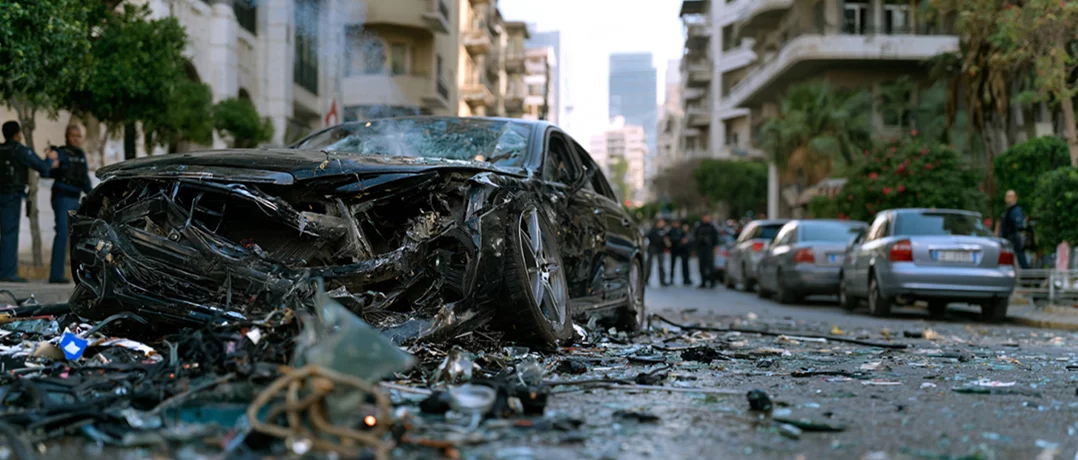
The discovery of a large explosives shipment in Daher el-Baidar has reopened one of the country’s most sensitive debates: the relationship between state authority, illegal weapons, and the possibility of renewed political violence.
For many Lebanese politicians who lived through the period of assassinations that followed the 2005 killing of former Prime Minister (PM) Rafik Hariri, the seizure immediately brought back memories of a period when explosives and targeted attacks reshaped the country’s political landscape.
The issue is not where the weapons are going, but why they exist
Speaking to The Beiruter, Lebanese Member of Parliament (MP) May Chidiac, who previously suffered from a failed assassination attempt on 25 September 2005, argued that the significance of the incident extends beyond the quantity or destination of the explosives. In her view, the central issue is the continued existence of weapons outside the authority of the Lebanese state and the challenge this poses to Lebanon’s institutions.
According to Chidiac, the discovery should not be interpreted as a new message sent to the state, but rather as evidence of a broader problem that authorities have struggled to address for years.
For Chidiac, attempts to explain the presence of such explosives by suggesting they may have been intended for external use fail to address the fundamental question. She argued that whether weapons are allegedly intended for use against Israel or elsewhere, their possession and movement by a non-state actor remain incompatible with the principle of state sovereignty. “The issue is not the destination,” she said, stressing that Lebanon cannot accept the existence of military-grade explosives outside official state control.
Whether they claim these explosives were meant for Israel or for elsewhere, the principle remains the same: no weapon can exist outside state authority
Chidiac criticized what she described as attempts to shift the discussion away from the core issue by presenting alternative explanations for the shipment. In her assessment, the debate should focus on the state’s monopoly over weapons rather than the stated justification behind their possession.
She also pointed to previous incidents involving illegal weapons and explosives, arguing that Lebanon has repeatedly faced similar challenges without reaching a definitive resolution.
The shadow of past political assassinations in Lebanon
The discovery of C4 explosives was particularly alarming for Chidiac because of Lebanon’s recent history.
She recalled that many political figures, including herself and MP Marwan Hamadeh, were targeted during years of political assassinations and attempted assassinations since 2005. Lebanon’s PM Nawaf Salam also acknowledged the sensitivity of the issue, noting that the explosives seized included a substance that had been used in previous political assassinations in Lebanon, which remains deeply embedded in the collective memory of Lebanese political actors and the population as a whole.
Chidiac specifically referred to the case of former minister Michel Samaha, who was convicted in Lebanon for transporting explosives from Syria as part of a plot to carry out attacks. She argued that the similarities between the materials involved in past cases and those reportedly seized in Daher el-Baidar explain why the incident immediately raised concerns.
We have all been targeted with the same type of material before.
For Chidiac, the concern lies in preventing Lebanon from returning to a period when political disputes were settled through violence rather than institutions.
From statements to action: The challenge facing the state
Following the seizure, Lebanese officials stressed that the investigation would continue and that those responsible would be pursued.
Chidiac welcomed the government’s statements but argued that public declarations must be followed by concrete measures. In her view, credibility depends on whether authorities can move beyond political messaging and ensure accountability. Her remarks came after PM Salam vowed that the government would pursue the case without hesitation. Following a cabinet meeting, Salam stressed that there would be “no leniency and no overlooking, but rather truth and accountability,” according to Lebanon’s Minister of Information Paul Morcos. In this context, Chidiac asserted that
The government’s statement is good, but it must be followed by action.
Chidiac stressed that authorities must arrest those involved, confiscate the explosives, and ensure that the investigation reaches all those responsible. She called for the confiscation of the explosives, the continuation of judicial investigations, and the prosecution of all individuals involved in transporting or organizing the shipment.
For Chidiac, the broader challenge is whether the Lebanese state can demonstrate that its decisions apply equally to all actors, regardless of political affiliation or influence. She argued that the state must enforce its authority through institutions rather than rely solely on political dialogue, warning that failure to do so risks repeating previous cycles of instability.
A state proves itself through action, not through declarations.
She also linked the issue to previous government decisions concerning weapons outside state control, arguing that Lebanon cannot maintain stability while parallel security structures continue to operate.
What happened: The Daher el-Baidar explosives seizure
Lebanese authorities intercepted an explosives shipment at the Daher el-Baidar checkpoint on the Beirut-Bekaa route after searching a vehicle carrying two individuals. The seized materials included large quantities of TNT and C4 explosives. However, the investigation, which is being overseen by Military Court Government Commissioner Judge Claude Ghanem, has not established that the seized explosives were intended for an assassination attempt. Security officials have stressed that determining the purpose of the shipment requires further evidence beyond the discovery itself.
As part of the expanding investigation, Judge Ghanem returned the preliminary investigation files of the two detainees, identified as Ali Karaki. (reportedly the son of a Resistance Brigades official in Hezbollah in central Bekaa) and Haitham Amhaz, to military police investigators, requesting further questioning regarding the nature of the explosives, their source, and their intended destination. He also instructed security agencies to identify two individuals known as Sajed and Zulfiqar, whom the detainees allegedly described as Hezbollah officials. Preliminary confessions indicated that Sajed had handed over the shipment in the Bekaa Valley, while Zulfiqar was awaiting its delivery in Beirut’s southern suburbs.
The seizure prompted reactions from several political figures, including calls for a full investigation and accountability for anyone found responsible. Lebanon’s Minister of Justice Adel Nassar stated that the investigation into the explosives and related cases would continue to the end, reaffirming the government’s stated commitment to combating illegal weapons and prosecuting those violating the law.
While the investigation remains ongoing, the incident has already become a major test for Lebanon’s security institutions and their ability to enforce state authority while trying to prevent the recurrence of a violent chapter in Lebanon’s modern history.
-
-

-
The Beiruter
-
