



From al-Sadr’s doctrine to the institutionalization of the popular mobilization forces via the Lebanese “Laboratory”.
Hezbollah’s central role in building Iraqi militias
Hezbollah’s central role in building Iraqi militias
By Omar Harkous | April 11, 2026

Reading time: 5 min
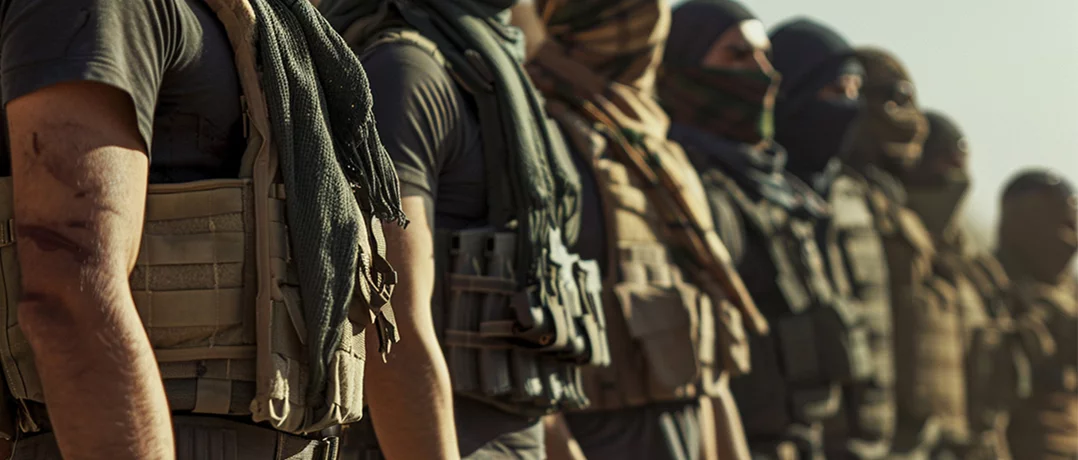
Iraqi factions today launch rockets and drones at the U.S. embassy and military bases hosting American troops. The operations bear a striking resemblance to Hezbollah’s playbook in Lebanon, underscoring the deep entanglement of Iran’s regional network, rooted not only in strategy but in a shared ideological framework. But how did this movement begin, and how did it evolve into its current form?
Political Shiism in Iraq is the product of a long historical trajectory, one that began in the seminaries of Najaf and culminated in military and political institutions that now shape the modern Iraqi state. Its roots stretch back to the late 1950s, when a perceived need emerged to counter the spread of communist and leftist ideas within Iraqi society. It was in this context that Muhammad Baqir al-Sadr emerged as a defining figure, not merely as a cleric, but as the architect of a comprehensive Islamic political project, embodied in the founding of the Islamic Dawa Party.
Al-Sadr was not simply a political founder; he was arguably the foremost theorist of political Shiism in the twentieth century. In works such as Our Philosophy and Our Economics, he mounted a sustained critique of both capitalism and socialism, seeking to provide Islamic thought with intellectual depth capable of competing with dominant secular ideologies. Yet this intellectual ascent was met with fierce repression from the Ba'athist regime, particularly under Saddam Hussein, who viewed the movement as a direct threat to his authority.
The confrontation reached its peak in the late 1970s following the success of Iran’s Islamic Revolution. Al-Sadr’s open support for Ayatollah Khomeini prompted Baghdad to criminalise membership in the Dawa Party in March 1980. Weeks later, on April 8, al-Sadr and his sister Bint al-Huda were executed, an event that marked a turning point. The movement shifted from clandestine domestic activism to armed opposition in exile, particularly in Iran and Lebanon.
The birth of the Badr Corps
The Iran–Iraq War (1980–1988) proved decisive in transforming Iraqi Shiite opposition from a political-religious current into organised military formations. Tehran capitalised on Iraqi dissidents fleeing repression, establishing the Badr Corps in 1982 as the armed wing of the Supreme Council for the Islamic Revolution in Iraq, under the direct supervision of the Islamic Revolutionary Guard Corps (IRGC).
Its ranks were drawn from two principal groups: exiled Iraqi opposition fighters and Iraqi prisoners of war who pledged allegiance to Iran. These recruits underwent intensive training in camps such as al-Sadr Camp in Ahvaz, specialising in guerrilla warfare in marshland terrain and intelligence operations behind enemy lines.
Ideologically, the Badr Corps was anchored in the doctrine of Wilayat al-Faqih (Guardianship of the Jurist), with its leadership declaring absolute loyalty to the Supreme Leader in Tehran. It functioned not merely as a military force, but as a government-in-exile, complete with intelligence, social, and media structures, preparing its cadres to assume power roles in post-2003 Iraq.
The Lebanese “Laboratory”
Iran’s frontlines were ablaze, and Lebanon served as the second arena for Iraqi Shiite opposition. This connection dates back to the 1970s, when Mostafa Chamran, an Iranian figure with military experience in Egypt and Algeria and academic training in the United States, arrived in Lebanon in 1971. There, alongside Imam Musa al-Sadr, he helped establish the Movement of the Dispossessed and its armed wing, Amal, in 1975.
Chamran transformed southern Lebanon and the Bekaa Valley into open training grounds for Shiite cadres, Lebanese and Iraqi alike. Iraqi exiles benefited from this environment, receiving instruction in guerrilla tactics, explosives, and clandestine security operations.
For Chamran, Lebanon was a staging ground for exporting revolutionary doctrine even before the Iranian Revolution itself. He later transferred these urban warfare techniques back to Iran during the war with Iraq, where he became the country’s first defence minister before being killed in action. This overlap effectively turned Lebanon into an early “laboratory” for the combat doctrines later deployed against Saddam’s regime, and, after 2003, against U.S. forces.
An organic interconnection
The founding of Hezbollah in 1982, amid Israel’s invasion of Lebanon and with IRGC support in the Bekaa Valley, marked a new phase. From its inception, Hezbollah was not purely Lebanese; it was part of a transnational network linking Lebanese, Iranian, and Iraqi actors.
Hezbollah’s military commander, Imad Mughniyeh, played a pivotal role in this network. Intelligence reports suggest he and his associates oversaw the training of Iraqi fighters from the 1980s onward. This deep integration laid the foundations for what would later be known as the “unity of arenas,” with Lebanese operatives developing extensive familiarity with Iraq’s terrain and social fabric.
Throughout the 1990s, Iraqi opposition forces remained in training camps in Iran and Lebanon, undergoing both ideological and military preparation. This period forged a generation of leaders united not only by opposition to Saddam Hussein, but by unwavering loyalty to Iran’s “axis of resistance".
The 2003 shock
The U.S. invasion of Iraq in 2003 reshaped the landscape entirely. Trained cadres flowed back into Iraq from Iran and Lebanon, filling the security and political vacuum.
Hezbollah’s role evolved from symbolic support to direct operational involvement. At the request of Iran’s Quds Force, it established a specialised unit tasked with transferring battlefield expertise honed against Israel into Iraq. This included training in advanced improvised explosive devices (EFPs), urban warfare, special operations, kidnappings, such as the 2007 Karbala attack, and the construction of intelligence and surveillance networks.
During this period, “special groups” splintered from Muqtada al-Sadr’s Mahdi Army to form more disciplined, Iran-aligned factions, including Asaib Ahl al-Haq and Kataib Hezbollah. These groups received direct funding and instructions from the Quds Force, with field training overseen by Hezbollah operatives.
Kataib Hezbollah and the consolidation of power
Kataib Hezbollah, formally established in 2007, emerged as the most secretive and powerful faction in Iraq. It represents a near-replica of the Lebanese Hezbollah, not only in name but also in structure, ideology, and allegiance to Wilayat al-Faqih.
Following the assassinations of Qassem Soleimani and Abu Mahdi al-Muhandis in 2020, Iran faced the challenge of maintaining cohesion among Iraqi factions. Hezbollah stepped in as a stabilising force, with Sheikh Mohammad Kawtharani, responsible for the “Iraq file”, playing a central role.
Fluent in Iraq’s political and tribal dynamics, Kawtharani became a key mediator among Shiite factions and an influential figure in the selection of Iraqi prime ministers. The United States designated him a global terrorist in 2013, offering a $10 million reward for information on his activities.
The popular mobilisation forces
The rise of ISIS in 2014 provided an opportunity for Iran-aligned factions to legitimise their presence under state authority. The Popular Mobilisation Forces (PMF) were formed as a volunteer force, but dominant factions, Badr, Kataib Hezbollah, and Asaib Ahl al-Haq, controlled the battlefield and held the largest arsenals.
Over time, the PMF evolved into a formal state institution under the prime minister, granting these groups legal cover and substantial financial resources, while retaining their ideological and operational ties to Iran and Hezbollah.
Beyond the battlefield, cooperation expanded into a transnational economic network. Iraq became a hub for money laundering and sanctions evasion, with figures such as Shibl al-Zaydi facilitating oil smuggling, real estate investments, and financial operations. U.S. Treasury reports have accused Hezbollah of exploiting militia control over Iraq’s economy to fund its networks across Lebanon and Syria.
A strategic convergence
What has unfolded in Iraq, from the founding of the Dawa Party to the rise of the PMF, is not a series of disconnected events, but a carefully layered historical accumulation. The Iran–Iraq War and the Lebanese experience provided training grounds that shaped today’s leadership.
Iraq has now become the most critical strategic depth for both Hezbollah and Iran. The relationship is no longer one of support; it is one of deep integration. Iraqi factions view Hezbollah as the elder model; Hezbollah, in turn, sees Iraq as the human and financial reservoir sustaining its regional project.
The journey from al-Sadr’s intellectual framework to the institutionalised power of the PMF stands as one of the most complex and consequential processes of militia-state formation in the modern Middle East.
