As conflict intensifies, Lebanese civilians are increasingly exposed to danger as military activity becomes embedded within populated areas.




As conflict intensifies, Lebanese civilians are increasingly exposed to danger as military activity becomes embedded within populated areas.

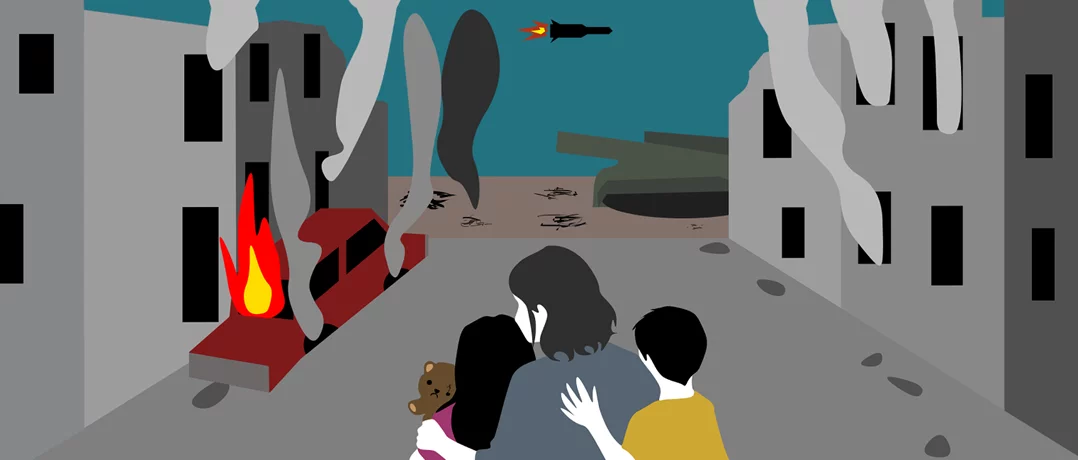
As violence escalates once again along Lebanon’s southern front, a recurring and uncomfortable reality returns to the forefront: Lebanese civilians are not simply caught in war - they are systematically placed within it.
For decades, Hezbollah’s military doctrine has relied on embedding its operations within civilian environments. Under international humanitarian law, the use of human shields refers to placing civilians or civilian infrastructure near military objectives to deter attack - a prohibited practice that deliberately exploits protected populations. In practical terms, this includes launching rockets from populated areas, storing weapons inside residential buildings, and integrating military infrastructure into dense urban settings. When these lines are blurred, civilians are no longer shielded from war; they become part of its operational logic.
This dynamic is not unique to Lebanon. In asymmetric conflicts elsewhere, including Afghanistan in the early 2000s, armed groups were documented preventing civilians from leaving targeted areas in order to complicate military operations. Such practices illustrate a broader pattern in which civilian presence is instrumentalized for strategic advantage.
During the 2006 war, human rights investigations documented multiple incidents in which Hezbollah’s conduct exposed Lebanese civilians to significant danger. In Bar`ashit, a residential home was destroyed after weapons were reportedly stored in a neighboring house, killing a father and his teenage daughter. In Marwahin, fighters brought weapons into the village and stored them near a mosque and inside civilian homes; days later, civilians fleeing the area were killed in an airstrike. In Dahiyeh, testimony indicated that weapons were moved into a civilian shelter where residents had taken refuge. In Aitaroun, rockets were launched from within close proximity - approximately 100 to 150 meters - to civilian homes shortly before a strike killed nine members of one family.
These cases, though limited in number, demonstrate a clear pattern: the integration of military activity within civilian spaces increases the exposure of civilians to retaliation and amplifies the humanitarian cost of conflict.
Nearly two decades later, this model has not only persisted but evolved. During the 2024 escalation, the embedding of military infrastructure within densely populated areas became more pronounced, particularly in Beirut’s southern suburbs. The development of precision-guided missile capabilities required more advanced facilities, which multiple analyses indicate were often located within civilian neighborhoods.
Open-source investigations conducted by international media outlets such as Reuters and BBC Verify between 2023 and 2024 have provided geolocated visual evidence showing rocket launch platforms positioned in close proximity to civilian homes, schools, and agricultural buildings in South Lebanon. Through the analysis of videos, satellite imagery, and on-the-ground footage, these investigations identified recurring patterns rather than isolated incidents, indicating that launch sites were often embedded within populated environments. This proximity effectively increases the risk to civilians, as such locations become immediate targets in retaliatory strikes.
On the other hand, For many residents, evacuation is neither immediate nor feasible. Economic constraints, logistical barriers, and the speed of escalation leave civilians effectively trapped. As a result, populated areas become operational environments, and civilians are exposed to unpredictable cycles of targeting and destruction.
This pattern follows a consistent geographic distribution. Southern Lebanon remains the primary frontline zone, where military activity intersects with civilian villages. Beirut’s southern suburbs represent a dense urban offices where command structures and infrastructure are embedded within residential blocks. The Bekaa Valley functions as a logistical and operational corridor, again in proximity to populated areas. Across these regions, the overlap between civilian life and military presence is not incidental; it is structural.
Hezbollah’s military infrastructure reflects this integration. The organization maintains an extensive network of rocket launch sites, underground facilities, weapons depots, and command centers distributed across these areas. Its arsenal, estimated in the tens of thousands of rockets and missiles, includes increasingly sophisticated precision systems. What is critical is not only the scale of this infrastructure, but its location: storage and operational facilities have repeatedly been identified within or beneath civilian buildings and near essential civilian spaces such as schools, homes, and agricultural lands.
In dense urban environments like Dahiyeh, this integration is particularly acute. Military assets are embedded within residential blocks, making any targeting operation inherently high-risk for civilians. Recent conflict dynamics in Dahiyeh illustrate this pattern: in 2024, a central command bunker was targeted, resulting in the destruction of 353 buildings; in 2025, more than ten locations linked to drone activity and military infrastructure were struck; and in 2026, at least 20 buildings were destroyed through multiple waves of airstrikes (till March 11). These figures reflect targeted or destroyed locations, not the total number of military sites, which are likely to remain significantly higher but unverifiable.
The 2024 war also provides a critical empirical dimension through the targeting of Hezbollah leadership. Several senior figures were killed while located within densely populated civilian environments: Hassan Nasrallah, the Secretary-General, was targeted in Dahiyeh within an underground headquarters situated beneath residential buildings; Fouad Shukr, a senior military commander, was killed in a residential apartment building in Dahiyeh; Ibrahim Aqil, commander of the Radwan Force, was located in an urban civilian neighborhood in the same area; and Ahmed Wahbi, a Radwan unit commander, was also present within a residential zone in Dahiyeh. In South Lebanon, Wissam al-Tawil, deputy commander, was killed near populated villages; Taleb Abdallah, southern front commander, operated within a civilian-proximate operational zone; and Mohammed Nasser, a field commander, was likewise positioned near populated areas.
The pattern is clear: high-value military figures were repeatedly located within civilian environments. While proving legal intent for human shielding requires a high threshold, the consistency of this co-location strongly suggests either deliberate reliance on civilian proximity or, at minimum, a systematic failure to remove military targets from populated areas. In practice, the effect is the same: civilians become structurally embedded within the battlefield.
In the current phase of the conflict, this dynamic extends beyond military tactics into the socio-political sphere. The embedding of military infrastructure in civilian areas contributes to displacement and humanitarian strain. At the same time, Hezbollah provides financial aid, reconstruction assistance, and social services to affected populations.
This creates a reinforcing cycle: civilians are exposed to harm, then become dependent on the same organization for recovery. Over time, this dual role - as both military actor and provider - strengthens Hezbollah’s domestic legitimacy while sustaining its operational model. Civilian suffering is thus integrated into a broader narrative of “resistance,” blurring the boundary between protection and exposure.
The use of human shields constitutes a violation of international humanitarian law when civilians are intentionally used to deter attack. Even where intent is difficult to establish, embedding military operations within civilian environments represents a failure to take feasible precautions to protect civilians.
Accountability remains limited. Verification challenges, politicized narratives, and the asymmetric nature of non-state actors complicate enforcement. Meanwhile, the burden continues to fall on civilians.
Perhaps the most critical dimension is the absence of intervention. Lebanese citizens do not determine the timing of war, the placement of military infrastructure, or the strategic decisions that shape conflict. Yet they remain the primary victims of those decisions.
Lebanon’s tragedy lies not only in being a battleground, but in the systematic way its population is positioned within that battlefield. The repeated integration of military objectives into civilian spaces transforms homes into targets and communities into zones of risk.
Until this dynamic is addressed - through stronger state sovereignty, international accountability, and the separation of military activity from civilian life - each new escalation will reproduce the same outcome.
Lebanese civilians will remain on the front line of wars they neither chose nor control.